


Carrefour’s return to India is not a revival of the hypermarket strategy it abandoned in 2014. It is a test of whether a global retailer can build a profitable urban network by combining smaller stores, local sourcing and later-stage digital fulfilment in a market where physical retail and quick commerce are expanding at the same time.
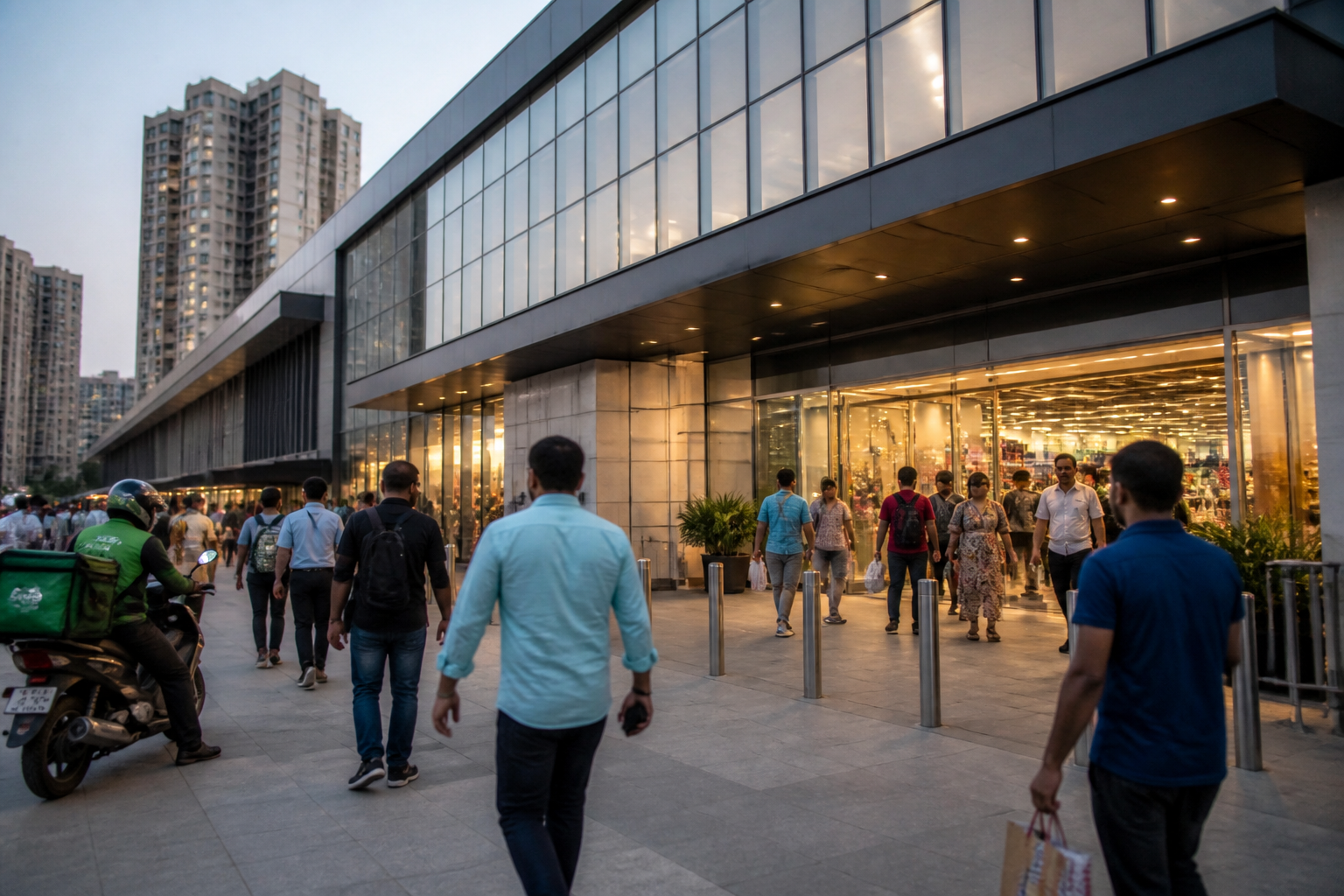
The French retailer has re-entered through a franchise partnership with Dubai-based Apparel Group. Its first consumer-facing store opened at Boulevard Walk in Greater Noida last month. The flagship covers more than 50,000 square feet and carries more than 15,000 stock-keeping units. A second store in the Delhi-National Capital Region is expected to be about 10,000 square feet, a sharp departure from the 10,000-12,000 square metre hypermarkets that once defined Carrefour’s international expansion.
That change in scale is not a cosmetic adjustment. It reflects the economics of Indian urban retail, where real estate, inventory, staffing and customer acquisition costs can quickly make a large store unproductive. Carrefour’s executives have indicated that its most productive Indian format may be between 15,000 and 25,000 square feet, while smaller supermarkets will also be tested. The company is therefore entering India with a format designed around local operating conditions rather than attempting to reproduce its traditional model.
The timing is significant because India’s retail market has become more complex since Carrefour’s first attempt. The company entered in 2010 through cash-and-carry wholesale stores and opened five outlets before exiting in 2014. At the time, foreign retailers faced restrictions on selling directly to consumers, making wholesale one of the limited routes available. Carrefour’s operation was neither profitable nor loss-making when it withdrew, as the company focused on challenges in France.
The market it has returned to is considerably larger. A BCG-Retailers Association of India report cited by the Economic Times estimated India’s retail market at Rs 82 lakh crore in 2024, compared with Rs 35 lakh crore in 2014. It projected that the market could exceed Rs 190 lakh crore by 2034. More than 58% of purchase journeys remained entirely offline, even as digital commerce expanded. That combination is central to Carrefour’s calculation: online retail is growing rapidly, but it has not eliminated the need for stores or made one retail format dominant across the country.
The challenge is that the physical store now competes not only with neighbourhood retailers and supermarkets but also with delivery networks that have altered urban shopping behaviour. An Equirus estimate reported in July put India’s quick-commerce market at about Rs 1.08 lakh crore in 2026, representing annual growth of roughly 40%. The combined dark-store networks of Blinkit, Instamart and Zepto had exceeded 5,000 locations by May, according to the report.
Quick commerce is particularly effective for top-up purchases and small baskets. Consumers can order milk, snacks, household products or other essentials and receive them within minutes. That convenience has created a new expectation in cities, but it does not cover every shopping occasion. A larger grocery trip still offers a different value proposition: broader assortment, the ability to inspect fresh products and the opportunity to consolidate purchases without paying a separate last-mile delivery cost for each small order.
Carrefour’s strategy is built around that distinction. Rather than immediately constructing a separate dark-store network, the company plans to establish stores first and use them as part of a future digital fulfilment system. Apparel Group chairman Nilesh Ved told PTI that Carrefour would move into e-commerce and quick commerce once its supply chain was ready. The initial plan is to use stores instead of dark stores, with the strategy changing according to what the Indian market requires.
This approach treats the store as more than a point of sale. It can hold inventory, generate customer traffic, support local fulfilment and provide information about purchasing patterns. In theory, that allows a retailer to spread the cost of physical space across several functions. In practice, the model depends on whether each store generates enough sales density and whether its stockroom and delivery operations can support online orders without undermining the economics of the store itself.
Reliance Retail provides the most visible example of how physical and digital networks can be combined. As of June 2026, Reliance Retail had 20,169 stores, 78.4 million square feet of retail space and more than 396 million registered customers. JioMart used a network that combined more than 3,100 physical stores with over 600 dark stores across more than 1,200 cities and 5,100 pin codes. Reliance said its omnichannel customers spent about 2.7 times as much as customers who purchased only offline.
Carrefour does not have Reliance’s scale, and it will not acquire an equivalent network in the near term. Its opportunity is narrower: to build a focused cluster of productive stores and gradually use those locations to support online demand. That makes store selection, local supply chains and geographic density more important than headline store counts. A dispersed network may create visibility, but a concentrated network is more likely to support efficient replenishment and fulfilment.
The partnership with Apparel Group is therefore as important as Carrefour’s brand. Apparel Group already operates more than 300 stores across 50 Indian cities and has relationships with landlords, suppliers and local operating partners. It is targeting $1 billion in Indian revenue over the next five years. Carrefour contributes international sourcing, merchandising, store formats and a global retail playbook, while Apparel Group provides local market knowledge and operating infrastructure.
The arrangement also addresses a weakness in Carrefour’s first India attempt. A foreign retailer can bring capital and brand recognition, but it still has to understand local real estate, consumer price sensitivity, supplier reliability and regional differences in demand. The partnership reduces the amount of infrastructure Carrefour must build from the beginning, although it does not remove the pressure to make individual stores profitable.
Localisation is visible in the planned assortment. Carrefour has described the first store as a combination of international products and locally sourced groceries, fresh food, bakery products, household goods and personal care items. Patrick Lasfargues, Carrefour’s executive director for international partnerships, said the company had effectively started with a blank sheet of paper when rebuilding its Indian assortment.
That approach matters because the Indian grocery market is highly price-sensitive. Lasfargues told the Economic Times that he had observed discounts of 30% to 50% from maximum retail prices in Indian stores, with deeper promotions in non-food categories. A premium foreign brand cannot assume that its international identity alone will persuade customers to pay more. Its offer must compete on price, availability, quality and convenience at the same time.
Carrefour also expects India to become a sourcing base, not only a destination market. The company plans to develop Indian private labels after it reaches sufficient scale, with the process expected to begin within 9 to 18 months. Private labels accounted for about 37% of Carrefour group sales in 2024. The company has discussed sourcing products such as chocolates, spices and rice through India, with the possibility of exporting them to international markets within five years.
This gives the Indian operation two potential functions. Stores can generate domestic sales and customer data, while the supplier network can support Carrefour’s global private-label business. The second opportunity may take longer to develop, but it changes the calculation behind expansion. Store growth would not be the only measure of success if the Indian operation also improves sourcing and export capability.
The competitive gap remains substantial. Reliance has a large national store and distribution network. DMart has built its model around value, high sales productivity and large stores, while its cautious online expansion suggests that not every shopping occasion requires instant delivery. Blinkit, Zepto and Instamart have a head start in dense urban fulfilment, and Flipkart and Amazon are also expanding their quick-commerce operations.
Carrefour’s proposed advantage is therefore not speed or scale. It is the possibility of making a smaller number of stores perform several jobs: serving walk-in customers, holding inventory, supporting delivery and connecting Indian suppliers to a global retail system. That model can work only if the stores remain productive before digital operations are added. Carrefour’s executives have said the company will not rush into online grocery because moving too early could damage profitability and leave it with limited understanding of customer behaviour.
The company is targeting about 50 stores in three years, although acquisitions could accelerate that number. It is examining existing food retailers that may be facing execution or ownership problems. Carrefour has said its stores globally generally take between 1.5 and three years to break even, and Lasfargues believes the Indian operation could potentially reach that point faster.
The evidence supplied in the report does not establish whether that timetable will be achieved. It does show why the second India entry is structurally different from the first. Carrefour is entering a larger market, through a local partner, with smaller formats, a more localised assortment and a stated preference for profitable growth over rapid expansion.
The larger urban question is whether India’s retail infrastructure will develop around separate channels or increasingly connected ones. Quick-commerce companies have built dedicated fulfilment networks for speed. Large retailers are using stores as distribution assets. Carrefour is attempting to start with the store and add digital capability once the physical network is economically viable.
Its return will therefore be judged less by the novelty of a foreign retailer reopening in India than by whether the company can make urban retail space work harder. The next indicators will be the performance of the smaller Delhi-NCR format, the pace of store expansion, the launch of private labels, the development of local sourcing and the point at which Carrefour begins using stores for e-commerce or quick-commerce fulfilment. Those milestones will show whether its second India strategy has produced a sustainable retail network rather than another large-format experiment.
