


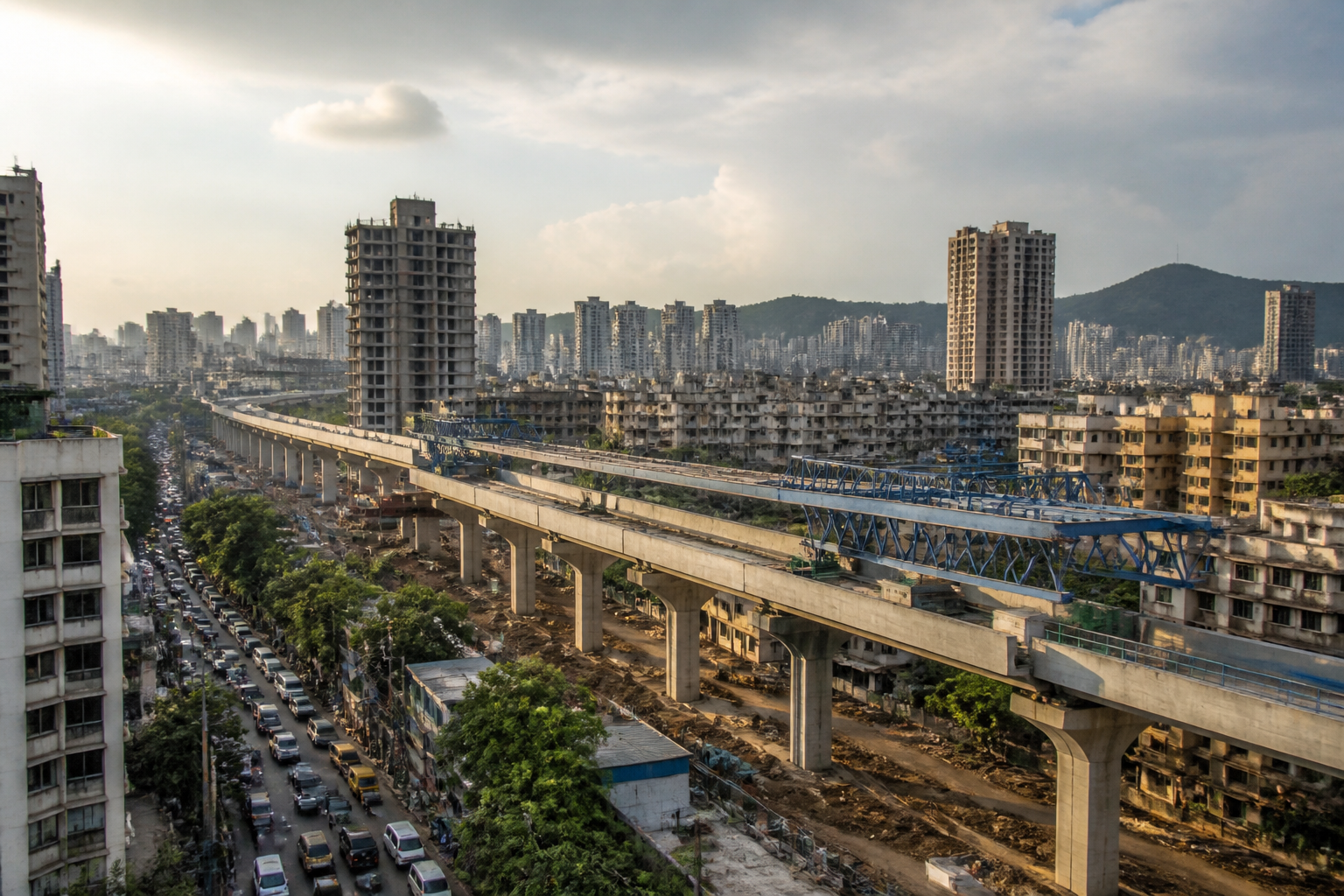
A meeting on Thane’s internal metro project has brought the city’s central transport question into sharper focus: can a major transit corridor be built without leaving the rehabilitation of affected residents unresolved? The project is being advanced by the Thane Municipal Corporation and MahaMetro as a response to congestion on the city’s internal roads. Yet the latest discussion, held at the municipal headquarters, showed that the route’s social and land requirements remain contested even as project work has begun.
MahaMetro managing director Shravan Hardikar presented the project to elected representatives at the meeting. The gathering included Transport Minister Pratap Sarnaik, Member of Parliament Naresh Mhaske, legislators Jitendra Awhad, Sanjay Kelkar, Niranjan Davkhare, Madhavi Naik and Ravindra Phatak, along with corporators from different political parties. Instead of producing a straightforward endorsement, the presentation prompted questions about the project’s alignment, affected structures, land acquisition and the rehabilitation of households that may have to move.
That reaction is significant because the internal metro is not being discussed only as a transport investment. It is also becoming a test of how Thane manages infrastructure construction in dense neighbourhoods. The report states that the proposed corridor could affect between 1,400 and 1,500 families, although the administration has not yet finalised the number. The final figure is expected only after surveys and biometric procedures are completed. That gap between a preliminary estimate and an officially verified list is at the heart of the current uncertainty.
The project is planned over approximately 30 kilometres, of which 70 per cent of the required space has reportedly become available. Land is also being acquired for the depot. The administration has said that efforts are under way to minimise the project’s impact on army land. At the same time, areas including Lokmanya Nagar, Azad Nagar and Manorama Nagar have been identified for possible rehabilitation through cluster redevelopment.
These details point to two different stages of project preparation moving at different speeds. On one side, the authorities are securing land and advancing the project. On the other, the exact number and identity of affected households, the availability of rehabilitation sites and the permissions required for cluster redevelopment remain unsettled. For residents, the sequence matters. A transport corridor can be technically planned while its social consequences remain insufficiently defined.
The representatives’ questions focused on this disconnect. Naajib Mulla asked whether the survey had been completed if the number of affected residents was still not known. He also questioned how rehabilitation could be carried out through cluster redevelopment when construction permissions had not yet been obtained in several locations. Sanjay Kelkar argued that a clear survey and rehabilitation plan should precede project permissions. The concern was not necessarily opposition to the metro itself, but the absence of publicly established information about where affected residents would go and what the municipal administration would do for them.
This is a familiar institutional problem in urban infrastructure: the project is often presented through its route, stations and engineering objectives, while the land and housing arrangements required to make that route possible are handled as a later administrative task. In a dense city, however, rehabilitation is not a secondary component. It determines whether construction can proceed, whether affected households receive a credible alternative and whether public consent survives the disruption created by the project.
The Thane meeting also exposed the importance of route design. Sarnaik said that the project must be completed, but urged authorities to consider the character of dense settlements such as Lokmanya Nagar. In areas where displacement would be substantial, he suggested examining an underground alignment. That proposal introduces a technical and financial question, but the supplied report does not establish whether a revised underground route has been approved, assessed or costed. It therefore remains a suggestion raised in the meeting rather than a confirmed change to the project.
The route is intended to connect Kalwa, Mumbra and Diva, and the preparation of a detailed project report for this extension is under way. The administration has also said that the metro is being planned in a manner that would connect it with the bullet train project. These proposed connections broaden the corridor’s strategic role: it is not being framed only as an internal Thane line, but as part of a wider regional transport network. However, connectivity ambitions do not remove the need to settle local questions of land, access and rehabilitation.
The project’s public legitimacy will depend partly on how those local questions are answered. Several social organisations have opposed the project, citing tree removal and the displacement of residents. A recent civic meeting also reportedly saw criticism that the metro could become a costly asset with limited public value. Those objections reflect a broader urban planning tension. New transport infrastructure can improve mobility, but its benefits are not automatically distributed equally. Residents who lose homes, shops, access routes or neighbourhood networks experience the project differently from commuters who may eventually use the line.
The debate over rehabilitation is especially complicated by Thane’s existing redevelopment conditions. The authorities have referred to cluster redevelopment as a possible route for resettlement, but the report also records questions about pending permissions. That means the proposed solution is itself dependent on another development process whose timing and approvals are not fully described. Until the location, eligibility criteria, construction status and delivery schedule of rehabilitation housing are made clear, the promise of resettlement remains an administrative intention rather than a settled arrangement.
The numbers currently available illustrate the scale of the challenge but not its full distribution. Seventy per cent of the project land is said to be available, while the potential number of affected families remains an estimate of 1,400 to 1,500. The two figures cannot be read as a complete progress report because land availability and rehabilitation readiness are different measures. A corridor may have much of its alignment secured while key stretches remain blocked by unresolved property, housing or consent issues.
The same distinction applies to the project’s detailed planning. The authorities have presented the corridor as a response to congestion on Thane’s internal roads, and the proposed network is expected to serve Thane as well as Kalwa, Mumbra and Diva. But the supplied material does not provide passenger projections, construction deadlines, cost estimates, station locations or a confirmed operational date. Without those details, it is not possible to assess the metro’s future capacity or compare its expected benefits with the disruption involved in building it.
What the meeting does establish is that implementation is being discussed before several foundational questions have been publicly closed. The municipal corporation is responsible for the land acquisition required for the project, and Municipal Commissioner Saurabh Rao said the work was progressing quickly. He also said that the final list of affected residents would be prepared soon. That next step is crucial because a verified list can define who is eligible for compensation or rehabilitation and create a basis for further public scrutiny.
The project therefore sits at the intersection of three administrative responsibilities. MahaMetro must plan and execute the transport system. The municipal corporation must secure land and coordinate local implementation. Elected representatives are demanding that the affected population and rehabilitation arrangements be disclosed. The report does not indicate that these responsibilities have broken down, but it shows that their coordination is being tested by the project’s social consequences.
For Thane, the larger question is not whether the city needs better public transport. The meeting indicates broad acceptance that congestion requires a response and that the metro project should move towards completion. The more difficult question is what form that response should take in neighbourhoods where available land is limited, construction affects established communities and redevelopment permissions may take time.
The evidence currently confirms a project with an approximately 30-kilometre planned route, reported availability of 70 per cent of the required space, a depot land-acquisition process and a preliminary estimate of 1,400 to 1,500 potentially affected families. It also confirms that the rehabilitation plan, final affected-household count and some approvals remain unresolved in the public account provided. The next significant development will be the completion of the survey and biometric process and the publication of the final affected-resident list. Until then, Thane’s internal metro will be judged not only by its engineering plan, but by the credibility of the arrangements made for the people living along it.
