


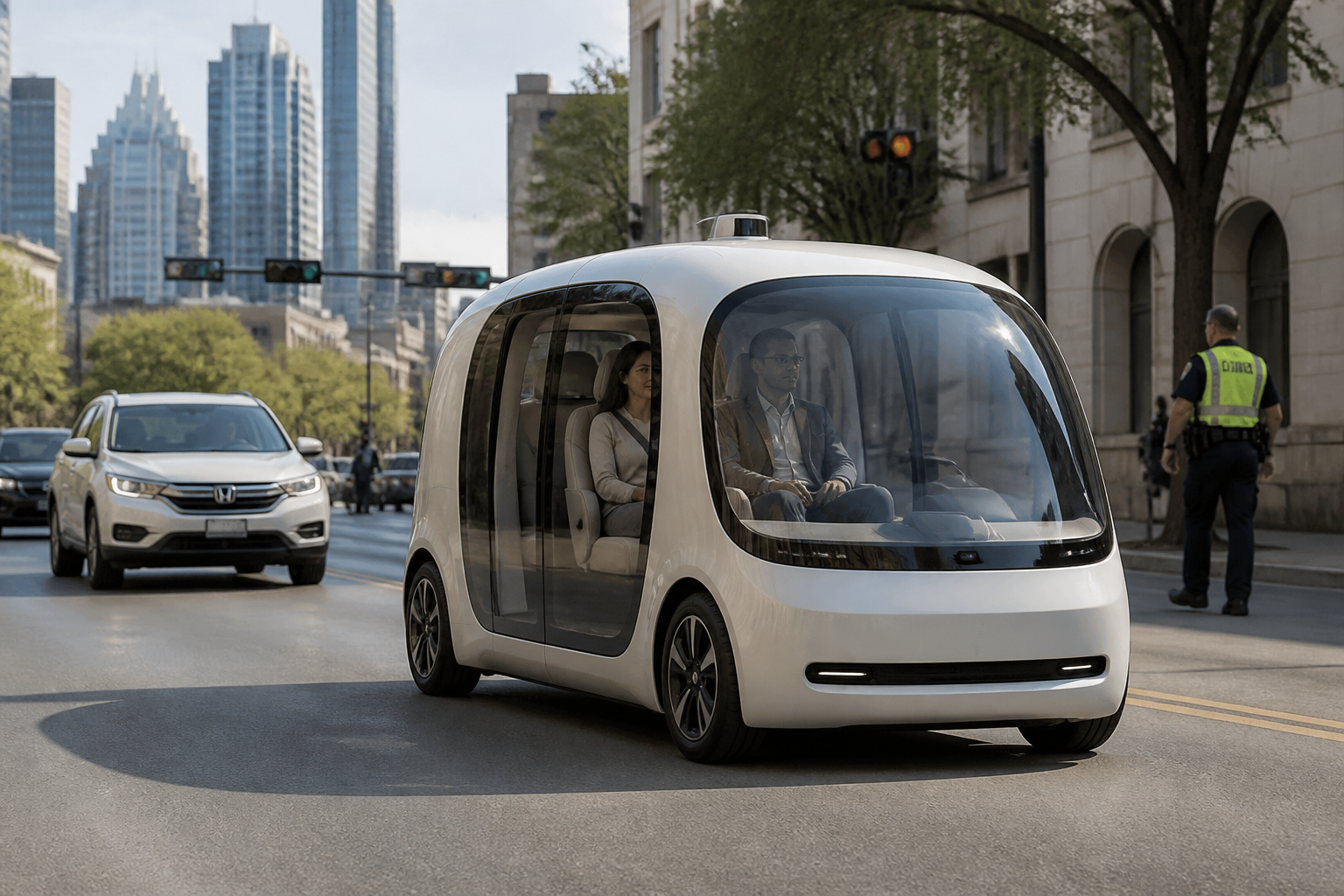
Tesla’s Cybercab launch was presented as a step towards a national driverless taxi network. Within a day, however, the two-seat vehicle became the subject of a US safety investigation focused on a basic question for autonomous urban transport: can a vehicle with no steering wheel, mirrors or brake pedals be certified and deployed under existing federal rules?
The National Highway Traffic Safety Administration, or NHTSA, is examining whether Tesla complied with federal requirements when it put the Cybercabs on Austin, Texas, streets. The agency is auditing the process and technical data used by Tesla to certify the vehicles. The investigation does not itself establish that Tesla violated the rules, but it places the regulatory process at the centre of the company’s robotaxi plans.
That makes the Cybercab probe more than a dispute over one new vehicle. It is a test of whether a regulatory system designed around conventional cars can assess machines in which the passenger cannot take control, the vehicle does not contain familiar manual equipment and the software is expected to manage the journey. The supplied evidence does not show the investigation’s eventual outcome. It does show that the transition from assisted driving to fully driverless public transport is creating a new compliance challenge.
Tesla chief Elon Musk launched the Cybercab service in Austin on Thursday, sending dozens of the vehicles onto city streets during a launch event for invitees. The cars have two seats and lack manual controls that passengers could use to take over in an emergency. Tesla had said before the launch that it relied on a self-certification process to establish compliance with federal standards.
In the filing cited by the report, NHTSA said it would examine the process and technical data behind that certification. Automakers generally self-certify vehicles before placing new models on public roads. A regulatory audit or investigation does not automatically follow every certification. In this case, the agency said the Cybercab involved significant changes rather than minor modifications, creating new safety issues that required scrutiny.
This distinction is central to the wider urban mobility question. Self-certification can allow manufacturers to introduce vehicles without waiting for a separate approval of every model. But a vehicle without a steering wheel, mirrors or brake pedals presents a different relationship between the passenger, the machine and the regulator. The passenger is no longer a driver who can respond directly to a hazard. The vehicle’s compliance therefore depends more heavily on its design, software, operating conditions and the evidence submitted by its manufacturer.
The report does not provide the technical data reviewed by NHTSA, nor does it specify which federal provisions the agency believes may have been breached. It also does not establish whether the vehicles are unsafe in operation. What is established is that the regulator is examining whether Tesla’s certification process and supporting technical information met federal requirements.
That process matters because the Cybercab is intended to operate as part of a public-facing taxi network rather than as a privately owned experimental vehicle. Tesla plans to integrate the new vehicles into its existing cab service, which until now has used conventional Tesla models. A robotaxi therefore has two regulatory identities: it is a motor vehicle subject to safety rules, and it is part of an urban transport service carrying passengers who may have limited ability to intervene during an emergency.
Tesla’s Austin launch was described as the beginning of a national rollout of a low-cost, driverless taxi service. The company’s robotaxi network had already been operating in Austin for more than a year, according to the report, and had begun offering rides in five other cities in Texas and Florida. The Cybercab launch therefore extends an existing service strategy while introducing a vehicle with a substantially different design.
The numbers in the report illustrate the scale and speed of that transition. Dozens of Cybercabs were placed on Austin streets at launch. The existing robotaxi network had operated for over a year in Austin and expanded to five other cities. Yet the new vehicle faced regulatory examination almost immediately after its public deployment. The sequence shows how commercial rollout and regulatory review can occur in parallel rather than in a neatly separated order.
The market response also reflected the uncertainty surrounding the launch. Tesla shares fell nearly 6% on Friday to $354.08, erasing the gains recorded a day earlier after enthusiasm over the service. Share-price movement does not determine whether a transport system is safe or compliant, but it indicates that investors were weighing the regulatory issue alongside the promise of a national robotaxi network.
Tesla is not the first company to face this problem. The report notes that rival robotaxi operator Zoox faced a probe three years ago after self-certifying its own steering-wheel-free vehicles. Regulators eventually granted approval, but only after carrying out a formal review. That earlier case provides a directly relevant precedent: a vehicle can proceed through a self-certification route and still face additional regulatory examination when its design departs significantly from conventional models.
The comparison also shows why the question cannot be reduced to whether autonomous vehicles are generally permitted. The regulatory issue is more specific. It concerns how authorities evaluate a vehicle whose core operating model removes the human driver from the control loop. The safety case must account for the absence of manual controls, the performance of the automated system and the conditions under which passengers are carried on public roads.
The supplied report places the Cybercab investigation within a broader series of federal inquiries involving Tesla’s self-driving software. One probe is examining the software’s role in crashes that occurred in fog, sun glare and other low-visibility conditions, including a crash in which a pedestrian was killed. Another is examining dozens of incidents involving vehicles using partial self-driving software that allegedly ran red lights or travelled on the wrong side of the road. Some of those incidents involved collisions and injuries. A third investigation is examining whether Tesla failed to report crashes promptly as required.
These inquiries concern different systems and questions, and the report does not say that any one of them proves a defect in the Cybercab. Their relevance lies in the regulatory burden they create around the company’s broader automated-driving programme. The Cybercab is not being assessed in isolation from Tesla’s existing record of regulatory scrutiny. At the same time, the available evidence does not justify treating the investigations as a single finding against the company or its new vehicle.
For cities, the important institutional issue is the division of responsibility. NHTSA is examining compliance with federal vehicle safety requirements. Austin, meanwhile, is the place where the service is being operated on public streets. The supplied material does not detail the city’s permitting conditions, local oversight arrangements, passenger complaint systems or emergency-response protocols. Those omissions are significant because federal vehicle certification and local transport operations address different parts of the public-interest question.
A vehicle may satisfy one layer of regulation while the service around it raises separate operational questions. Who responds when a driverless taxi stops in traffic? How does a passenger summon help if manual controls are unavailable? What information must be provided before a rider enters? The source material does not answer these questions, so they cannot be presented as established features or failures of Tesla’s Austin service. They are, however, the kinds of issues that become relevant when a vehicle moves from testing into passenger transport.
The Cybercab case also highlights the tension between innovation and administrative certainty. A self-certification system can accommodate new products without requiring regulators to redesign the entire approval process before each launch. But when the product changes the assumptions built into existing safety rules, a regulator may need to examine both the vehicle and the manufacturer’s interpretation of those rules. NHTSA’s decision to audit Tesla’s process and technical data indicates that the certification record itself is part of the safety question.
The timing adds another layer. Tesla’s launch was intended to demonstrate that driverless taxis could move from a technology programme into a scalable urban service. The investigation arrived almost immediately, before the company’s national ambitions could be separated from the first public deployment of the new vehicle. That does not mean the rollout has been halted; the supplied report does not state that it has. It means the path to scale is now being assessed alongside the vehicle’s commercial introduction.
What the evidence confirms is limited but consequential. Tesla has launched a two-seat, steering-wheel-free Cybercab service in Austin. NHTSA is investigating whether the vehicles complied with federal requirements and is reviewing the certification process and technical data. Tesla is pursuing a wider robotaxi strategy, while its self-driving systems are already subject to other federal investigations. Zoox’s earlier experience shows that a formal review can follow self-certification for a similarly unconventional vehicle.
What remains uncertain is equally important. The report does not establish whether NHTSA will find a violation, require changes, grant approval after review or take another action. It does not provide the technical evidence behind Tesla’s certification or describe the precise operating restrictions placed on the Cybercabs. The next significant developments will therefore be the regulator’s findings, any response from Tesla and the conditions under which the vehicles continue carrying passengers on public roads.

