


Jefferies expects India to record real GDP growth of 6.5-7 per cent in the current fiscal, with nominal growth at around 11-12 per cent. The more consequential signal for cities, however, is not the headline growth forecast alone. It is the combination of faster bank credit, stronger lending to micro, small and medium industrial enterprises, rising power demand, resilient tax collections and a recovery in residential sales across the country’s top seven cities.
Taken together, these indicators suggest that economic activity is broadening beyond a narrow corporate or financial-market story. They point towards stronger formal demand, higher working-capital needs and renewed activity in sectors that influence urban employment, construction, housing and infrastructure use. But the same outlook also carries a significant constraint: energy prices remain a major risk, and the brokerage expects the Reserve Bank of India to raise the repo rate by 50 basis points by the end of 2026 from its current level of 5.25 per cent.
The central question is therefore not simply whether India can grow at 6.5-7 per cent. It is whether this growth can translate into sustained urban investment and housing demand without being weakened by higher energy costs, tighter financial conditions or an uneven recovery across businesses and households.
Credit is the clearest indicator of the momentum identified by Jefferies. Bank credit grew 19.1 per cent year-on-year at the end of August, while corporate lending increased 21.6 per cent in July. Loans to micro, small and medium industrial enterprises rose 24.9 per cent, supported by deposit growth of 17.8 per cent in August.
These figures matter for cities because credit is one of the mechanisms through which economic activity reaches urban production systems. Industrial businesses use financing to purchase equipment, maintain inventories, expand facilities and meet operating costs. Their activity, in turn, supports logistics, commercial space, local services and employment. The data does not establish that a new private-sector investment cycle has already begun, but Jefferies interprets the increase in corporate lending as a possible revival of the long-awaited capital expenditure cycle.
The rise in lending to smaller industrial enterprises is particularly relevant. Jefferies said the pickup could indicate that recent GST and labour reforms, along with efforts to improve ease of doing business, are beginning to generate benefits. That is an interpretation by the brokerage rather than a demonstrated causal finding in the material available. Still, the lending pattern offers an important lens on how policy changes may be reflected in the formal financial system.
For urban economies, the distinction between credit availability and completed investment is important. A loan can signal business confidence or a need for working capital, but it does not by itself confirm that factories, offices, warehouses or other facilities are being built. The next evidence to watch is whether higher lending is followed by sustained corporate investment and stronger activity in the physical economy.
Domestic demand provides a second part of the picture. GST receipts rose 14.8 per cent year-on-year in August, according to the Jefferies report. Power demand growth accelerated to 9.4 per cent during April-August, compared with 1.8 per cent in January-March. These indicators cover different parts of the economy, but both are relevant to the functioning of cities: tax receipts reflect transactions recorded in the formal economy, while electricity demand is connected to commercial, industrial and household activity.
Neither indicator should be treated as a complete measure of urban prosperity. GST collections do not show how demand is distributed between households, businesses or regions, and power demand does not distinguish between productive activity and other forms of consumption. Their value lies in the direction of movement reported by Jefferies. Together with the credit data, they reinforce the brokerage’s assessment that domestic demand has remained resilient despite geopolitical challenges and elevated energy risks.
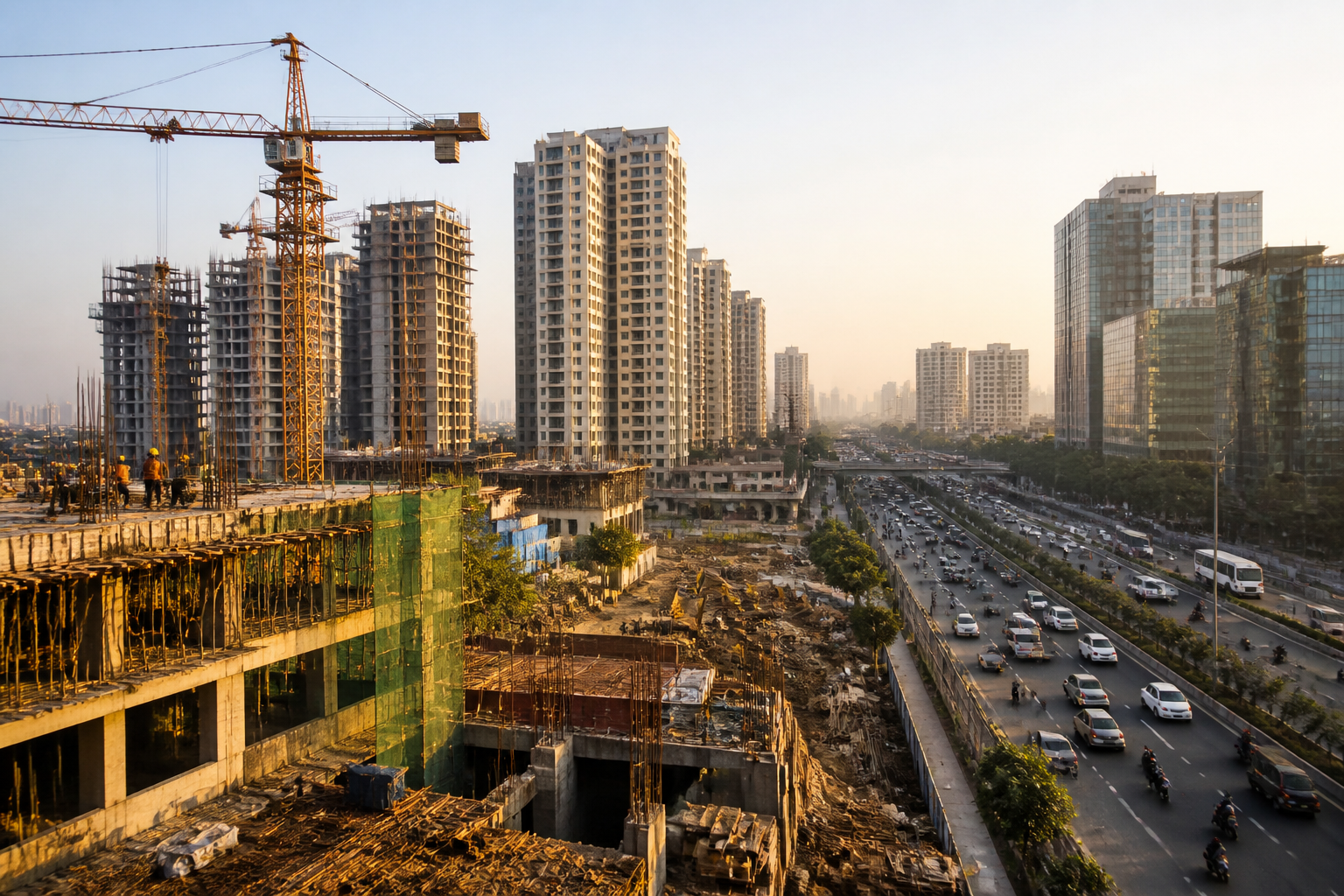
The housing signal is more direct. Residential real estate sales across the top seven cities rose 7 per cent year-on-year in the first seven months of 2026, compared with a 1 per cent decline in 2025. This marks a shift from the previous year’s contraction in the segment covered by the report.
The figure also reveals the limits of the available evidence. It applies to the top seven cities and to sales, not to all urban housing markets, new construction, housing affordability or household formation. A rise in sales indicates improved transaction activity, but it does not establish whether homes have become more affordable, whether the increase is broad-based across income groups or whether developers are responding with new supply.
Even so, residential sales are an important transmission channel between macroeconomic conditions and the built environment. Stronger sales can support developer cash flows, construction activity and demand for materials and services. They can also influence related urban systems, including transport access, utilities and local employment. The report does not provide city-wise sales figures, price data or information on unsold inventory, so the depth and distribution of the recovery remain unclear.
The relationship between earnings and urban investment is another part of the outlook. Jefferies expects corporate earnings growth to accelerate to 17 per cent in the fiscal year beginning April 2027, from an estimated 14 per cent in the current fiscal. The brokerage links this expectation to an improvement in nominal GDP growth.
This is a forecast, not a completed outcome. It also does not specify which sectors will drive the projected acceleration or how much of it will translate into capital expenditure, hiring or urban development. For the built environment, the distinction matters because earnings growth can improve corporate balance sheets without necessarily producing immediate investment in offices, factories, housing or infrastructure.
The report’s policy landscape is therefore shaped by two opposing forces. On one side, stronger credit, improving formal demand and a possible revival in private-sector capital expenditure could support urban economic activity. On the other, the expected increase in the repo rate could raise borrowing costs for businesses, homebuyers and developers. The material supplied does not establish the timing or scale of the impact, but the interest-rate expectation creates a clear tension within the outlook.
Energy is the other major risk. Jefferies said India’s economic outlook remains exposed to developments in the Middle East through their impact on energy prices. Brent crude was around $106 per barrel at the time of the report, while disruptions around key oil routes were adding pressure to energy markets.
The brokerage said India had so far avoided significant energy supply disruptions by continuing to source discounted Russian crude while increasing purchases of US energy. That assessment describes the current position reported by Jefferies; it does not remove exposure to global energy volatility. Higher energy costs can affect transport, logistics, construction inputs, industrial production and household budgets, although the supplied report does not quantify those effects.
This makes energy a critical variable for cities. Urban growth depends on the movement of people, materials and goods, while construction and industrial activity require reliable and affordable power and transport. If energy risks intensify, the effect would not be confined to financial markets. It could influence the operating costs of businesses and the affordability of urban services. The extent of that impact remains uncertain in the absence of sector-specific estimates in the report.
What the evidence confirms is a set of positive signals rather than a complete urban growth cycle. Credit is expanding, lending to smaller industrial enterprises is growing faster than overall bank credit, GST receipts and power demand have strengthened, and residential sales in the top seven cities have recovered from the decline reported for 2025. These developments support Jefferies’ view that India’s structural growth story remains intact.
What the evidence does not yet confirm is whether the momentum will become a durable, broad-based increase in private investment and urban construction. The report provides no detailed breakdown of regional performance, affordability, housing supply, infrastructure capacity or employment. It also leaves open how higher interest rates and energy costs could affect the indicators now pointing upwards.
For urban policymakers, developers, lenders and households, the next milestones are not limited to the GDP number. The more revealing signals will be whether corporate lending converts into actual capital expenditure, whether SME expansion is sustained, whether housing sales extend beyond the largest markets and whether energy pressures alter demand and investment decisions. India’s growth outlook is positive in the Jefferies assessment, but its urban consequences will depend on how these financial, physical and institutional indicators move together.

