


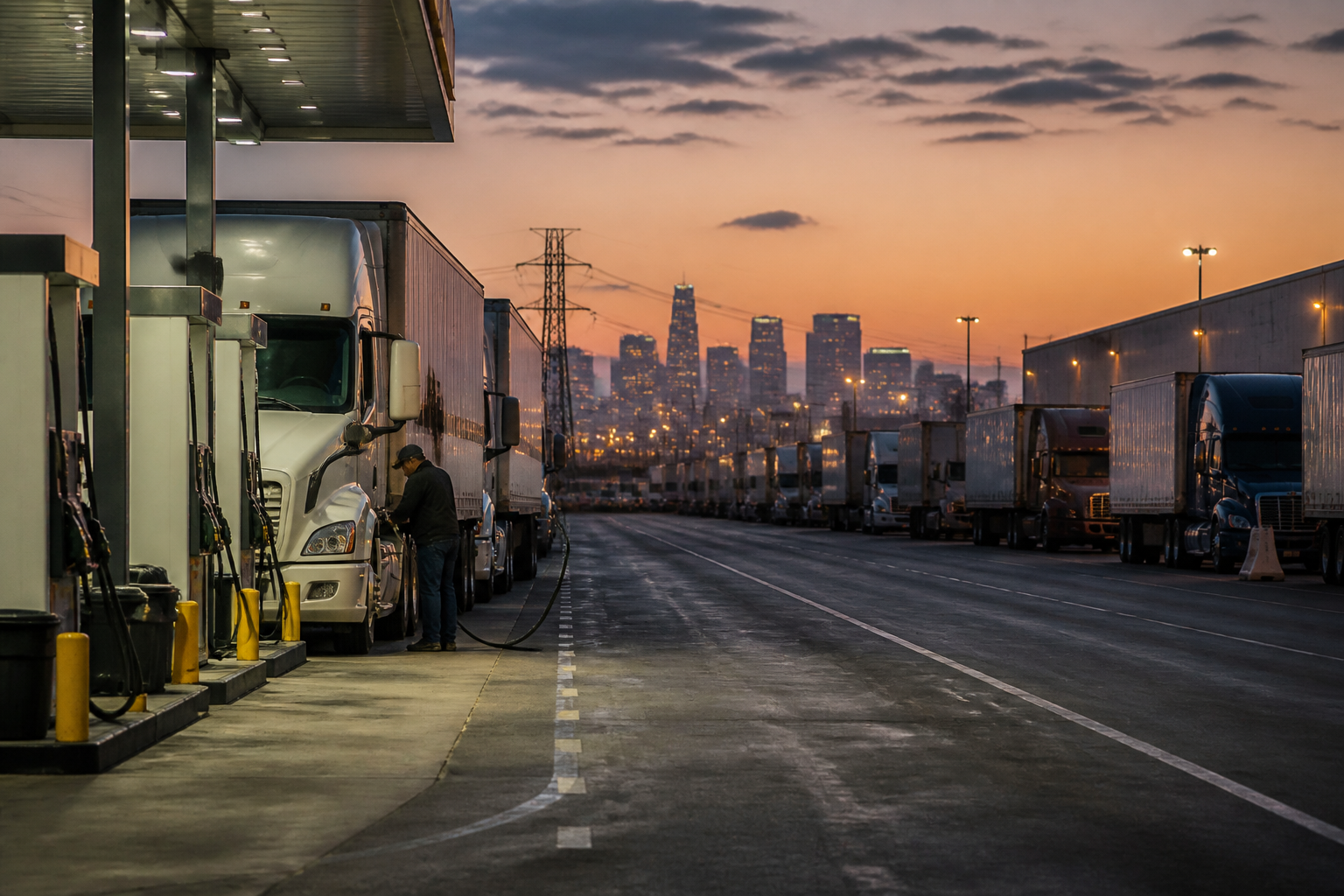
US diesel prices have reached a record national average in the United States as the conflict involving Iran and disruption around the Strait of Hormuz intensify pressure on fuel supply chains. The increase is not confined to motorists or fuel stations: diesel is embedded in the movement of food, construction materials, manufactured goods and farm output, making the shock an urban logistics problem as much as an energy-market story.
According to the American Automobile Association, the national average diesel price reached $6.4866 a gallon on September 19. The figure was up from $6.16 a gallon a week earlier, an increase of about 33 cents, or 5.3 percent. It also exceeded the previous record cited in the report.
The longer-term movement is sharper. AAA data cited by Aaj Tak Business shows that the national average was about $3.71 a gallon a year earlier. Diesel was therefore roughly 75 percent more expensive over the year. On February 27, immediately before the start of the US-Iran conflict identified in the report, the average stood at $3.75 a gallon. Compared with that level, the September 19 price represented an increase of about 73 percent.
The immediate urban consequence of such a rise is transmitted through commercial fleets rather than private vehicles alone. Heavy trucks, trains, agricultural machinery and fishing boats all rely substantially on diesel, according to the report. When the operating cost of these systems rises, the effect can appear in freight rates, wholesale distribution, farm production, industrial operations and, eventually, retail prices.
That transmission mechanism matters because cities depend on transport networks that extend far beyond municipal boundaries. Urban food markets, construction sites, warehouses, ports and retail centres are supplied through regional and national freight corridors. A higher diesel bill can therefore affect the cost of moving a shipment long before a consumer sees a higher price on a shop shelf. The report does not quantify the increase in freight or food prices, but it identifies diesel as a direct cost across these networks.
## Why the Strait of Hormuz matters
The Strait of Hormuz is central to the disruption described in the report. It is identified as a maritime route responsible for about 20 percent of global oil demand, and the report says that Iran has closed the passage amid the conflict. Any sustained interruption to that route places pressure on crude oil availability and on the refined products derived from it.
The report cites a Reuters account from March saying that oil exports from eight major producing countries in the Gulf region had fallen by at least 60 percent from February levels because of the war. It also points to attacks on Russian refineries and disruptions to refining and export infrastructure in Middle Eastern countries as factors that have further tightened the market.
This is an important distinction in understanding fuel inflation. The price paid for diesel is not determined by crude oil alone. The US Energy Information Administration, as cited in the report, identifies crude costs, refinery margins, distribution costs, taxes and the diesel crack spread as relevant components. The crack spread measures the difference between the cost of crude oil used as an input and the wholesale price of diesel.
When supplies of middle distillates are limited, both the price of crude and refining margins can rise. That creates pressure even in markets that are not directly dependent on crude shipments through Hormuz. The result is a fuel-price shock shaped by the full chain from extraction and shipping to refining, storage, distribution and taxation.
## America’s supply role creates a domestic squeeze
The United States has also become an important supplier of refined petroleum products to markets facing shortages, according to the report. That role can support global fuel availability, but it can also put additional pressure on domestic diesel inventories. The Wall Street Journal is cited as the source for this assessment.
This creates a supply-chain tension. American refiners and exporters may respond to high international demand, while domestic users compete for the same refined products. The country’s position as a supplier to other markets does not shield its own trucking, agricultural and industrial users from tighter availability. Instead, domestic prices can reflect both global scarcity and the commercial incentive to sell into high-priced external markets.
For cities, this reveals the vulnerability of urban economies to infrastructure located far outside them. A fuel shortage or price spike at an international shipping route can affect the cost of bus operations, municipal contracting, waste collection, construction logistics and last-mile delivery, even when the disruption occurs thousands of kilometres away. The supplied report does not provide city-level data for these services, but the dependence on diesel-powered freight and machinery establishes the connection.
California illustrates the uneven geography of the price shock. AAA data cited in the report puts the state’s average diesel price at $8.4161 a gallon, nearly $2 above the national average. That difference shows that the national figure masks substantial variation between fuel markets. Local refining capacity, distribution arrangements, taxes and regional supply conditions can determine how quickly a global shock reaches businesses and households.
The same pattern is relevant to urban planning and infrastructure policy. Cities may invest in public transport, logistics facilities and new housing, but the operation of these systems remains tied to energy costs. A construction project depends on diesel-powered equipment and material deliveries. A warehouse depends on truck access. A food distribution network depends on vehicles that can run reliably and affordably. Fuel is therefore a hidden operating input in many parts of the built environment.
## From fuel prices to inflation risk
The report describes the increase in diesel prices as a growing inflation risk. The mechanism is straightforward: higher fuel costs raise the expense of moving goods, operating machinery and maintaining supply chains. Businesses may absorb part of the increase, pass it on through freight charges or transfer it to the final price of goods and services.
The burden is likely to be most visible in sectors with high fuel exposure, including road freight, farming, construction and industrial distribution. Truck drivers face higher operating costs, while farmers use diesel for machinery and transport. Construction firms may encounter higher costs for moving cement, steel, aggregates and equipment, although the supplied material does not quantify the effect on any particular project or material.
The central evidence in the report confirms the scale and speed of the diesel increase, but it does not establish how long the record price will last or how much of it will be passed through to consumers. Those outcomes would depend on the duration of the Hormuz disruption, crude prices, refinery operations, inventories, taxes and the response of exporters and domestic buyers.
What is clear is that fuel markets and urban systems cannot be treated as separate questions. The price recorded by AAA is a market indicator, but its consequences are distributed through the physical infrastructure of everyday life: roads, railways, farms, warehouses, ports, factories and neighbourhood shops. The diesel shock shows how a geopolitical disruption can become a cost-of-living and city-operations problem through the logistics networks that keep urban economies functioning.
The developments to monitor are the status of shipping through the Strait of Hormuz, Gulf-region export volumes, refinery and export infrastructure, US diesel inventories and the next movement in national and state-level fuel prices. These indicators will determine whether the record reached on September 19 remains a short-term market spike or becomes a deeper pressure on freight, industry and household costs.

