


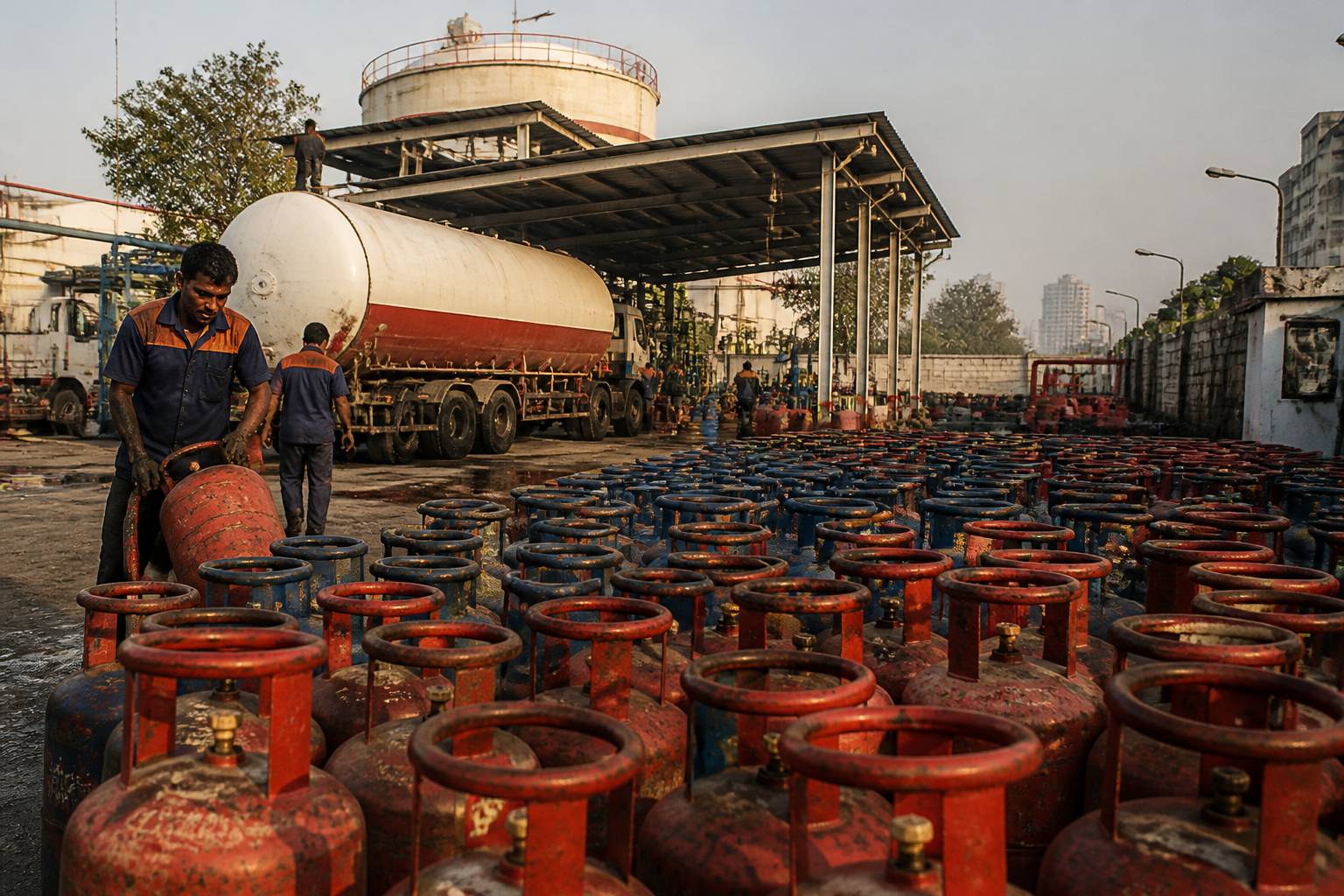
India’s LPG under-recovery rose to more than ₹62,000 crore in August 2026, exposing how quickly a disruption in international energy routes can move through the country’s cooking-fuel supply chain and into the finances of public-sector oil marketing companies (OMCs). The increase was not driven by one isolated price movement. It reflects the combined pressure of higher international prices, reduced availability through the Strait of Hormuz, longer voyages from alternative suppliers and the continued sale of LPG cylinders below market-linked costs.
The Hindu BusinessLine reported that cumulative under-recovery at PSU OMCs increased by roughly 5 per cent month-on-month in August. The companies continue to sell LPG to consumers at prices below their estimated market cost, leaving them to absorb the difference. The under-recovery per cylinder, which was around ₹721 in June and about ₹500 a month later, stood at roughly ₹188 in August and has risen to approximately ₹210 in the current month.
These figures show that the financial burden has not disappeared even as the per-cylinder gap narrowed from its June level. Instead, the cumulative loss continued to expand because the OMCs remained exposed to high procurement costs and substantial volumes of imported fuel. The issue is therefore not only the retail price of a cylinder. It is also the scale, timing and cost of replacing imported LPG in a market where demand must continue to be served.
Before the West Asia conflict began on February 28, India imported about 60 per cent of its LPG consumption, according to the report. Around 90 per cent of those imports transited the Strait of Hormuz, a route that became severely disrupted during May and June. That concentration made the LPG system vulnerable to a logistical shock even when domestic distribution networks and retail outlets continued to function.
The impact is visible in import volumes. India’s LPG imports reached a six-month high of 1.3 million tonnes in August, rising approximately 50 per cent from July. Yet imports were nearly 33 per cent lower than in August a year earlier. The combination of a month-on-month recovery and year-on-year decline points to a system that was rebuilding supplies after disruption, but had not returned to its earlier import pattern.
The procurement data also show how supply disruption translated into higher effective costs. A back-of-the-envelope calculation cited in the report indicates that India procured roughly 1.65 tonnes of LPG for every $1 million spent in August, about the same rate as in March. In April, the quantity was around 1.39 tonnes per $1 million. During May and June, when the Strait of Hormuz disruption sharply constrained supply, the amount fell to roughly 1.17 tonnes and 1.18 tonnes respectively.
This is an important distinction for understanding the OMC losses. A country can increase the nominal quantity of LPG imported and still face financial stress if the cost of securing each tonne rises. The August recovery in import volumes therefore did not automatically restore affordability for the companies. It took place against a market where procurement routes, freight rates and supplier economics had all changed.
The United States became India’s largest LPG supplier in August, with about 0.62 million tonnes imported from the country, compared with 0.89 million tonnes in July, according to OPEC data cited by The Hindu BusinessLine. The United States had been India’s fifth-largest supplier until January 2026 and moved ahead of Kuwait a month later. Following the outbreak of the West Asia conflict, it became India’s top supplier for five consecutive months from March.
That shift represents diversification, but not a cost-free solution. US LPG is linked to Mont Belvieu prices, which were reported at $0.68 per gallon in August, equivalent to around $360 per tonne. The benchmark is generally lower than Saudi Contract Prices, but the distance between the US Gulf Coast and India increases the delivered cost. In other words, a lower source-market price does not necessarily mean a lower price at an Indian port or depot.
Freight has become the central complication. Equirus Securities, cited in the report, said Houston-to-Asia very large gas carrier freight exceeded $200 per tonne in mid-April and rose above $300 in August as eastbound demand tightened vessel availability. The brokerage said US-to-Asia LPG flows declined from around 4.8 million tonnes in July to roughly 4.2 million tonnes in August and were estimated to fall further to 3.6 million tonnes in September.
For India, this creates a difficult procurement balance. Alternative suppliers can reduce dependence on a disrupted route, but longer voyages require more shipping capacity, consume more time and expose importers to a tighter freight market. The result is a form of diversification that improves route flexibility while increasing the delivered cost of fuel. The OMCs may secure supply, but they do so under financial conditions that intensify under-recovery.
Regional pricing pressure has added to the strain. Saudi Arabia’s September propane contract price rose by $5 per tonne to $625, according to the report, as constrained regional supply pushed prices higher. Saudi Contract Prices are an important reference for LPG markets, and a rise in that benchmark can raise the cost of cargoes even when Indian buyers are attempting to broaden their supplier base.
The institutional structure behind the problem is straightforward but consequential. PSU OMCs procure LPG in international markets and sell cylinders to consumers at regulated or politically managed retail prices. When the selling price is below the market-linked procurement and distribution cost, the difference appears as under-recovery. The immediate effect is carried on the companies’ books, while the wider policy question is how that burden is eventually managed through pricing decisions, compensation or the financial strength of the public-sector suppliers.
The supplied report does not establish whether the latest increase will be compensated through a specific government mechanism, passed through to consumers, or absorbed by the OMCs. It does establish that the companies are continuing to accumulate higher sourcing costs. That distinction matters: the current data describe a growing exposure, not a completed settlement of who will bear it.
The household impact is also mediated by this institutional arrangement. Consumers may continue to see relatively stable LPG prices even as international procurement costs rise. That protects short-term affordability, but it can conceal the volatility being absorbed elsewhere in the system. If the gap persists, the pressure moves into OMC finances and public policy. If prices are adjusted, the pressure becomes more visible to households. The report does not provide a new retail price decision, so the effect on consumers cannot be quantified from the supplied material.
India’s dependence on imported LPG also reveals the limits of treating energy security as a question of supply quantity alone. The country had access to additional US cargoes in August, but the cost and availability of vessels became decisive. Routes, freight, benchmark prices and geopolitical risk all shaped the final cost. The resilience of the cooking-fuel system therefore depends not only on securing molecules of LPG, but also on maintaining affordable access to shipping and multiple import corridors.
The August figures bring these pressures together. Imports rose to 1.3 million tonnes, yet remained well below the level of a year earlier. US supply became more important, but flows from the country weakened as freight costs increased. Saudi propane prices rose, while Indian OMC under-recovery crossed ₹62,000 crore. Each number describes a separate part of the supply chain; together, they show how disruption at an international maritime chokepoint can become a fiscal problem for domestic fuel distributors.
The larger urban question is how cities and households remain protected from global supply shocks when essential energy is priced below its market cost. LPG is used across urban and rural India, but the exposure is particularly significant for dense settlements where households, small businesses and service providers depend on reliable cylinder distribution. The supplied evidence does not quantify disruptions at the consumer or city level, but it shows that the financial buffer protecting retail prices is becoming more expensive to maintain.
What the evidence confirms is that India has partly diversified LPG sourcing after the West Asia disruption, but the replacement supply has not eliminated vulnerability. Higher freight, constrained regional availability and rising benchmark prices continue to accumulate costs for PSU OMCs. The next developments to monitor are the September movement in US-to-Asia LPG flows, further changes in Saudi propane pricing, the per-cylinder under-recovery and any official decision on how the growing cumulative burden will be handled.

