


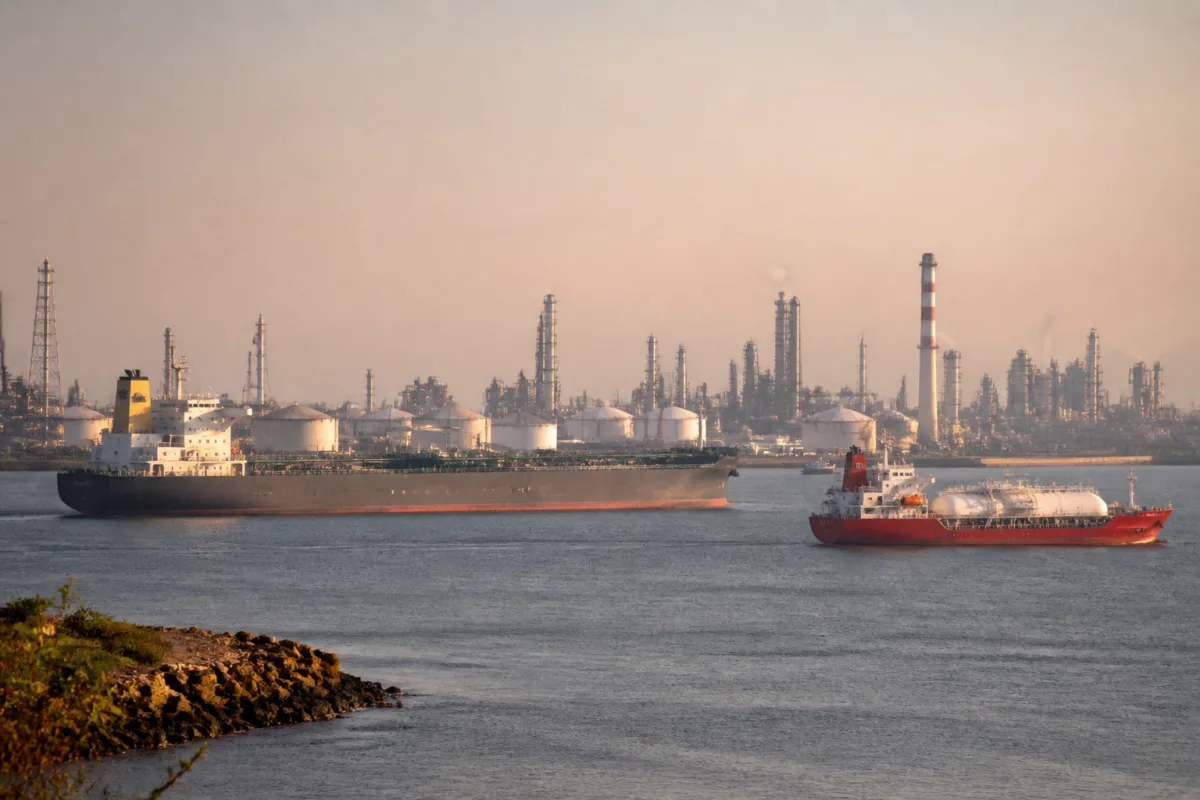
Indian Oil Corporation’s plan to buy crude oil carriers and liquefied petroleum gas vessels is more than a fleet-expansion decision. It signals how India’s energy security is increasingly being shaped by the reliability, cost and ownership of the shipping routes that connect overseas suppliers to domestic refineries and fuel markets.
The state-owned refiner’s board has approved the purchase of a few vessels and tenders were issued several months ago, according to Director of Finance Anuj Jain, who spoke during the company’s second-quarter earnings call, as reported by The Economic Times. IOC is also examining whether ships can be built in India under the government’s Make in India initiative.
The immediate trigger is the disruption and uncertainty around commercial movement near the Strait of Hormuz, alongside higher freight rates and war-risk insurance costs linked to tensions in West Asia. But the underlying issue is broader. India imports most of its crude oil, which means that refining capacity alone cannot guarantee energy security. The country also needs dependable access to tankers, ports, insurance and maritime routes.
IOC has traditionally used a combination of time-chartered and voyage-chartered vessels. Its current arrangements include three crude oil vessels and nine LPG vessels on time charter. Jain said these contracts had provided significant cost savings during the current crisis, illustrating why shipping capacity has become a financial and operational concern for an oil company rather than a peripheral logistics function.
The difference between contracted and spot-market freight rates has been substantial. IOC’s time-chartered crude carriers cost around USD 2-2.50 per barrel, while spot-market rates have reached as much as USD 8-10 per barrel. LPG freight, which would normally cost about USD 40 per tonne, has risen to USD 160-180 per tonne in the spot market, Jain said.
These figures show the value of having shipping capacity secured before a disruption occurs. A refinery can continue operating only if crude reaches it at a manageable cost. When vessels become scarce or freight costs rise sharply, the additional expense enters the supply chain before crude is processed, transported inland or sold to consumers. For LPG, which is distributed through a large household and commercial network, higher freight costs also affect the economics of moving an essential fuel into the country.
IOC is considering three linked approaches: optimising existing charter arrangements, owning ships and supporting domestic shipbuilding. They represent different degrees of control. Chartering allows flexibility and avoids the full capital cost of ownership, but exposes the company to changing market conditions when contracts expire. Owning vessels can provide greater control over availability and scheduling, although it also brings responsibilities for maintenance, crewing, compliance and asset utilisation.
Domestic shipbuilding adds another layer to the strategy. The Economic Times report does not specify the proposed vessel sizes, shipyards, construction timelines or financing structure. It does, however, place IOC’s shipping decision within the government’s wider Make in India framework. That connects energy logistics with industrial policy: the question is not only where India sources its crude, but also whether more of the equipment needed to transport strategic commodities can be designed, financed and built domestically.
IOC’s procurement pattern has already become more geographically diverse. The company sourced 55 per cent of its crude requirements from Russia during the first half of the current financial year, while Middle Eastern supplies accounted for 24 per cent. Africa contributed about 10 per cent, Brazil 7 per cent, the United States 2-5 per cent and Venezuela 3-4 per cent, according to Jain’s disclosures.
The spread of suppliers reduces dependence on a single geography, but diversification does not remove maritime exposure. Crude from different origins still has to move through international shipping lanes, and the cost and availability of suitable vessels can vary by cargo type, route and geopolitical risk. In this sense, procurement diversification and shipping control are complementary strategies rather than substitutes.
IOC has also increased its reliance on spot purchases. Spot imports accounted for about 87 per cent of its crude sourcing in the first half of FY27, compared with around 50 per cent in the previous financial year. Spot buying can allow a refiner to respond to price differences and changing supply opportunities, but it can also increase exposure to short-term movements in freight, insurance and crude markets.
Jain said IOC had negotiated discounts against benchmark prices despite volatile global markets. During the September quarter, the premium or discount paid over benchmark crude ranged from a discount of USD 5 per barrel to a premium of USD 12 per barrel. In the preceding quarter, the range was from zero to a premium of USD 18 per barrel. The company continued buying Russian crude at what it described as optimal prices and also processed Venezuelan crude.
The data points to a procurement model that is becoming more flexible, but also more operationally demanding. A refiner buying from several regions and using a high share of spot cargoes needs to coordinate vessels, routes, delivery windows, storage and refinery operations. Any disruption can affect not just the price paid for crude but also the timing of arrivals and the amount of inventory that must be held as protection.
IOC said it had maintained refinery operations at optimal levels despite supply-chain disruptions. It increased crude inventories to about 39 days, from its usual 33-35 days. It was also holding 20 days of LPG inventory and 23-25 days of petrol and diesel stocks. These inventory levels provide a buffer, but they also tie up capital and require adequate storage infrastructure.
That is the institutional dimension of the shipping decision. Energy resilience is not created by one asset or one ministry. It depends on coordination between the refiner, shipping companies, ports, insurers, shipyards, storage facilities and government agencies. The proposal to own or build vessels suggests that IOC is assessing whether more direct control over one part of this chain can reduce vulnerability elsewhere.
The company’s financial results provide the immediate context for the announcement. IOC reported a net profit of Rs 21,630 crore in the September quarter, compared with a loss of Rs 2,661 crore in the preceding quarter and a profit of Rs 7,610 crore in the year-earlier period. It recorded a gross refining margin of USD 18.52 per barrel, excluding the impact of the special additional excise duty, and an inventory gain of Rs 6,948 crore.
These results show that the quarter benefited from refining performance and inventory effects. They do not, by themselves, establish the long-term financial return from owning ships. That assessment would depend on purchase prices, financing costs, operating expenses, utilisation rates and future freight conditions. Those details were not provided in the reported material.
The oil price environment has nevertheless made supply-chain exposure more visible. Indian basket crude, which averaged around USD 65-70 per barrel in February, remained above USD 100 for much of the first quarter and averaged about USD 120 per barrel in October, Jain said. When the commodity itself becomes more expensive, freight and insurance form an even more consequential part of the delivered cost.
For India’s urban economy, the implications are indirect but extensive. Refineries supply transport fuels, LPG and industrial inputs that support commuting, goods movement, construction, manufacturing and household activity. Shipping disruptions do not automatically translate into shortages, particularly when inventories are available, but they can increase the cost and complexity of keeping these systems supplied.
The proposed fleet therefore represents a shift in how an oil marketing company may define its core capability. Refining and retail networks remain central, but maritime logistics can determine whether imported crude and LPG arrive at the right place, at the right time and at a tolerable cost. In a country dependent on overseas energy, the boundary between energy policy and transport infrastructure is increasingly difficult to separate.
What IOC has announced so far is a direction, not a completed programme. The company has approved the purchase of a few vessels and issued tenders, while exploring domestic construction. The number of ships, procurement outcomes, construction partners, delivery dates and final ownership model remain to be established. Those milestones will determine whether the strategy becomes a limited hedge against freight volatility or a larger restructuring of India’s public-sector energy logistics.
The evidence currently confirms three developments: IOC is seeking greater control over shipping capacity, it is diversifying crude procurement, and it is carrying higher inventories against geopolitical and supply-chain uncertainty. The larger urban and economic question is whether India’s energy infrastructure can remain affordable and reliable when the routes connecting it to global markets become the main source of risk.

