


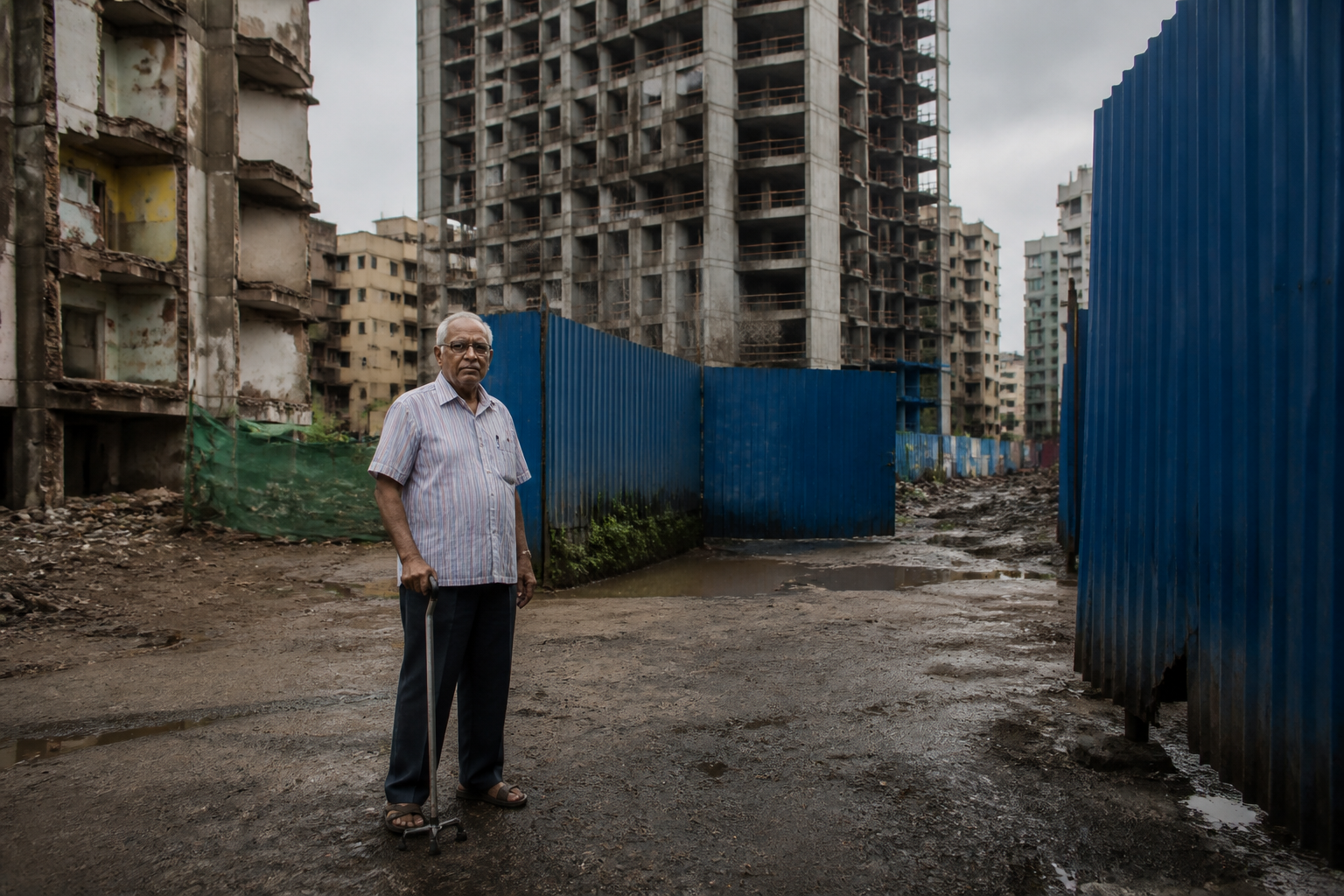
Mumbai’s redevelopment model is meant to replace ageing homes with safer, larger or better-planned accommodation. For a group of elderly, disabled and financially vulnerable flat owners, however, the process has produced the opposite: demolished homes, unpaid transit rent, missing alternative accommodation and years of legal uncertainty. Their cases show how redevelopment can leave residents exposed even after economic offences investigations and money-laundering proceedings begin.
The Times of India has reported that around 50 flat owners and homebuyers are caught in prolonged disputes linked to redevelopment projects in D N Nagar, Andheri, Kandivli and Goregaon. At least 21 cases have been filed against members of the Tanna family. The Economic Offences Wing has taken over investigations and chargesheets have been filed in several cases. Police have arrested Jayesh Tanna, while his brother Deepa Tanna is absconding. Jayesh’s wife Heena, son Vivek, daughter Shraddha and daughter-in-law Anita have also been named in first information reports and obtained anticipatory bail, according to the report.
The Enforcement Directorate has separately registered a case under the Prevention of Money Laundering Act. Several properties allegedly linked to the Tannas have been provisionally attached. These proceedings establish that the disputes have moved beyond ordinary delays in construction. But they do not, by themselves, return homes to residents or guarantee that promised payments will be recovered. That separation between criminal investigation and immediate housing relief is the central urban problem in the cases described.
For residents, the first institutional promise in a redevelopment project is not simply a future flat. It is a chain of obligations that must protect them during the transition. The arrangements described in the report include a Permanent Alternative Accommodation Agreement, an alternative flat and transit rent. Once an original home is demolished, each part of that chain becomes essential. If construction stops or contractual commitments are disputed, the resident may have no existing home to return to and no reliable income stream to pay for temporary accommodation.
Mahendra Chokshi’s experience illustrates this vulnerability. The 68-year-old, who is blind and dependent on others, has spent four years in an old-age home after his Kandivli home was demolished for redevelopment. He is still waiting for alternative accommodation and financial dues. His flat was valued at Rs 85 lakh, but the figure represents more than a disputed property asset: it is also the housing security he expected in old age. According to allegations in his case, the flat was later dealt with through forged memorandums of understanding. An FIR was registered in 2022.
The case also demonstrates why legal enforcement can be difficult for people who have already lost control over their housing situation. Chokshi cannot read documents placed before him, relies on others for physical assistance and has limited financial means to sustain a prolonged legal battle. A redevelopment dispute therefore creates more than a property claim. It can produce a practical access-to-justice problem in which the resident must navigate agreements, police procedures, financial records and court processes without the home, money or independence that would make the process manageable.
Other cases reported by the newspaper show that the problem is not confined to one individual or one project. Ninety-two-year-old bedridden Kamla Gandhi has claims exceeding Rs 7 crore, as well as another claim of around Rs 2 crore. Vijay Jadhav, 82, who is unable to walk, is seeking resolution of claims estimated at Rs 5 crore in D N Nagar. Jayshree Shah, a 71-year-old single woman, has been waiting since 2010 and says she is owed around Rs 90 lakh in connection with an incomplete D N Nagar redevelopment project. Harsha Pariyani, who is disabled, says she has been waiting for around Rs 90 lakh since 2011 in another D N Nagar project in Andheri.
These cases reveal the unequal distribution of risk in redevelopment. A developer may treat delay as a commercial or legal problem, but a resident whose home has already been demolished experiences it as an immediate loss of shelter. The risk is particularly severe for residents who are elderly, disabled, single or living alone. They may have no second property, limited ability to relocate and little capacity to absorb unpaid rent. Shah told the Times of India that she had handed over her flat expecting additional space in the new project, but after 15 years remained homeless in a rented flat while the builder had stopped paying rent.
The institutional structure around redevelopment is complex. Residents surrender possession of an existing flat in exchange for a future entitlement. The entitlement may involve a new flat, additional area, a formal permanent accommodation agreement and financial support during construction. The report also refers to mortgages and property transactions as issues that can become entangled in lengthy legal proceedings. Each additional transaction can make it harder for a resident to establish who is responsible for delivery, payment or possession.
This complexity matters because the criminal justice system and the redevelopment system operate on different timelines and pursue different objectives. The EOW’s role is to investigate alleged economic offences and prosecute cases where evidence supports charges. The ED’s money-laundering case addresses alleged proceeds and financial transactions under the applicable law. Property attachment can preserve assets for proceedings, but it is not the same as completing a stalled project or compensating every affected resident. The supplied report does not establish what final recovery or rehabilitation mechanism will be available to the complainants.
The cases also raise questions about oversight before demolition. The report does not provide a complete account of the approvals, escrow arrangements, project monitoring systems or resident-consent procedures applicable to each redevelopment scheme. It therefore cannot establish whether the projects were approved under identical arrangements or whether the alleged failures occurred through a common method. What it does establish is that residents were expected to rely on contractual and institutional safeguards that, according to their complaints, did not prevent prolonged displacement.
A developer familiar with such projects told the newspaper that disputes can become prolonged when agreements, transit rent, alternative accommodation, mortgages and property transactions enter legal proceedings. This explanation identifies why a project can remain unresolved, but it does not answer the more immediate question of who carries the cost while the dispute continues. In the reported cases, residents say that cost has been transferred to them through unpaid rent, lost homes and years of waiting.
The story is also a reminder that redevelopment is often measured through physical output: the number of towers proposed, the additional floor area promised or the number of old buildings cleared. For existing residents, those indicators are incomplete. The meaningful test is whether they receive secure temporary accommodation, regular rent, legally enforceable permanent rights and possession of the promised replacement home. A project that generates construction activity but leaves original residents without shelter has delivered redevelopment in physical terms while failing in its social function.
The allegations concerning the Tanna family remain subject to investigation and legal proceedings. The Times of India report states that affected owners allege funds were diverted or transferred overseas while projects remained incomplete, and that no forensic audit of the projects and transactions had been conducted. These are allegations, not established findings in the supplied material. Their significance lies in the residents’ demand for a financial explanation of where project-related money went and how outstanding housing and payment obligations can be addressed.
The report also records a dispute over firearm licences held by members of the Tanna family. Complainant Mehul Katara said he approached the Human Rights Commission and that police cancelled Jayesh Tanna’s licence in 2026, while the licences of Vivek and Deepa had not been revoked. This issue is separate from the housing claims, but it illustrates the wider institutional pressure surrounding the cases and the complainants’ continuing efforts to secure official action.
Mumbai’s redevelopment system ultimately depends on residents accepting present disruption for a future housing benefit. That bargain becomes unstable when the present loss is certain but the future benefit is delayed, disputed or impossible to trace. Elderly and disabled residents face the greatest exposure because they are least able to relocate, earn additional income or manage complex litigation. The cases reported from Kandivli, Andheri, Goregaon and D N Nagar therefore raise a citywide governance question: how should residents be protected when redevelopment fails after their original homes have been demolished?
The evidence supplied in the report confirms prolonged displacement, large financial claims, multiple police cases and separate ED proceedings. It does not establish the final liability of the accused, the total recoverable amount or a completed rehabilitation plan for the affected residents. Those outcomes will depend on investigations, court proceedings, property recovery and any administrative or project-level intervention that follows. Until then, the cases show that a redevelopment promise is only as secure as the mechanisms that protect residents when construction and contracts break down.
