


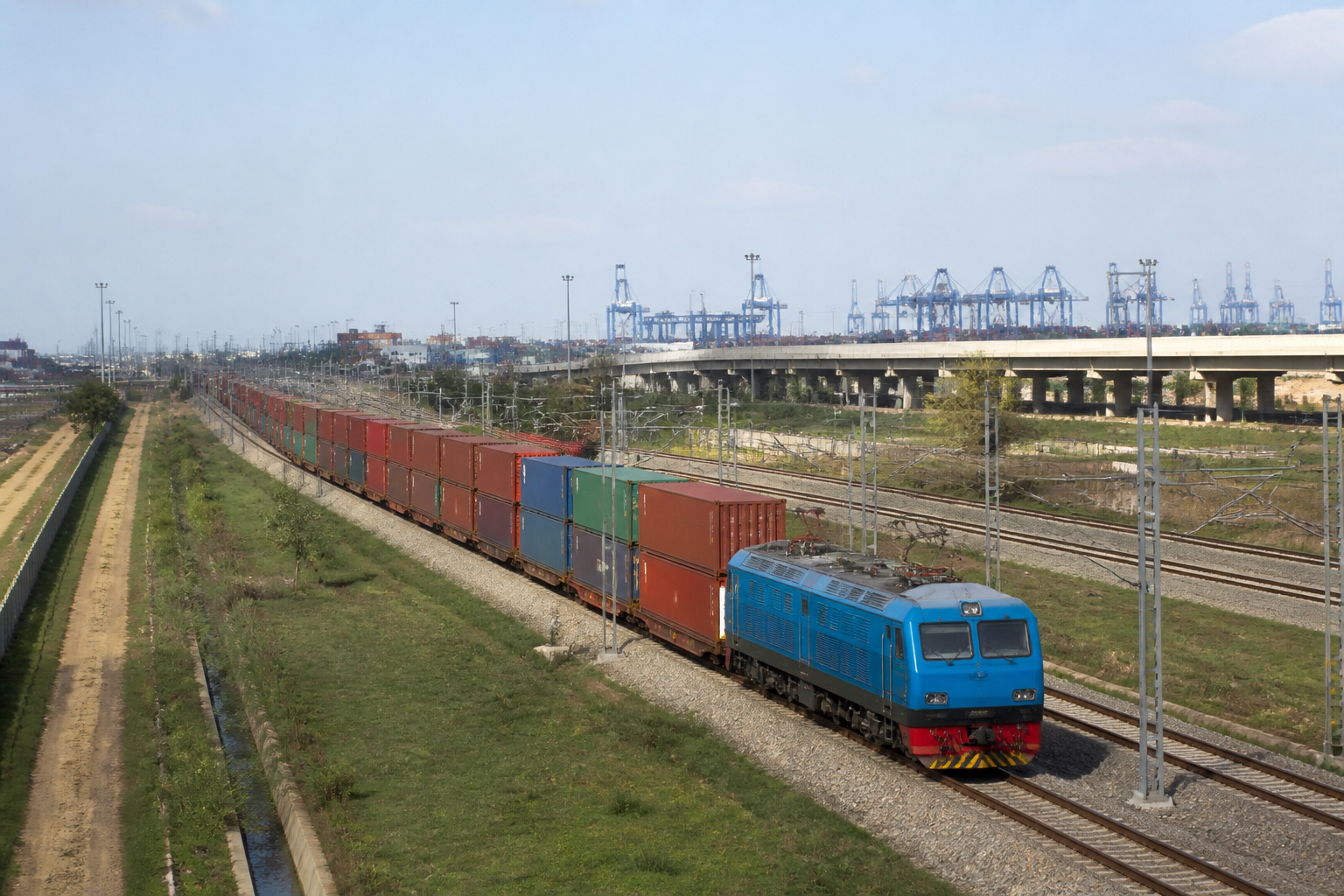
India’s Dedicated Freight Corridor network became fully operational across 2,843 route kilometres on Tuesday after Prime Minister Narendra Modi inaugurated three sections of the Western Dedicated Freight Corridor developed at a cost of more than Rs 20,700 crore.
The newly commissioned sections cover 326 route kilometres and include New Sanand (North)-New Makarpura, New Umbergaon-New Saphale and New Saphale-New Jawaharlal Nehru Port Terminal (JNPT). The sections connect industrial areas in Gujarat and Maharashtra with the country’s western port network.
The Ministry of Railways has developed two dedicated freight corridors. The Eastern Dedicated Freight Corridor runs 1,337 kilometres from Ludhiana to Sonnagar, while the Western Dedicated Freight Corridor connects Dadri with JNPT over 1,506 kilometres.
The direct link to the Jawaharlal Nehru Port Authority is expected to speed up the movement of export-import cargo, improve connectivity between industrial hubs and ports, reduce logistics costs and ease congestion on Mumbai’s conventional railway network. The corridors are also intended to support multimodal freight movement by enabling faster and more reliable cargo transfers between regions.
The Prime Minister also flagged off freight train services from New Sanand (North), New Makarpura, New Umbergaon and New JNPT in Mumbai. Until the latest sections were commissioned, the two corridors were handling an average of about 443 trains a day, according to information cited by the Ministry of Railways.
Railway freight loading has risen alongside the expansion of the dedicated network. The figures provided by the Railways show freight loading increasing from 1,098 million tonnes in 2014-15 to 1,670 million tonnes in 2025-26. Loading stood at 1,617 million tonnes in 2024-25 and 1,591 million tonnes in 2023-24.
The Railways said the corridors have supported higher average speeds, quicker turnaround times and improved operational reliability. The use of double-stack container trains and higher axle-load trains has also increased freight-carrying capacity. By shifting freight traffic from conventional routes to the dedicated corridors, the network has released capacity for additional goods and passenger services elsewhere on the railway system.
The Railways is also pursuing measures to strengthen freight handling beyond the corridors themselves. These include the development of modern freight terminals under the Gati Shakti Multi-Modal Cargo Terminal policy, upgrades to railway-owned goods sheds and schemes encouraging private investment in specialised wagons for commodities such as cement, oil, steel and fly ash.
The Joint Parcel Product-Rapid Cargo Service scheme is intended to provide customised logistics services, including door-to-door delivery and online booking of parcel space through aggregators and India Post’s Virtual Aggregation Platform. CONCOR is using the scheme for services on the Delhi-Kolkata and Mumbai-Kolkata sectors and is conducting a door-to-door logistics pilot at Sonik Goods Shed.
The Union Budget 2026 also announced a proposed Dedicated Freight Corridor linking Dankuni in the east with Surat in the west. The Ministry of Railways has begun preparing or updating the Detailed Project Report for the proposed corridor.
