


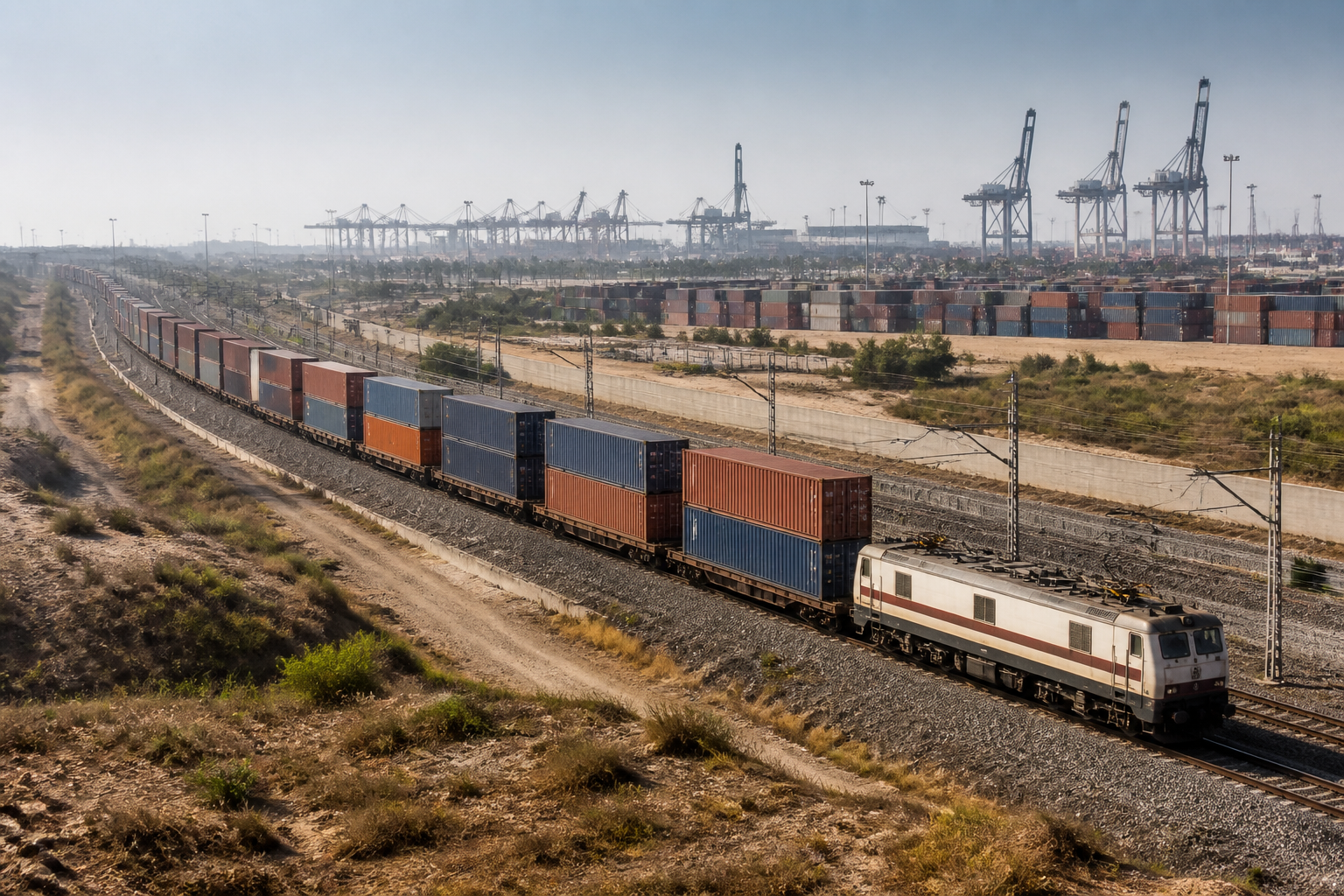
India’s Dedicated Freight Corridor network has reached a defining milestone with the commissioning of the remaining 326 route kilometres of the Western Dedicated Freight Corridor. The three sections inaugurated by Prime Minister Narendra Modi connect New Sanand North with New Makarpura, New Umbergaon with New Saphale, and New Saphale with Jawaharlal Nehru Port Terminal. Developed at a cost of more than Rs 20,700 crore, the sections bring the entire 2,843-km Dedicated Freight Corridor network into operation.
The immediate significance is operational. India’s two freight-only railway corridors are now available across their full planned length: the 1,337-km Eastern Dedicated Freight Corridor between Ludhiana and Sonnagar, and the 1,506-km Western Dedicated Freight Corridor between Dadri and Jawaharlal Nehru Port Terminal. Together, they create a dedicated north-south and east-west freight system linking industrial regions, production centres and ports.
The completion changes the role of the corridors from a series of partially operational stretches into a functioning national freight network. The Ministry of Railways has said the corridors are handling an average of about 443 trains every day. The new sections also connect directly with the Jawaharlal Nehru Port Authority network, a link expected to improve the movement of export-import cargo and strengthen connections between the northern hinterland, industrial hubs and western ports.
That port connection is central to the Western DFC’s purpose. Freight moving between production centres and ports depends not only on track capacity but also on the continuity of the route. A missing or incomplete section can require cargo to return to conventional routes, where passenger and goods trains compete for capacity. With the final Western DFC sections commissioned, freight can move across the corridor towards JNPT with fewer such breaks in the dedicated system.
The network is also intended to address a long-standing constraint in India’s railway system: the shared use of routes by passenger and freight services. The Railways has said that shifting freight to the Eastern and Western corridors has freed additional capacity on the conventional network. That capacity can then support more goods and coaching services on existing routes. The effect is therefore not limited to trains using the DFC itself; it extends to the railway network that no longer has to accommodate the same volume of freight traffic on mixed-use sections.
The operating data supplied by the Railways points to a broader rise in freight activity. Indian Railways’ freight loading increased from 1,098 million tonnes in 2014-15 to 1,670 million tonnes in 2025-26. The increase was not uniform, but the trend strengthened after 2020-21, when loading stood at 1,233 million tonnes. It rose to 1,418 million tonnes in 2021-22, 1,512 million tonnes in 2022-23, 1,591 million tonnes in 2023-24, 1,617 million tonnes in 2024-25 and 1,670 million tonnes in 2025-26.
These figures do not, by themselves, establish how much of the growth is directly attributable to the Dedicated Freight Corridors. They do show that DFC completion has taken place alongside a period of rising railway freight volumes. The Ministry has linked the corridors’ performance to higher average speeds, quicker turnaround times and improved reliability, while also highlighting the use of double-stack container trains and higher axle-load trains. The supplied material does not provide a separate quantified breakdown of the DFC’s contribution to total freight loading, so the relationship should be understood as an operational association rather than a precise causal measurement.
The infrastructure’s intended value lies in reducing the friction between different parts of the logistics chain. Faster rail movement can improve the connection between inland production and port terminals, but the effectiveness of that movement also depends on terminals, goods sheds, road links, cargo aggregation and last-mile delivery. The Railways has therefore paired the DFC programme with a broader freight strategy that includes terminal development, wagon investment and customised cargo services.
Under the Gati Shakti Multi-Modal Cargo Terminal policy, the Railways is promoting modern freight terminals while also upgrading goods sheds owned by the railway system. These facilities are important because a high-capacity corridor can still deliver limited benefits if cargo cannot be efficiently loaded, unloaded, stored or transferred to another mode. The report does not provide a national count of upgraded terminals or measure their performance, but it identifies terminal capacity as part of the Railways’ wider logistics approach.
The wagon schemes address another part of the system. The Railways has introduced measures intended to support private investment in specialised wagons for commodities such as cement, oil, steel and fly ash. Specialised rolling stock can improve the fit between cargo requirements and railway operations. It also indicates that corridor performance is being pursued through a combination of track infrastructure, train technology and freight-market participation rather than through new lines alone.
The Joint Parcel Product-Rapid Cargo Service scheme extends the same logic to smaller or more customised consignments. It is designed to provide logistics solutions based on customer requirements, including door-to-door parcel services and online booking of parcel space through aggregators and India Post using the Virtual Aggregation Platform. Container Corporation of India is using the scheme for door-to-door parcel services on the Delhi-Kolkata and Mumbai-Kolkata sectors and is operating a pilot at Sonik Goods Shed.
This institutional framework reveals the principal policy challenge after construction: converting corridor capacity into dependable end-to-end logistics. Dedicated tracks can raise speed and reliability between two points, but shippers also need predictable collection, terminal handling, documentation and delivery. The Railways’ emphasis on terminals, wagons and parcel services suggests that the next phase is as much about integration as it is about physical expansion.
The completion of the current network also creates a new baseline for future planning. The Union Budget 2026 announced a proposed Dedicated Freight Corridor linking Dankuni in the east with Surat in the west. According to the supplied report, work on preparing or updating the Detailed Project Report has begun. Unlike the three commissioned Western DFC sections, this proposed corridor remains at the planning stage in the available material. Its eventual significance will depend on project definition, financing, land requirements, construction timelines and integration with existing freight routes, none of which are established in the report.
The contrast between the completed network and the proposed Dankuni-Surat link illustrates how India’s freight strategy is evolving. The first two corridors were designed around major industrial and port connections, with the Eastern DFC serving the Ludhiana-Sonnagar axis and the Western DFC linking Dadri to JNPT. The next proposed link would add another east-west connection, but the available evidence does not yet show how it would alter freight flows or distribute capacity across regions.
For cities and urban regions, the effects of the DFC are likely to be mediated through logistics geography rather than through the railway tracks alone. Industrial hubs, port-linked areas, warehousing districts and terminal locations can become more closely connected when freight movement is faster and more reliable. At the same time, the value of those connections depends on how terminals are planned, how road traffic is managed around them and whether first- and last-mile systems can absorb increased cargo movement. The supplied material identifies these components as priorities but does not provide local impact assessments.
The completion of the 2,843-km network therefore confirms a substantial infrastructure achievement while leaving several performance questions open. The Railways has reported 443 trains a day, rising freight loading, higher speeds and improved reliability. It has also reported additional capacity on conventional routes and stronger access from the northern hinterland to western ports. What is not established in the available material is the precise reduction in transit time or logistics cost for specific commodities, the share of national freight shifted to the DFC, and the measurable effects on congestion across individual railway sections.
Those indicators will determine whether the completed corridors function not only as large railway assets but as an integrated freight system. The next developments to monitor are the performance of the newly commissioned sections, the expansion and utilisation of multimodal terminals, the results of the parcel and wagon initiatives, and the preparation of the Detailed Project Report for the proposed Dankuni-Surat corridor. India has completed the core DFC network; the evidence of its wider impact will now come from how consistently cargo moves across the infrastructure and beyond it.
