


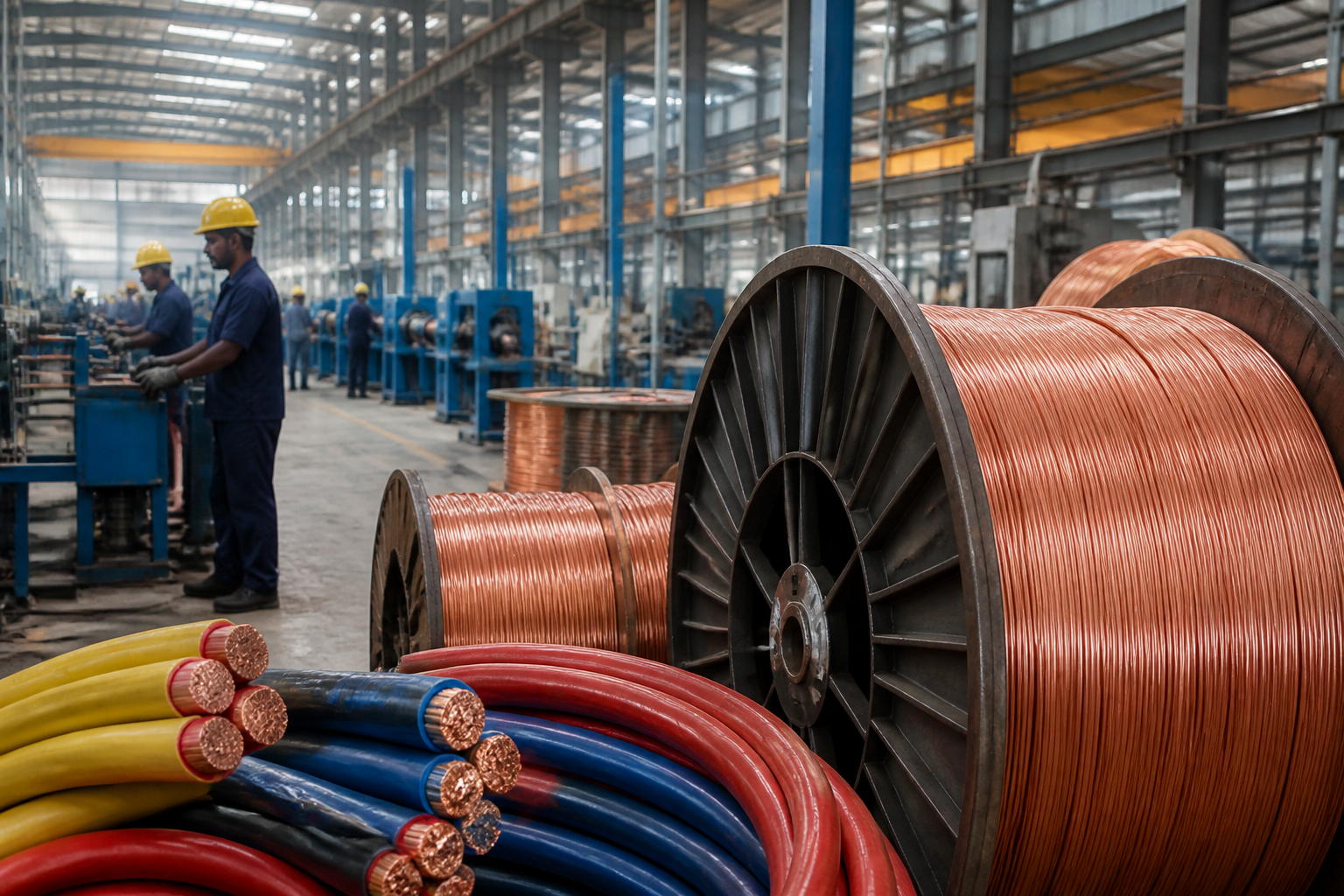
Copper prices have reached a record $14,533 a metric ton just as India’s wires and cables industry faces a major competitive shift. The combination is creating pressure on established manufacturers from two directions: higher input costs that must be passed on to customers, and the entry of UltraTech’s Ultravolt business with ambitions to become one of the country’s two largest players within five years.
The immediate question is not simply whether cable makers can raise prices. It is whether the industry can preserve volumes and margins when copper, its primary input, is becoming more expensive and a large corporate entrant is expanding distribution, manufacturing capacity and brand visibility. For an industry closely linked to housing, construction, electrification, renewable energy and industrial investment, the outcome will extend beyond listed-company valuations.
The evidence available so far points to a market entering a more demanding phase. Companies are passing on higher copper costs, but brokerages are questioning whether demand will absorb those increases without slowing volume growth. At the same time, UltraTech’s entry is introducing another source of uncertainty: the possibility that established companies will have to compete more aggressively on price, distribution and customer engagement.
Copper supply is central to the pressure. The metal’s latest rally has been supported by tariff-related trade flows and expectations that mine supply will remain tight. Data from the International Copper Study Group showed global mine output declining 1.1% in the first half of the year. Major producers Codelco and Freeport-McMoRan reported double-digit production declines, while Morgan Stanley revised its earlier expectation of expanding mine supply and now sees output as little changed or slightly lower.
If that pattern continues, this could become the first annual decline in mine supply since 2017. The supply concern is important for cable makers because copper is not a marginal cost component that can be easily substituted. When the underlying commodity rises sharply, manufacturers must either increase prices, accept lower margins or attempt to manage working capital and procurement more efficiently.
Indian companies have already begun responding through price revisions. Polycab India said during its fourth-quarter earnings call that it had taken a cumulative price increase of approximately 18% to 19% between January and March after the sharp rise in copper prices. RR Kabel announced increases of between 2% and 3.5%, although their implementation was reportedly kept on hold.
These moves illustrate the difficulty of passing on commodity inflation. A price increase protects the nominal value of revenue, but it can also affect customer demand, particularly in a market where distributors, contractors and consumers may delay purchases or shift to lower-priced alternatives. If price increases outpace volume growth, revenue may remain resilient while the underlying expansion of the industry weakens.
JM Financial has identified this as one of the main questions facing the sector: whether cables and wires growth is approaching a peak. The brokerage said that after a period of strong growth, investors may need to pay closer attention to the absence of volume growth. With elevated copper prices becoming the base from late the third quarter or the fourth quarter of fiscal 2027, revenue growth could appear weaker over the following 12 months even if companies continue to raise prices.
That distinction between value growth and volume growth matters for construction and infrastructure markets. Wires and cables are used across residential buildings, commercial developments, industrial facilities, power systems, solar installations and communications networks. Higher prices can raise project costs, but a slowdown in physical demand would signal a different problem: that developers, contractors and end users are reducing or postponing consumption rather than merely paying more for the same quantity.
The second major change is the arrival of UltraTech’s Ultravolt. UltraTech has begun commercial production at its Jhagadia facility in Gujarat earlier than initially expected. The business has launched with installed capacity of about 1.1 million kilometres, covering house wires and light-duty cables as well as flexible and submersible cables, solar cables, communication cables and selected power and industrial cables.
The scale of its proposed distribution network is intended to make the entry significant from the beginning. Ultravolt plans to distribute products across more than 500 districts and 6,000 pin codes, while targeting more than 100,000 retailers. It is also using more than 5,000 UltraTech Building Solutions outlets and had onboarded over 1,600 electricians ahead of the launch.
UltraTech has committed Rs 1,800 crore to the business and has said it aims to become one of the top two wires and cables players within five years. Its eventual capacity could rise to between 3.5 million and 4 million kilometres. Nomura estimates that the company could capture about 6% to 7% of the organised wires and cables market by fiscal 2030, assuming strong industry demand and asset turnover of five to six times.
The significance of the entry lies in the assets UltraTech can bring from its existing building-materials operations. Its distribution reach, relationships with retailers and access to construction-linked customers could allow it to build scale more quickly than a new entrant starting without an established network. Motilal Oswal said copper would be available near the plant, within a range of 100 kilometres, and that the business could manage working capital efficiently, potentially operating with negative working capital in a manner similar to UltraTech’s cement operations.
For incumbent companies, however, the relevant issue is not only the capacity that Ultravolt adds. It is the possibility of a change in competitive behaviour. JM Financial said UltraTech and Diamond Power could cumulatively command more than 12% of the market by fiscal 2029 estimates, while Crompton and Bajaj would add to the competitive landscape. The brokerage also noted that the industry includes about 20% unorganised players, making the effect of market-share shifts difficult to assess.
A fragmented market can provide room for established brands to defend their position, but it can also make pricing discipline more vulnerable. JM Financial said that even if market-share losses for incumbents remain debatable, margins could face pressure if competition disrupts pricing discipline. Existing companies may need to spend more on distribution, advertising and electrician engagement to protect their networks.
The stock-market response shows how quickly investors have reassessed the sector. The entry of UltraTech triggered a sharp selloff in listed wires and cables companies, wiping out about Rs 21,500 crore in market value over two trading sessions. Polycab India accounted for the largest rupee decline, with about Rs 8,766 crore erased from its market capitalisation. KEI Industries lost about Rs 5,158 crore, while Havells India, RR Kabel, APAR Industries and Finolex Cables together lost Rs 7,501 crore.
The selloff does not establish how market share or profits will ultimately change, but it does identify the risks investors are pricing. Companies face the possibility of slower volumes, lower margins and higher spending to retain distribution. They are also being valued at a point when the sector’s growth assumptions are under examination. JM Financial said wires and cables companies were trading at a 4% to 5% premium to their five-year average price-to-earnings multiple and about 25% above their long-term average.
Nomura has similarly pointed to moderation in industry volume growth after the sharp rise in copper prices as an additional headwind. The concern is that companies may be able to protect reported revenue for a period through price increases, while the market gradually becomes less supportive of volume expansion and higher valuations.
Copper’s own outlook adds another layer of uncertainty. London Metal Exchange prices were headed for a 10th consecutive weekly gain, the longest such stretch since 1994. Citigroup analyst Tom Mulqueen forecast copper at $15,000 a ton by the end of the year, with the possibility of about $17,000 if manufacturing recovers or demand from the energy transition, data centres or strategic stockpiling proves stronger than expected.
The supply side remains unresolved. Mulqueen has played down the risk that large US inventories will quickly return to the global market, arguing that stockpiles are likely to unwind gradually even without tariffs. Anglo American Chief Operating Officer Ruben Fernandes has also said demand is expected to outpace supply growth in the coming years, although the timing of new supply remains uncertain.
For India’s construction and infrastructure ecosystem, the key issue is therefore the interaction between commodity inflation and market competition. Higher copper prices can be reflected in cable quotations, but manufacturers cannot assume that every increase will be absorbed without affecting demand. A new large-scale competitor may expand consumer choice and distribution, but it can also make it harder for incumbents to preserve margins.
The available evidence confirms that the industry is facing a simultaneous input-cost shock and competitive reset. It does not yet establish whether UltraTech will achieve its market-share targets, whether copper prices will remain at current levels or how much demand will respond to higher cable prices. Those outcomes will depend on supply conditions, project activity, the ability to pass through costs and the pace at which Ultravolt converts its planned distribution footprint into sustained sales.
