


Subheadline: India’s waterways are moving more freight, but their biggest test may be whether they can connect digital commerce to communities that roads alone do not serve efficiently.
Standfirst: India’s logistics expansion is exposing a gap between connectivity and accessibility. Rural internet use is growing, online commerce is reaching dispersed communities, and road infrastructure has expanded, yet delivery remains difficult in riverine, island and backwater regions. The development of inland waterways offers a possible complement to road-based distribution, particularly where water is already a practical transport corridor. But the opportunity is not simply about moving parcels by boat. It depends on whether jetties, aggregation points, fulfilment hubs, technology and local delivery networks can operate as one system. The evidence in the latest industry discussion points to a broader shift in logistics thinking: from extending standardised networks everywhere to adapting distribution models to local geography.
India’s digital economy is reaching communities that conventional logistics networks still struggle to serve. Consumers in riverine, island and backwater regions can increasingly shop online, but the physical delivery of those orders remains constrained by geography. The question for logistics providers is therefore shifting from whether demand exists to how reliably and efficiently that demand can be reached.
The scale of the opportunity is substantial. The Indian logistics industry is forecast to grow to as much as $281.74 billion by 2026, while rural internet users exceeded 427.7 million during financial year 2025-26, according to the material cited in the report. Those figures indicate a growing digital customer base, but they do not by themselves establish that delivery networks have become equally accessible. The distance between a logistics hub and a customer can remain expensive, time-consuming and operationally difficult, especially in dispersed or water-bound settlements.
That distinction is important. India has made considerable progress in rural road connectivity, with 99 per cent of eligible habitations connected under PMGSY-I, as cited in the report. Yet a road reaching a habitation does not necessarily mean that every delivery can be completed efficiently. Local traffic, narrow access routes, dispersed settlements and water barriers can still make the final stage of a shipment disproportionately difficult.
This is where inland waterways enter the logistics discussion. India has 111 National Waterways covering more than 20,000 kilometres. By March 2026, 32 waterways covering more than 5,100 kilometres were functional, while the movement of goods through the waterways had exceeded 198 million tonnes by February, according to the figures cited. Much of this growth has been driven by bulk cargo. The next question is whether the same network can support more consumer-oriented logistics without being treated as a replacement for roads.
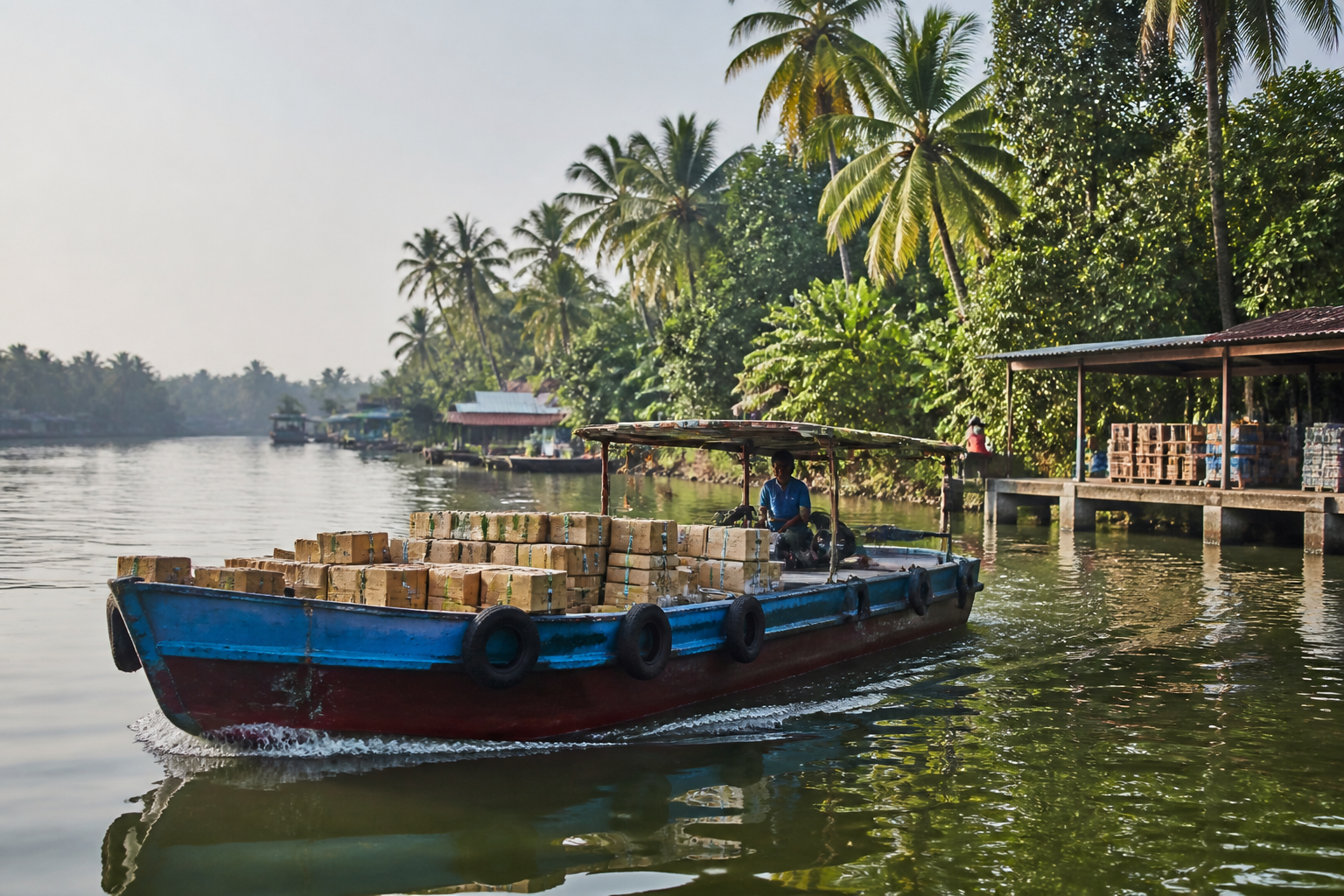
The evidence presented does not suggest that waterways can deliver parcels directly to most customers. Instead, it points to a multimodal model in which boats move goods through areas where water is a practical corridor, after which local delivery networks complete the journey. The effectiveness of that model would depend on the connections between waterways and the rest of the logistics chain: roads, jetties, aggregation points, storage facilities, fulfilment hubs and delivery personnel.
The government’s stated objective of increasing the share of freight carried on waterways from about 2 per cent to 5 per cent by 2030 provides a policy frame for this transition. The report identifies PM Gati Shakti and the Jalvahak scheme as initiatives that could support the effort. The supplied material, however, does not establish how much of the target would come from consumer shipments, nor does it provide a separate performance assessment of these schemes for last-mile commerce.
That distinction matters because bulk freight and parcel delivery have different operating requirements. Bulk cargo can be consolidated into large movements between fixed points. Digital commerce requires more frequent handling, smaller shipments, tracking, sorting and coordination with doorstep delivery. A waterway may reduce the cost or congestion associated with one section of the journey while creating new requirements at the transfer point.
The report’s example from Kerala illustrates how local operating knowledge can become part of a formal logistics network. The Vallam Express initiative in the Alappuzha region serves 14 villages and nearly two lakh residents by combining organised logistics with local boat operators. Those operators understand routes that are inaccessible or impractical by road. The example suggests that local capacity is not necessarily an informal substitute for modern logistics; it can be integrated into a more structured delivery system.
This is also the central challenge to a one-size-fits-all approach. DTDC Express chief executive Abhishek Chakraborty told NDTV that India’s varied geographies, infrastructure and communities require logistics networks to adapt without compromising reliability. His comments frame scale not as the uniform replication of one infrastructure model, but as the coordination of multiple modes and local ecosystems.
The same point appears in the discussion of urban congestion. Antim Suman, co-founder and chief operating officer of Edgistify, told NDTV that the largest delays for last-mile riders often occur in city traffic rather than on highways. He argued that inland water transport could be used upstream, with urban water terminals also functioning as fulfilment hubs. In that model, inventory would be positioned closer to local demand before a rider begins the final delivery.
The report attributes a potential cost advantage to inland water transport, describing it as up to 60 per cent cheaper than road transport. It also argues that each barge could reduce the number of heavy trucks using congested streets. The supplied material does not provide the conditions, routes or cargo categories behind that comparison, so the figure cannot be treated as a universal saving for parcel delivery. It does, however, identify the specific operational question that logistics planners must answer: whether water transport can reduce the most expensive or congested part of a journey after the full transfer process is included.
That question places infrastructure planning at the centre of the discussion. A waterway alone is not a logistics network. It becomes part of one only when vessels can connect predictably with storage, sorting and road-based delivery. The location and function of terminals may therefore matter as much as the navigability of the water route. A terminal used only for bulk cargo may not meet the needs of e-commerce, which requires faster and more granular handling.
The policy landscape is consequently broader than a single transport programme. PM Gati Shakti is identified in the report as a possible mechanism for coordinating infrastructure, while Jalvahak is associated with the effort to increase freight movement on waterways. PMGSY-I represents a different but related layer: road connectivity expands the network that waterborne shipments must eventually join. Together, these references point to an institutional challenge involving transport planning, logistics operators, local authorities and communities.
The available evidence also shows why infrastructure coverage should not be confused with service performance. India has more than 20,000 kilometres of National Waterways, but only 32 waterways covering more than 5,100 kilometres were described as functional by March 2026. Similarly, high rural internet use creates the possibility of online demand, but it does not prove that delivery times, costs or reliability are comparable across geographies.
The numbers reveal a system in transition. The logistics industry is expanding, rural internet users are increasing, and freight movement on inland waterways has crossed 198 million tonnes. At the same time, the share of freight carried by waterways remains about 2 per cent, against a stated goal of 5 per cent by 2030. The gap between current share and target indicates ambition, but the supplied material does not establish the annual rate of growth required or the investments needed to reach it.
The contrast between national scale and local implementation is particularly significant. A network of 111 National Waterways cannot be assessed only through aggregate length. Consumer access depends on which waterways are functional, where terminals are located, how frequently services operate and whether local boats and road networks can complete the final connection. The Alappuzha example shows the relevance of local adaptation, but one initiative cannot establish that the model is transferable to every riverine or island geography.
The larger urban question is whether logistics infrastructure should be designed around a single dominant mode or around the actual movement patterns of each place. Roads will remain essential for doorstep delivery, but waterways may reduce the distance, congestion or cost that road vehicles must cover in selected corridors. In cities and settlements shaped by canals, rivers, backwaters or islands, the most efficient logistics system may be one that recognises water as an existing urban and regional route rather than treating it as an obstacle.
For policymakers and logistics companies, the evidence points to integration rather than substitution. Waterways will not eliminate the final road journey. Their value will depend on how effectively they connect with jetties, fulfilment facilities, local boat operators, riders and digital tracking systems. The next developments to monitor are the operational performance of such multimodal networks, the expansion of functional waterways, the role of terminals in consumer logistics and whether the 2030 freight-share goal produces measurable improvements in access.
What the current evidence confirms is narrower but important: India’s logistics challenge is no longer only about building more roads or extending digital demand. It is also about matching delivery systems to geography. Inland waterways may become part of that solution where the physical network, institutional coordination and local operating knowledge can work together.
