


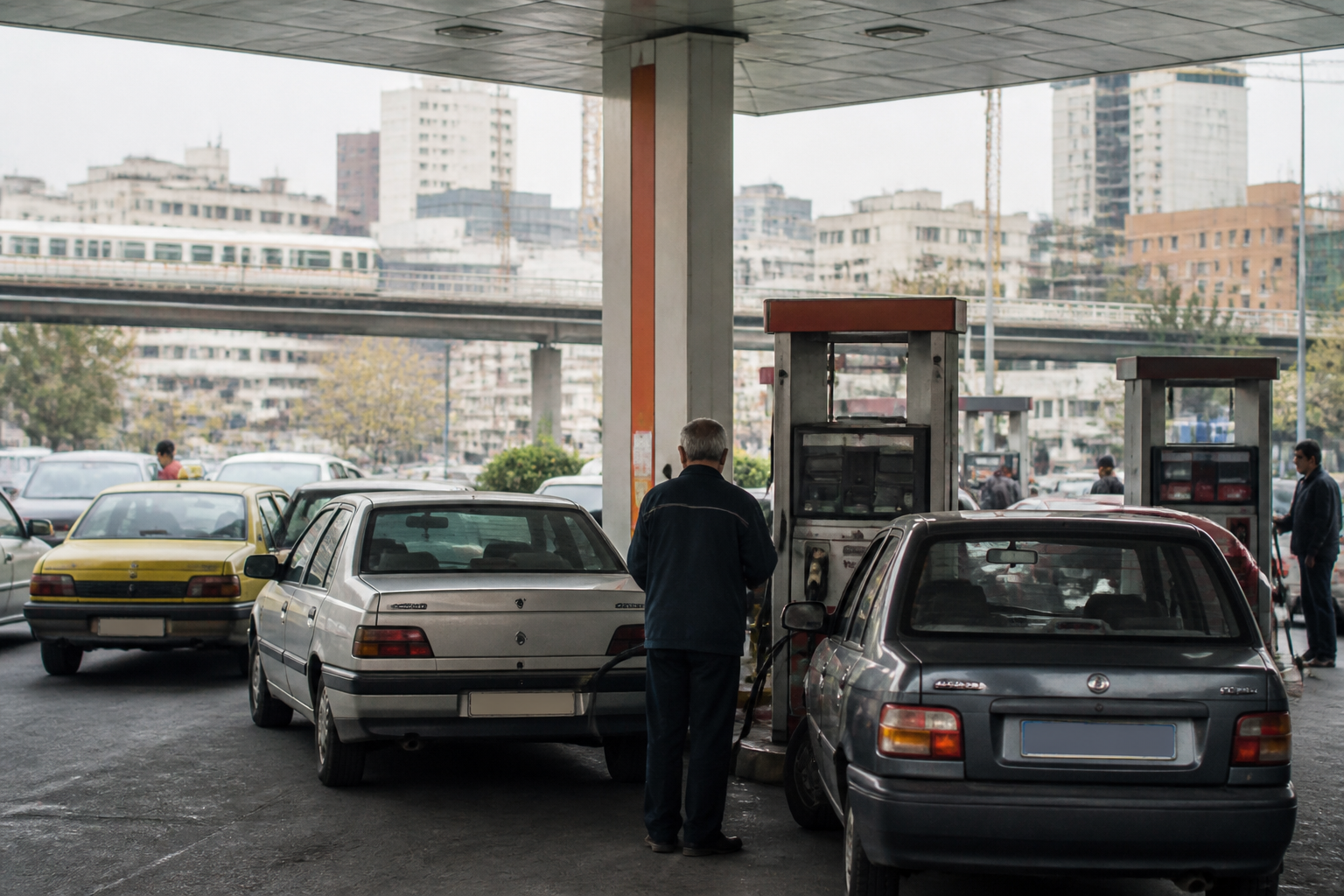
Iran has doubled the price of petrol for consumers who exceed a monthly quota, but the change is about more than the cost of fuel. It exposes the pressure created when a large urban population depends on ageing private vehicles, limited public transportation and a fuel system unable to match demand.
The revised rate took effect on Tuesday for purchases above 110 litres a month. Consumers crossing that threshold will pay 100,000 rials per litre, compared with the rate introduced in December. The government said the additional revenue would be distributed to households, while the state oil distribution company said the new rate would affect about 15 per cent of consumers.
The immediate policy objective is to reduce petrol consumption. Iran consumed 145 million litres of petrol a day in August, according to Keramat Veis Karami, chief executive of the state oil distribution company, while domestic production capacity stood at 122 million litres a day. The difference has to be imported. The pricing decision therefore sits at the intersection of energy security, household affordability and the performance of the transport system.
The urban question is straightforward but difficult: what happens when authorities try to control fuel demand in cities where private vehicles remain essential because public transport is insufficient and the vehicle fleet is ageing?
Fuel pricing as a substitute for transport reform
The new measure targets heavy users rather than applying a uniform increase to every litre of petrol. That design limits the immediate impact on consumers who remain within the quota, while placing a higher burden on households and users whose monthly consumption exceeds it. The policy also attempts to connect revenue collection with household support, although the supplied report does not establish how the distribution mechanism will work or how much money it will generate.
This is the second petrol price increase since December. The timing is significant because the currency has weakened sharply and purchasing power has declined. The US dollar was trading at 2.22 million rials on Monday, according to the report. Iran continues to have some of the world’s lowest petrol prices, but a low nominal price does not necessarily mean that fuel is affordable when incomes and the value of the currency are under pressure.
The result is a policy conflict. Cheap fuel can support mobility and reduce the direct cost of commuting, goods movement and household travel. At the same time, it can encourage high consumption, widen the gap between demand and domestic supply, and increase the fiscal or import burden on the state. Raising the price may reduce consumption, but it can also increase the cost of reaching work, education, markets and essential services.
Iran’s consumption gap is also a transport-planning problem
The gap between daily petrol consumption and domestic production capacity cannot be explained by prices alone. The report attributes high fuel use partly to ageing cars and difficulty obtaining spare parts. It also points to insufficient public transportation. Together, these factors indicate a mobility system in which households may have few practical alternatives to private vehicles.
An ageing vehicle fleet can consume more fuel and require more frequent repairs. When spare parts are difficult to obtain, households may keep older vehicles in service for longer rather than replace them. That can create a cycle of rising operating costs, lower reliability and continued dependence on petrol. A price increase addresses the cost of consumption, but not the underlying condition of the vehicles or the availability of alternatives.
Public transportation is the other side of that equation. The report does not provide figures on network coverage, ridership, fleet size or service frequency, so it is not possible to measure the exact capacity shortfall. It does, however, identify insufficient public transportation as one factor linked by experts to fuel consumption. That connection matters because fuel pricing works differently in a city with reliable transit than in one where residents must drive because alternatives are unavailable or impractical.
Where public transport is frequent, affordable and geographically accessible, higher fuel prices can encourage a shift in travel behaviour. Where it is inadequate, the same policy can function primarily as a household cost increase. The distinction is central to understanding the urban consequences of the Iranian measure.
Inflation turns a fuel policy into a cost-of-living policy
The government’s decision comes as Iran’s annual inflation rate is about 67 per cent, according to the country’s statistics centre, as cited in the report. Under those conditions, petrol is not an isolated commodity. Transport costs can feed into household budgets and the prices of goods and services moved through cities.
The direct effect will be concentrated among the 15 per cent of consumers identified as exceeding the quota. The wider effect is harder to determine from the available information. If commercial and household travel costs rise, the consequences may extend beyond drivers who purchase more than 110 litres a month. The report does not specify whether the quota applies uniformly across vehicle types, household circumstances or commercial users, leaving important distributional questions unanswered.
The proposed transfer of additional revenue to households is intended to address that pressure. Yet compensation policies depend on implementation: who qualifies, how payments are calculated, when they arrive and whether they keep pace with price increases. None of those details is established in the supplied material. The policy’s social effect will therefore depend not only on the petrol price but also on the design and delivery of the support mechanism.
Iran’s history makes the politics of fuel especially sensitive
The political sensitivity of petrol pricing is longstanding. A price increase in 1964 triggered mass demonstrations and led the shah to deploy military vehicles to replace those of striking taxi drivers. In 2019, another increase triggered nationwide protests followed by a crackdown that reportedly killed more than 300 people.
Those episodes show that petrol pricing has historically been connected to employment, public transport, household purchasing power and trust in government decisions. Petrol is treated by many Iranians as a basic entitlement, according to the report. That perception makes a fuel increase more than a technical adjustment to a subsidy or quota regime.
The latest policy is also being introduced during a period of economic strain and currency weakness. The government has framed the additional revenue as support for households, but the report does not include public reactions to the announcement or details of enforcement. It is therefore too early to determine whether the targeted structure will limit opposition or whether consumers will experience it as another broad cost increase.
The policy landscape remains incomplete
The available information shows a government trying to manage three linked pressures: petrol consumption above domestic production capacity, declining purchasing power and demand for household support. The state oil distribution company has supplied the key consumption and coverage figures, while the government has announced the revenue-distribution principle.
What is missing is an account of how the measure fits into a broader transport policy. The report does not identify a parallel expansion of public transportation, a vehicle replacement programme, a spare-parts intervention or a timetable for reducing dependence on imported petrol. Without such measures, the price change is primarily a demand-management tool.
That does not make it irrelevant to urban planning. It makes the relationship between pricing and infrastructure more important. A city’s ability to absorb a fuel-price change depends on the choices available to residents. If those choices are limited, the burden falls disproportionately on people who cannot easily alter their travel patterns.
The evidence confirms a structural imbalance but not its full urban scale
The clearest number in the report is the gap between 145 million litres of daily consumption and 122 million litres of domestic production capacity. That 23-million-litre difference indicates that current demand exceeds domestic capacity by a substantial margin. The report also establishes that the new higher rate applies above 110 litres a month and is expected to affect 15 per cent of consumers.
These figures identify the scale of the fuel-management problem, but they do not show how consumption is distributed between private households, taxis, commercial vehicles and other users. Nor do they reveal whether the highest users are concentrated in particular cities or income groups. Without that information, the precise urban and social incidence of the policy remains uncertain.
The evidence does support a broader conclusion: petrol demand is being shaped by infrastructure conditions as much as by price. Ageing vehicles, limited spare parts and insufficient public transportation can lock households into high fuel use. A price increase may reduce some consumption, but it cannot by itself renew the vehicle fleet or create a viable alternative to driving.
Iran’s latest petrol measure is therefore best understood as a test of how far pricing can compensate for weaknesses in the urban mobility system. The government has identified heavy fuel use, set a higher threshold price and promised to redirect the additional revenue to households. What remains to be established is whether the measure will be accompanied by credible improvements in public transportation and vehicle reliability, and whether household support will offset the inflationary pressure created by the change.
The developments to monitor are the implementation of the household transfers, the effect on daily petrol consumption, the response of public transportation systems and any further changes to fuel prices or quotas. Those indicators will show whether the policy is reducing an energy imbalance or merely shifting the cost of an unresolved transport problem onto urban residents.
