


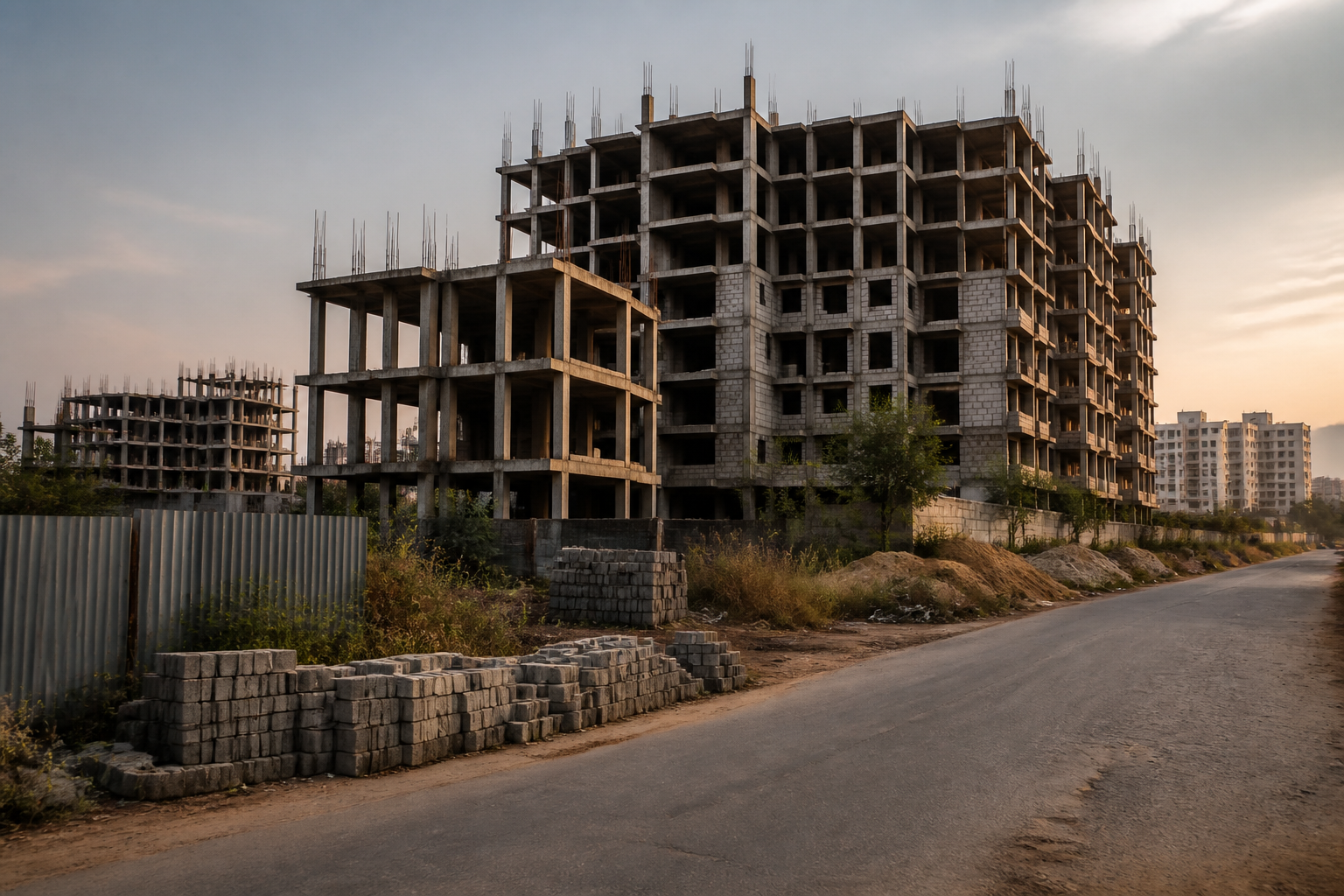
A Telangana RERA order directing a promoter to refund Rs 14.17 lakh paid by a homebuyer, along with interest, is more than a dispute over a delayed apartment. It illustrates how a stalled project can leave an allottee exposed even after contractual deadlines have passed, and how the regulatory framework distinguishes between delayed delivery and an apparently abandoned development.
The case concerns Lily Sahu, who signed an agreement of sale on June 21, 2022, for a 3BHK apartment in a project at Velimela village in Sangareddy district. According to the case details reported by Economic Times, she paid Rs 14.17 lakh against a total apartment price of Rs 56.7 lakh. The 1,575-square-foot west-facing unit was to include amenities, car parking and a proportionate undivided share of land.
The agreement required possession within 36 months of the promoter obtaining building permission from the Hyderabad Metropolitan Development Authority. That period expired without delivery. The project had also not progressed because, according to the report, the promoter had not obtained the necessary statutory approvals or begun legally compliant construction. The builder stopped responding, and the site remained without meaningful progress.
The case therefore raised a question that is central to housing regulation: should a buyer remain tied to a project whose completion has become uncertain, or should the buyer be allowed to exit and recover the money paid? Telangana RERA concluded that a refund was appropriate because the project had been abandoned and the promoter had failed to demonstrate a credible plan to restart it.
The authority’s reasoning is significant because it treated the circumstances as more serious than an ordinary construction delay. The report states that the promoter had previously been declared a defaulter under RERA and that the project registration had been revoked. The promoter had also been prohibited from undertaking, advertising, marketing, booking, selling or registering a new project, or acting as a real estate agent, until outstanding dues, refunds, interest, penalties and regulatory compliances were addressed.
Several other homebuyers had reportedly filed complaints against the same promoter. Telangana RERA had earlier taken cognisance of similar violations, including the alleged sale and marketing of units without mandatory registration under the Real Estate (Regulation and Development) Act, 2016. In one earlier complaint cited by the authority, the promoter was declared a defaulter.
This regulatory history shaped the outcome in Sahu’s case. The authority found that the promoter had failed to honour both statutory duties under RERA and contractual obligations under the agreement of sale. The order, as reported, described the continued inaction after collecting substantial sums from the complainant as a deliberate and dishonest course of conduct. The authority also concluded that the project had been stalled for several years and that the promoter had not established any genuine intent or credible plan to resume construction.
The distinction between a delayed project and an abandoned project matters for the remedy available to a buyer. Under Section 18(1)(a) of RERA, an allottee who does not wish to remain in a project because of delay may be entitled to withdraw and receive a refund with interest and compensation, where applicable. In this case, the reported findings on the promoter’s default, the project’s revoked registration and the absence of construction supported the decision to grant an exit rather than require the homebuyer to continue waiting.
The refund was not limited to the principal amount. Telangana RERA directed payment of the Rs 14.17 lakh deposited by Sahu with interest prescribed under Rule 15 of the Telangana RERA Rules, 2017. The rule, as described in the report, links the interest rate to the State Bank of India’s Marginal Cost of Lending Rate, with an additional two percentage points. Interest is calculated from the respective dates of payment until full and final realisation of the refund.
An estimate cited in the report placed the interest payable up to August 24, 2026, at approximately Rs 6.4 lakh. That figure is an estimate rather than a fixed final amount because the applicable rate and the duration of default determine the eventual calculation. The amount would continue to depend on when the refund is actually realised.
The case also demonstrates the difference between winning an order and recovering money. A regulatory direction creates a legal entitlement, but payment may still require enforcement if the promoter does not comply. According to Aradhana Bhansali, a senior partner at Rajani Associates quoted by Economic Times, failure to comply with a refund order can attract a continuing penalty for every day that the default persists. The penalty may cumulatively extend up to five per cent of the estimated cost of the real estate project, as determined by the authority.
RERA also provides a route for execution and recovery. The allottee may seek disclosure of the promoter’s assets and, where necessary, attachment and sale of assets to recover the amount due. Sections 40(1) and 40(2) of the Act allow amounts payable towards interest, penalty or compensation to be recovered as arrears of land revenue. The recovery framework therefore moves the dispute beyond a contractual claim and gives the homebuyer access to statutory enforcement mechanisms.
That enforcement architecture is important in stalled housing projects because the buyer’s financial exposure often begins long before possession is due. In Sahu’s case, more than a quarter of the stated apartment price had been paid, while the project reportedly had not moved into lawful construction. The homebuyer was therefore carrying a substantial financial commitment without receiving either a completed asset or evidence of a realistic delivery timetable.
The case also shows why project registration and continuing disclosure matter. RERA’s framework is intended to make project status, approvals and promoter obligations more visible to buyers. Where a promoter continues to market units without the required registration, or fails to meet regulatory obligations, the buyer’s risk increases. In this matter, the authority’s earlier actions against the promoter became part of the context for determining whether the project had any credible prospect of completion.
At the same time, the reported order does not establish that every delay automatically entitles a buyer to the same result. The remedy depended on the facts presented: the contractual possession period had expired, the project had reportedly seen no legal construction, the promoter had been declared a defaulter, the registration had been revoked, and the promoter did not appear to contest the allegations when notice was issued. Those findings distinguish the case from a project facing a documented but temporary delay with active construction and a credible completion plan.
The broader urban issue is the weakness that appears when housing delivery is treated primarily as a private transaction rather than as a regulated public-facing system. A homebuyer pays into a project whose progress depends on approvals, land title, finance, construction capacity and regulatory compliance. When one or more of those elements fail, the buyer may be left with a contract but without a usable home. RERA’s role is therefore not only to impose penalties after failure, but also to create a process for documenting default and recovering funds.
For homebuyers, the order reinforces the importance of preserving the agreement of sale, payment records, project-registration information, notices and evidence of construction status. The case also indicates that prior regulatory action against a promoter can be relevant when assessing whether a project remains viable. However, the final recovery of money may still require execution proceedings if the promoter does not voluntarily comply.
The evidence in the reported case confirms that Telangana RERA considered the project abandoned and ordered a refund with interest. It also confirms that the promoter faced earlier regulatory findings and that the statutory framework provides continuing penalties and recovery options. What remains uncertain from the available material is whether the promoter will pay within the stipulated period and whether Sahu will need to pursue attachment or other execution measures. Those next steps will determine how effectively the order translates from a regulatory decision into an actual recovery for the homebuyer.
