


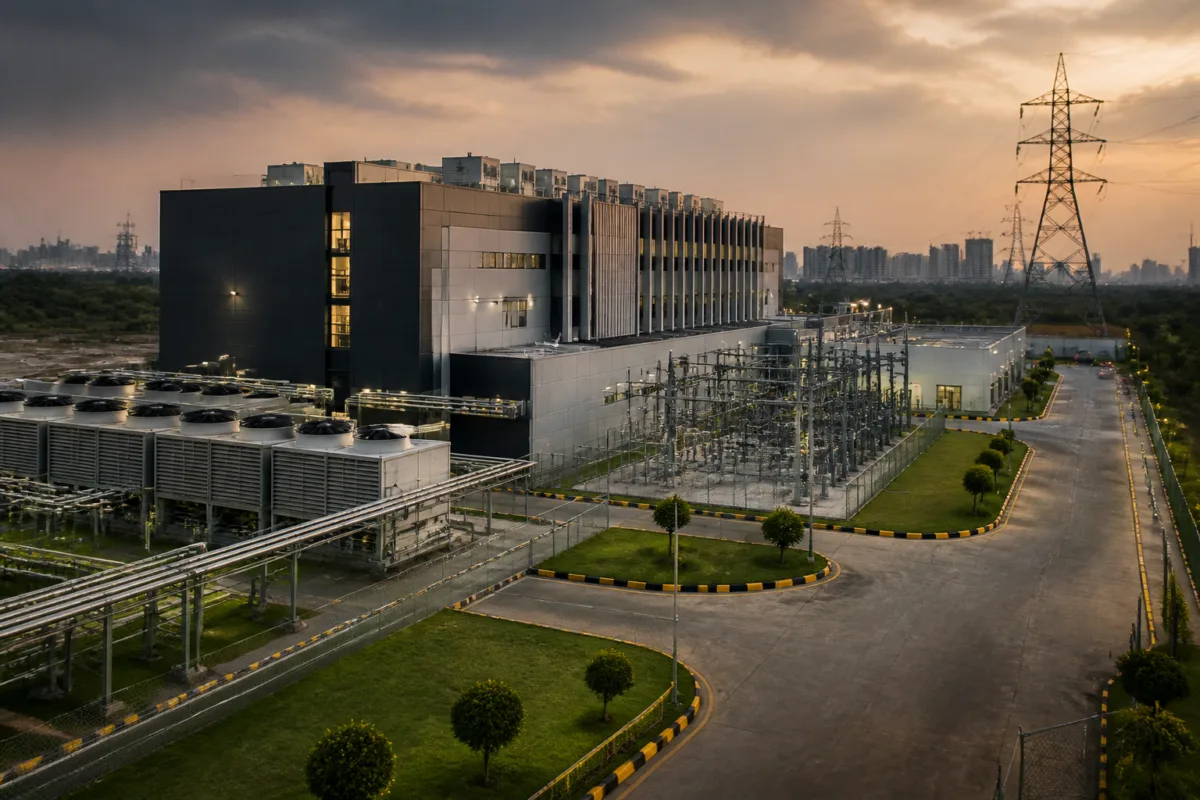
India’s data centres are beginning to serve a market larger than India’s own digital users. Global artificial intelligence companies are using infrastructure located and operated in the country to serve customers overseas, according to data-centre operators quoted by The Times of India. The shift is being driven partly by delays in securing power and capacity in other markets, turning India into a location for globally distributed computing rather than merely a domestic hosting destination.
That change matters because an AI workload is not just another tenant inside a conventional data centre. It requires concentrated computing capacity, substantial electricity, advanced cooling and the ability to expand quickly. The operators cited in the report describe a market in which customer requirements can move from tens of megawatts to more than 100 megawatts. In urban and regional infrastructure terms, this places data centres closer to power-intensive industrial facilities than to ordinary commercial buildings, even when their physical form resembles a large warehouse or technology campus.
Sunil Gupta, co-founder, chief executive officer and managing director of Yotta Data Services, said the company was already hosting some international customers and had contracted large capacities with others. He said international AI customers were using infrastructure hosted and operated from India to serve workloads beyond the country. The statement indicates that the location of the physical computing facility and the location of the end user no longer need to be the same.
For India’s cities, this changes the question data centres pose. The issue is no longer only whether a city can attract a facility, but whether its electricity network, land systems, transmission connections, water and cooling arrangements can support an asset whose demand may come from customers on another continent. The report does not identify the cities hosting these workloads, the contracted capacity of individual facilities, or the exact power sources being used. It does, however, show that operators are planning around infrastructure scale rather than only around local demand.
The most consequential constraint described in the report is power. Global AI companies are turning to Indian facilities as delays in securing power and capacity elsewhere push them to distribute computing infrastructure across countries. This makes electricity availability a competitive factor in the global AI industry. For data-centre operators, a site is valuable only when land, grid access, transmission, cooling and expansion can be aligned within the time required by customers.
Sridhar Pinnapreddy, founder and chief executive officer of CtrlS Datacenters, said discussions with customers can begin with a requirement for 20 megawatts and quickly turn into plans for 100 megawatts or more. The figures illustrate the uncertainty built into AI infrastructure demand. A facility planned around an initial requirement may need to accommodate a much larger load before its wider infrastructure is fully built out.
That has consequences for how capacity is planned. A 20-megawatt requirement cannot be treated simply as a fixed building specification if the commercial conversation may expand fivefold or further. Transmission access, substations, equipment yards, cooling systems and space for future construction become part of the original site decision. Pinnapreddy said AI was compressing the time available to respond while increasing the scale that operators needed to build for. He also said higher power densities and advanced cooling had to be planned alongside land, transmission and future expansion.
The combination is important. Land without reliable transmission cannot support a high-density computing facility. Power without suitable cooling cannot be converted into usable computing capacity. A building with sufficient floor area may still be constrained by the amount of electrical load it can receive or the heat its systems can remove. The operators’ comments therefore describe data-centre capacity as a coordinated infrastructure problem, not a standalone real-estate transaction.
The international nature of the demand also complicates the usual policy narrative around digital infrastructure. A data centre located in India may support overseas customers, while its physical requirements—electricity, transmission capacity, cooling infrastructure, construction materials and land—are borne locally. The economic activity generated by the facility and the infrastructure burden created by it may therefore be distributed differently across geographies.
The supplied report does not provide figures for employment, water consumption, investment, electricity tariffs, emissions, tax revenue or the share of India’s data-centre capacity committed to overseas workloads. Those gaps matter because the benefits and costs of expansion cannot be assessed from capacity demand alone. The report establishes that international AI customers are using Indian infrastructure and that operators are seeing requirements at a scale of 20 megawatts to more than 100 megawatts. It does not establish the wider economic or environmental outcome of that trend.
What it does establish is a change in the planning horizon. Traditional data-centre expansion could be understood through known requirements from domestic enterprises, cloud services or digital consumers. AI demand introduces a faster-moving capacity cycle, according to the operators. Their comments suggest that customers want computing infrastructure to be available quickly, while the physical systems needed to support it—land, transmission, power equipment and cooling—take time to plan and build.
This creates a potential mismatch between digital demand and urban infrastructure delivery. Computing customers may be able to scale their requirements rapidly, but electricity networks and construction projects cannot necessarily respond at the same speed. The result is that data-centre operators must secure optionality in advance: enough land for expansion, adequate transmission arrangements and cooling systems capable of supporting higher power densities. The article does not state how these requirements are being handled at specific sites, but it makes clear that operators regard them as linked planning decisions.
The institutional responsibilities are similarly distributed. Data-centre companies control the facilities and customer contracts. Power utilities and transmission agencies determine how electricity connections and network capacity are provided. Local authorities influence land use, construction permissions and civic services. The report does not name the specific agencies involved in the facilities discussed, so their individual responsibilities cannot be assessed here. The broader structure is nevertheless clear: the growth of AI infrastructure depends on coordination between private operators and public infrastructure systems.
That coordination becomes more important when the customer base is international. Local authorities may see a data centre as a major project seeking land and utility connections, while the operator sees it as part of a global network that must respond to demand elsewhere. The facility’s business case may therefore be shaped by conditions outside the host city, including power delays in other countries. This is one reason capacity planning cannot be based only on current local usage.
The report also points to a shift in the physical design of data centres. Higher power densities mean more computing equipment in a given facility or portion of a facility, while advanced cooling becomes necessary to manage the resulting heat. The combination can affect building design, mechanical systems, electrical equipment and the amount of supporting infrastructure required on the site. Without facility-level data, it is not possible to determine the exact technologies being deployed or their resource requirements in the facilities mentioned.
For urban planners, the central issue is whether data-centre growth is being treated as an isolated technology investment or as a new category of infrastructure demand. The operators’ comments support the second interpretation. A facility that may expand from 20 megawatts to 100 megawatts or more has implications for transmission planning, land reservation, construction sequencing and the resilience of the surrounding network. Its operational continuity may also depend on systems beyond the property boundary.
For citizens, the immediate impact may be less visible than that of a road, railway or housing project. Data centres do not necessarily generate large daily commuter flows, but they can shape where power infrastructure is strengthened, how land is allocated and which regions become preferred locations for high-capacity industrial development. The supplied material does not quantify local impacts or describe community responses, so those questions remain open rather than established.
The evidence currently supports a measured conclusion. India is being used by international AI companies as a base for serving workloads beyond the country, and operators report rapidly expanding requirements for power and computing capacity. The competitive advantage is not simply the presence of data-centre buildings. It is the ability to assemble land, transmission, electricity, high-density computing and cooling quickly enough to meet demand.
The developments that warrant monitoring are therefore practical: how much capacity is being contracted for overseas workloads, where that capacity is being built, how power connections are being arranged, what cooling systems are being used, and how much expansion is being planned from the outset. Until those details are available, the report shows the direction of the market but not its full urban, economic or environmental balance. What is clear is that India’s data-centre opportunity will be decided as much by infrastructure coordination as by demand for artificial intelligence.

