


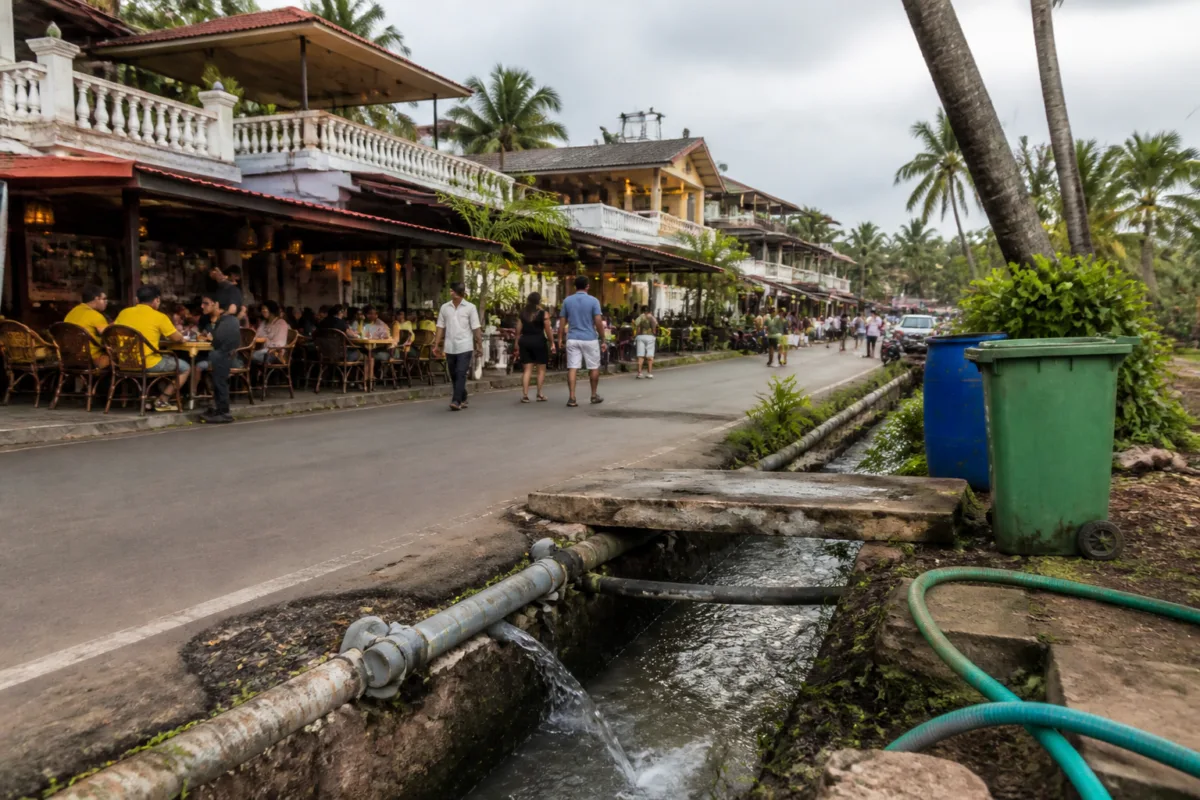
Goa’s restaurant rules have exposed a wider problem in environmental governance: a classification designed around the size of an individual establishment may not account for the cumulative pressure created by hundreds of hotels, guesthouses and eateries operating in the same tourism-intensive localities. The Goa State Pollution Control Board has objected to revised Central Pollution Control Board norms that place restaurants with up to 100 seats, along with smaller hotels and guesthouses, in the white category of industries.
The dispute is not only about regulatory terminology. It concerns how the state will monitor sewage, effluent treatment systems, solid waste, noise and pollution-control infrastructure in areas where hospitality activity is concentrated. It also raises a second institutional question: whether pollution-control boards can maintain their inspection and monitoring functions if the revised classification sharply reduces the consent fees they collect.
The GSPCB has said that adopting the revised norms would move about 80% of Goa’s hotels and restaurants into the white category. The board has written to the CPCB seeking a relaxation but has not received a response, according to the report. Until then, it has decided to continue applying its existing classification system.
That interim position leaves Goa operating with a regulatory framework that differs from the revised national classification. Under the existing state arrangement, hotels with up to 20 rooms and restaurants with seating capacity up to 36 are placed in the white category. Other establishments continue to pay at least the minimum applicable fee. The GSPCB has proposed that restaurants with more than 20 and up to 100 seats should remain in the green category, and has also recommended retaining guesthouses and banquet or marriage halls in the green category.
The conflict shows why the white, green and other industrial categories cannot be treated as simple labels. They determine the level of regulatory attention, the consent requirements applicable to an establishment and the fees paid to the pollution-control board. When a business moves from green to white, the change may reduce administrative and financial obligations even if the underlying waste and wastewater flows remain present.
### The problem with capacity-based classification
The CPCB’s revised norms use thresholds such as room count, seating capacity and built-up area. Hotels and guesthouses with up to 20 rooms, restaurants and dhabas with seating capacities below 100, and standalone banquet and marriage halls up to 1,000 square metres have been reclassified from green to white, according to the report.
The GSPCB’s objection is that these thresholds do not necessarily describe the environmental load of an establishment in Goa. A restaurant with 99 seats, the board has argued, cannot reasonably be treated as a small establishment, particularly in densely populated and coastal areas where tourism activity is concentrated. The difference between a 36-seat restaurant and a 99-seat restaurant is substantial in terms of customers served, water consumed, wastewater generated and solid waste handled, even though both may be grouped within a broad regulatory category under the revised norms.
The board has also challenged the assumption that the impact of each establishment can be assessed in isolation. Multiple restaurants, hotels and guesthouses may operate within the same locality, drawing on shared roads, drainage systems, sewage infrastructure and waste-collection arrangements. Each establishment may fall below an individual threshold, while the combined pressure on the locality may be significant.
This is the central urban-planning issue in the dispute. Environmental stress is often experienced at the level of a neighbourhood, watershed or coastal settlement, but regulation is frequently applied to individual premises. A capacity-based classification can therefore miss the cumulative effect of commercial activity when several establishments cluster in the same place.
### Monitoring is an infrastructure function
The GSPCB has specifically cited the need to monitor sewage, effluent treatment systems and pollution-control facilities. Those responsibilities are closely linked to the functioning of urban infrastructure. A restaurant or hotel does not generate only an abstract category of pollution; it produces wastewater, food waste, packaging waste, noise and demand for water and transport services.
The report also states that the board referred to the environment ministry’s November 4, 2009 notification on discharge standards. That reference indicates that the classification dispute is connected to the practical enforcement of discharge requirements, rather than being limited to a fee schedule. If establishments are reclassified but inspection requirements remain unchanged, the board’s workload may continue even as its fee income declines.
The GSPCB has said that establishments moved from green to white should continue paying fees applicable to the green category. Its stated reason is that inspection and monitoring requirements would remain unchanged and that the arrangement would help protect the financial sustainability of state pollution-control boards.
This creates a structural tension in environmental regulation. Pollution-control boards are expected to inspect facilities, assess compliance and respond to pollution risks, but their revenue model can be affected by the categories assigned to the establishments they regulate. If a large number of businesses shift to a lower-fee category without a corresponding reduction in regulatory work, the institution may face a mismatch between its responsibilities and its available income.
The supplied report does not establish the exact amount of revenue at risk or the number of establishments that would be affected individually. It does, however, record the GSPCB’s assessment that around 80% of Goa’s hotels and restaurants could move into the white category. That estimate makes the financial and administrative implications state-wide rather than marginal.
### Goa’s tourism geography complicates the thresholds
Goa’s environmental and urban conditions make the question of location especially important. The GSPCB has described the state as environmentally sensitive and has argued that the effects of hospitality activity cannot be assessed solely through the size or seating capacity of individual establishments.
The board’s concern is particularly relevant to densely populated and tourism-intensive coastal areas. In such locations, a concentration of hotels, guesthouses, restaurants and banquet facilities can increase pressure on sewage systems, waste management, roads and other local infrastructure. The report does not provide locality-level pollution or infrastructure data, so it cannot establish the performance of specific systems. It does show, however, that the state regulator sees cumulative impact as a factor that the revised classification does not adequately capture.
This distinction matters for urban governance. A restaurant’s legal category may be determined at the premises level, but its consequences are distributed across the surrounding settlement. Wastewater may enter a shared drainage network; solid waste may depend on a municipal collection system; noise may affect neighbouring homes and public spaces; and increased activity may intensify pressure on already constrained infrastructure.
The issue is therefore not simply whether a 99-seat restaurant is large or small. It is whether an establishment’s category should be determined only by its own capacity, or also by the environmental carrying capacity of the locality in which it operates. The GSPCB’s communication to the CPCB places that question at the centre of the regulatory review.
### The national rule and the state response
The CPCB’s revised norms appear to pursue a simplified classification for smaller hospitality establishments. The GSPCB’s response shows the difficulty of applying a uniform threshold to places with different environmental sensitivities, tourism patterns and infrastructure conditions.
The state board has not rejected the need for classification. Instead, it has sought a different threshold for Goa: restaurants above 20 seats and up to 100 seats should remain in the green category, while guesthouses and banquet or marriage halls should also continue under the green classification. It has simultaneously asked that establishments reclassified as white continue to pay green-category fees if the inspection and monitoring burden is unchanged.
These proposals separate two issues that are often treated as one: the level of regulatory scrutiny and the fee used to fund that scrutiny. The GSPCB’s position is that a change in classification should not automatically reduce the resources available for monitoring when the environmental risks and administrative duties remain.
The CPCB’s response will determine whether the national classification is relaxed for Goa or whether the state must eventually align its system with the revised norms. Until a response is received, the GSPCB’s decision to maintain existing classifications provides a temporary administrative arrangement, not a final resolution of the underlying dispute.
### The bigger urban question
The Goa case illustrates a broader problem in regulating urban growth: thresholds are administratively convenient, but environmental impacts are cumulative and place-specific. Room counts, seating capacity and floor area can provide clear rules, yet they may not reveal whether a locality has sufficient sewage treatment, waste collection, drainage or enforcement capacity.
The debate also demonstrates that pollution control is partly a question of institutional finance. If boards are expected to continue inspections and monitor pollution-control systems, a reclassification that reduces consent-fee revenue could affect how those responsibilities are sustained. The available report does not show whether alternative funding arrangements have been proposed beyond the GSPCB’s request to preserve green-category fees.
What the evidence confirms is that Goa’s regulator considers the revised norms inadequate for the state’s environmental sensitivity and tourism-driven concentration of hospitality activity. It also confirms that the GSPCB has asked the CPCB for relaxation and has retained its existing classification system for now. What remains unresolved is whether the CPCB will modify the norms, permit a state-specific approach or require Goa to implement the revised categories.
The next important development is the CPCB’s response. Its decision will determine whether environmental regulation in Goa continues to be based primarily on the capacity of individual establishments or begins to account more explicitly for the cumulative pressure that hospitality clusters place on urban infrastructure and sensitive coastal environments.

