


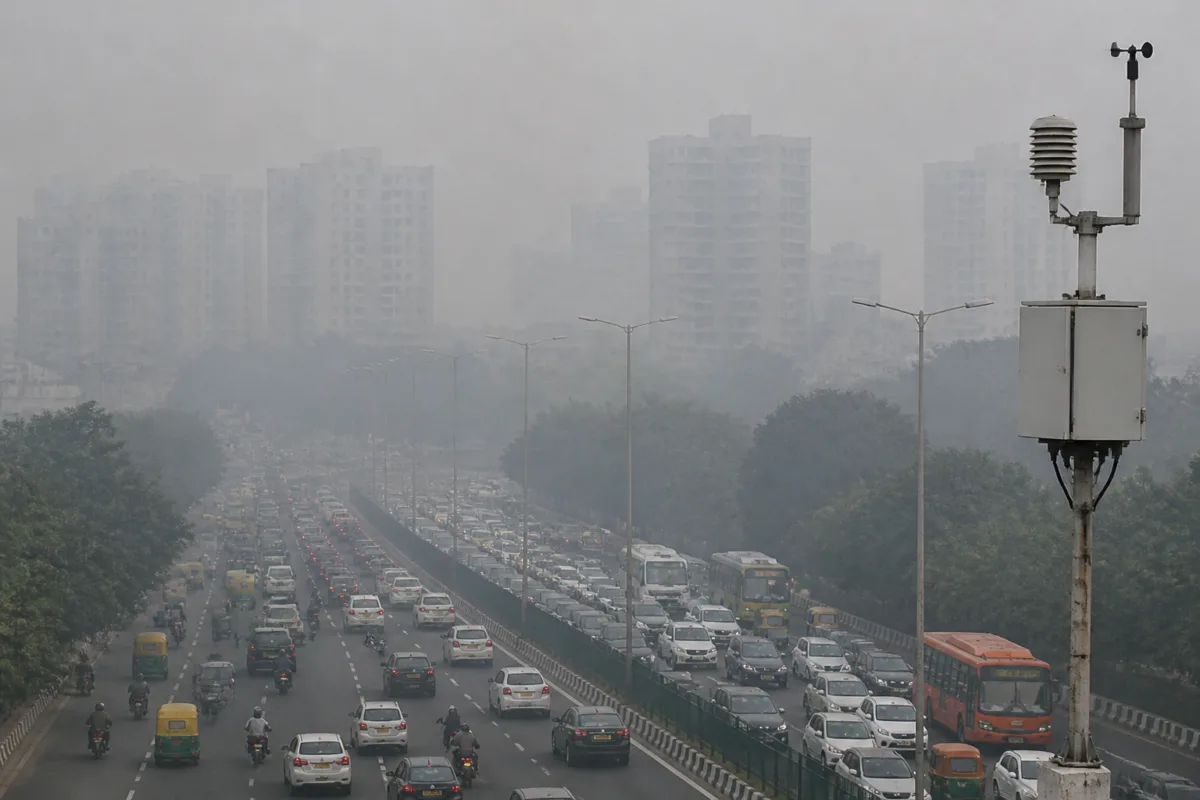
Delhi air quality entered the ‘very poor’ category on Sunday morning, with the city recording an Air Quality Index (AQI) of 350 and IIT Delhi reporting the highest station-level reading at 428, according to data from the Sameer app. The readings place air quality at several locations within the severe category under the Central Pollution Control Board’s classification system.
Of Delhi’s 54 monitoring stations, 47 recorded ‘very poor’ air quality, while seven stations reported readings in the ‘severe’ category. IIT Delhi recorded the highest AQI at 428, followed by ITO at 414. Both readings crossed the CPCB’s severe threshold of 401.
The distribution of readings shows that the deterioration was spread across the city’s monitoring network rather than confined to a single location. The citywide AQI of 350 falls within the very poor band, which covers readings from 301 to 400, while the station-level figures at IIT Delhi and ITO moved into the next, more serious category.
The CPCB classifies AQI readings from zero to 50 as ‘good’, 51 to 100 as ‘satisfactory’, 101 to 200 as ‘moderate’, 201 to 300 as ‘poor’, 301 to 400 as ‘very poor’ and 401 to 500 as ‘severe’. The scale is used to communicate the condition of ambient air through monitoring stations across the city.
Weather conditions were also recorded alongside the pollution readings. Delhi’s minimum temperature was 18.6 degrees Celsius, which was 5.1 degrees below the seasonal average, according to the India Meteorological Department. Relative humidity stood at 91 per cent at 8.30 am.
The IMD forecast a cloudy sky with light rain or drizzle during the day, with the maximum temperature expected to reach 27 degrees Celsius. These weather observations form part of the official conditions recorded as Delhi’s air quality remained in the very poor category.
The readings underline the uneven intensity of air pollution across Delhi’s monitoring network, with the worst reported conditions at IIT Delhi and ITO. The next updates from the city’s monitoring stations and weather authorities will indicate whether the recorded conditions change as the day progresses.

