


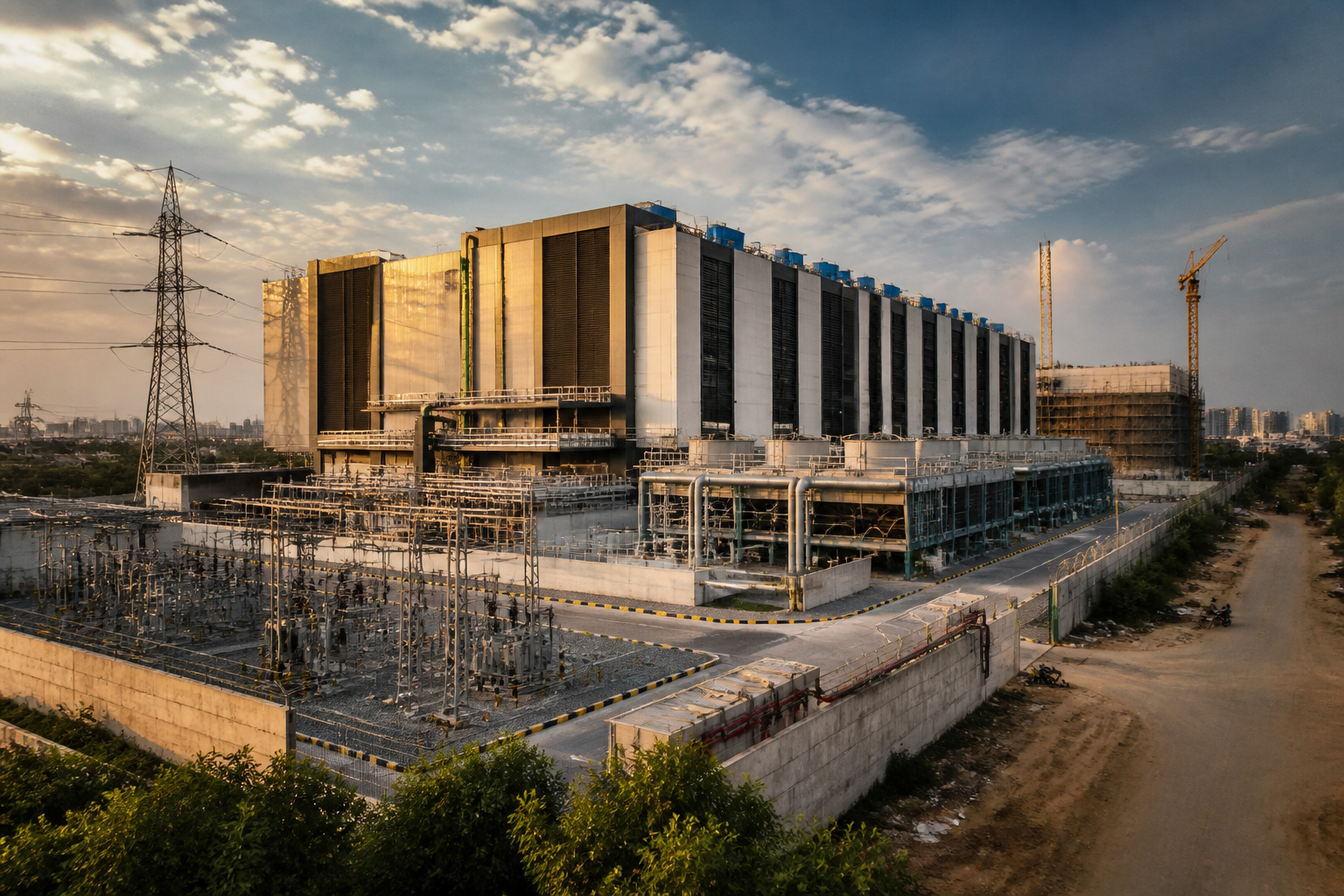
India’s data centre infrastructure opportunity is moving well beyond the construction of server buildings. A KPMG report cited by the Times of India estimates that the sector could create a $90 billion opportunity for construction and infrastructure companies by FY35, as capacity expands and artificial intelligence increases the demand for power, cooling, specialised equipment and reliable connectivity.
The opportunity is expected to rise from $30 billion by FY30 to $90 billion by FY35. India’s data centre capacity is projected to reach 7-7.5 GW by 2030. These figures describe more than a real estate or technology expansion: they point to a large, multi-layered infrastructure build-out involving civil works, electrical systems, cooling networks, fibre, security and external power supply.
That distinction matters because the economic value of a data centre is distributed across several systems. The facility itself is only one part of the requirement. It needs dependable electricity, equipment capable of handling high-density computing, cooling systems that can remove large amounts of heat, network infrastructure that can move data, and security systems that protect the operation. The KPMG assessment separates these components, offering a clearer view of where the infrastructure opportunity may emerge.
Design and construction could account for around $27 billion of the opportunity by FY35, according to the report. Cooling infrastructure could contribute another $24 billion, while power infrastructure within data centres could account for $18 billion. Power infrastructure outside the facilities is expected to add $12 billion. Network infrastructure and security are each estimated at about $5 billion.
The distribution shows why data centre growth cannot be assessed only by counting new facilities or measuring the value of buildings. A significant share of the opportunity lies in the systems that allow those facilities to operate continuously. Electrical equipment, cooling plants and external power connections may be less visible than a completed building, but they are central to the sector’s capacity to expand.
Artificial intelligence is intensifying that requirement. The KPMG report states that AI racks typically use 50-60 kilowatts of power per rack, compared with 8-12 kilowatts for non-AI workloads. This difference changes the internal design of data centres. Higher rack loads require stronger power infrastructure and increase the amount of heat that must be removed from the equipment.
The shift also puts pressure on conventional cooling approaches. The report says data centres are moving away from traditional air-based cooling towards water and liquid cooling, with liquid cooling becoming a fast-growing opportunity because of AI workloads. The change is not simply a matter of replacing one machine with another. It affects the design of the facility, the distribution of power and cooling, equipment procurement, maintenance requirements and the skills needed during commissioning.
This makes AI a built-environment issue as much as a computing issue. The physical infrastructure required for high-density workloads is different from that required for lower-density computing. A facility designed around 8-12-kilowatt non-AI racks may face different requirements when it begins accommodating racks drawing 50-60 kilowatts. The supplied evidence does not establish how individual operators will adapt, but it makes clear that the technical specification of new capacity is changing.
The opportunity is also unevenly distributed across the domestic supply chain. India already has a strong base in civil construction, cooling towers and fibre-optic cable manufacturing, according to the KPMG report. These existing capabilities could allow Indian companies to participate in parts of the expansion without developing entirely new industrial capacity.
At the same time, the report identifies areas where India depends more heavily on imports. These include advanced grid systems, battery energy storage systems, precision cooling and active network hardware. That creates a more complicated industrial picture. The total opportunity may be large, but the ability of domestic companies to capture it will vary by segment and by the level of technical specialisation required.
The distinction between established and import-dependent capabilities is important for infrastructure planning. Civil construction can support the physical expansion of facilities, but it cannot by itself resolve shortages or dependencies in precision cooling, grid equipment or network hardware. The projected growth therefore raises questions about procurement, manufacturing capability and the time required to bring specialised systems into operation.
Execution, rather than construction volume alone, is likely to shape how much of the forecast opportunity becomes operational capacity. KPMG said developers, engineering and construction companies, equipment manufacturers, utilities and regulators will need to work together, particularly to reduce construction timelines and delays in obtaining power. The report described execution capability in electrical, mechanical and commissioning segments as the primary differentiator as capacity expands.
This places utilities and regulators inside the data centre growth story. Power infrastructure outside the facility is estimated to represent $12 billion by FY35, making grid access a substantial part of the opportunity. A data centre may be privately developed, but its operation depends on connections and systems that involve wider infrastructure networks. Delays in obtaining power can therefore affect not only an individual project but also the pace at which national capacity is added.
The institutional structure is consequently more complex than a developer-led construction cycle. Developers may control the project and facility design. Engineering and construction companies may deliver the civil, electrical and mechanical systems. Equipment manufacturers supply specialised components. Utilities connect the facility to the power system, while regulators influence approvals and operating conditions. The KPMG findings suggest that coordination among these groups will be necessary to reduce delays.
The figures also show how the sector’s infrastructure requirements are changing over time. By FY30, the opportunity is projected at $30 billion, while the FY35 estimate rises to $90 billion. The supplied material does not provide a year-by-year investment path or explain whether the increase will be evenly distributed. It does, however, identify a broader structural opportunity for the engineering and infrastructure value chain as capacity is built to meet demand.
The projected 7-7.5 GW of data centre capacity by 2030 provides the physical scale behind that opportunity. Capacity growth will generate demand across construction, power, cooling, networking and security rather than in a single industry category. It also means that the economic impact cannot be measured only through the value of completed buildings. Supporting infrastructure may account for a larger share of the total requirement as workloads become more power-intensive.
Cooling illustrates this shift particularly clearly. Traditional air-based cooling is being supplemented or replaced by water and liquid systems as AI workloads increase rack density. The report’s estimate of $24 billion for cooling infrastructure by FY35 is almost as large as the $27 billion design and construction opportunity. That comparison underlines the extent to which thermal management is becoming a core infrastructure function rather than a secondary building service.
Power has a similarly divided role. The report estimates $18 billion for power infrastructure inside data centres and another $12 billion for infrastructure outside them. Internal power systems must support high-density racks and specialised equipment, while external infrastructure must provide the connection and reliability required by the facility. Treating these as separate requirements reveals the interaction between private project delivery and public or utility-linked infrastructure.
Security and networking are smaller components in the KPMG estimate, at about $5 billion each, but they remain necessary to the operation of the facilities. Network infrastructure connects data centres to users and systems, while security supports the protection of the physical and digital environment. Their inclusion in the opportunity estimate reinforces that data centre construction is a systems project rather than a conventional building project.
For India’s construction and infrastructure companies, the opportunity therefore comes with a capability test. Existing strengths in civil construction, cooling towers and fibre-optic cable manufacturing provide a base, but the report also identifies import dependence in advanced grid systems, battery storage, precision cooling and active network hardware. Capturing the opportunity will depend on how companies address these specialised requirements and how effectively the wider project ecosystem coordinates delivery.
For cities and utilities, the larger question is how quickly high-demand digital infrastructure can be integrated into existing power and construction systems. The supplied evidence does not identify specific locations, utility constraints or approval timelines, so it cannot establish where the greatest pressure will emerge. It does show that power availability, cooling technology and commissioning capability will be central to the next phase of capacity expansion.
The KPMG forecast confirms the scale of the potential market, but it does not guarantee that the full $90 billion opportunity will materialise uniformly across all segments. The evidence establishes a projected rise from $30 billion by FY30, capacity of 7-7.5 GW by 2030, and major requirements in construction, cooling and power. The developments that deserve monitoring are the pace of capacity additions, the ability to secure power, the adoption of liquid cooling, and the extent to which Indian suppliers can build capabilities in currently import-dependent systems.
