


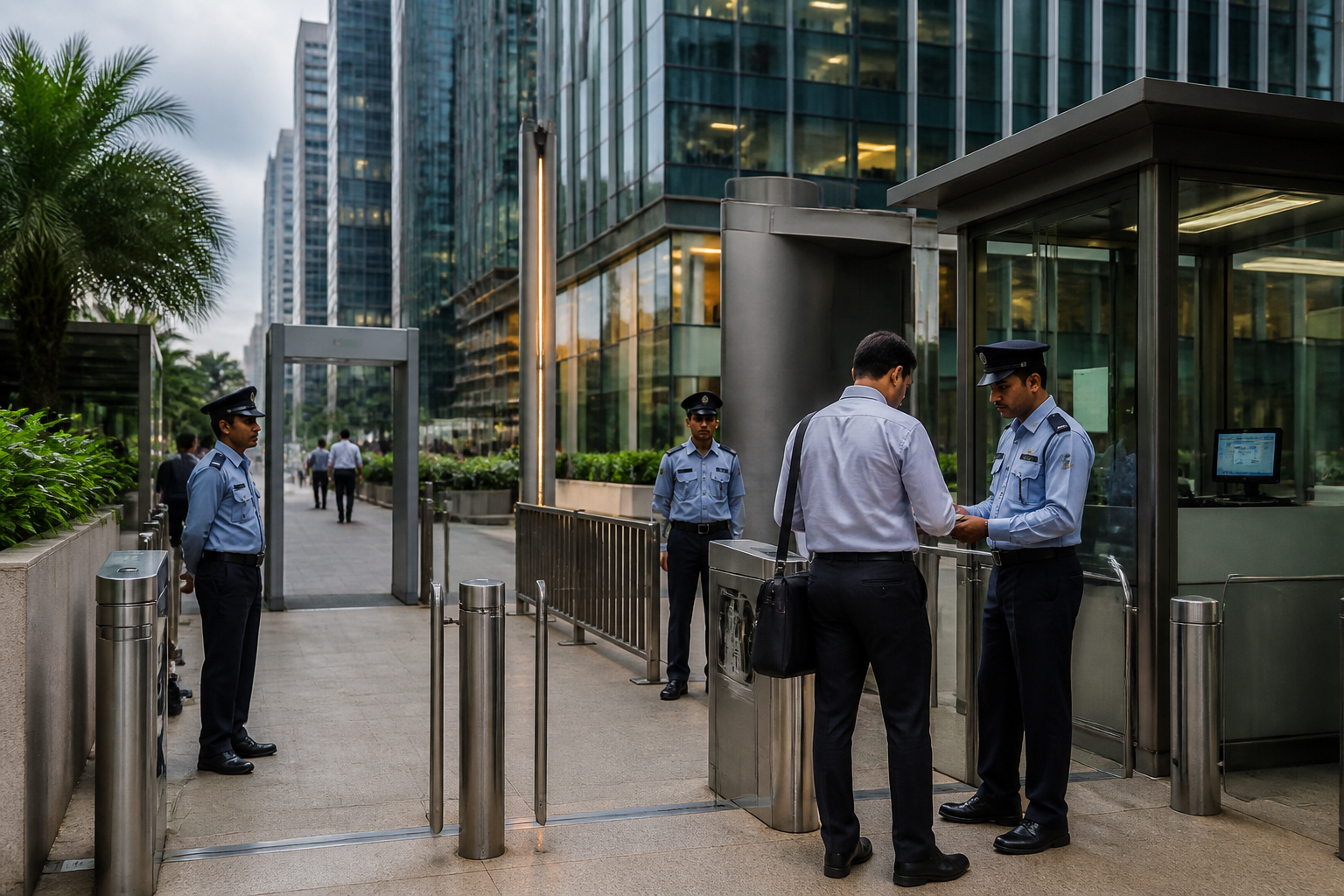
The alleged attempt to enter Mumbai’s Jio World Plaza using a fake Prime Minister’s Office identity card is more than a case of fabricated paperwork. It has brought into focus how high-profile commercial premises verify official access, how private security personnel are deployed, and how easily digital tools can be used to create documents that appear credible at first glance.
According to the police account reported before a metropolitan magistrate, 24-year-old businessman Rohan Parikh was arrested after allegedly presenting himself as a PMO official while trying to enter the BKC property. He was accompanied by private security guard Dilip Kunde, a former Army personnel, who allegedly carried a weapon. A third person, identified as Prathamesh Bagul, reportedly escaped and remains wanted.
The arrests took place a day before a possible visit by Prime Minister Narendra Modi to the Jio World Plaza, according to the report. The timing made the incident a security matter involving not only a private commercial property but also the protocols surrounding a potential visit by a senior constitutional functionary. The police have not said that the alleged group had any confirmed connection with the PMO or that a visit actually took place.
The case was placed before the 37th Metropolitan Magistrate, D S Khedekar. The Crime Intelligence Unit did not seek further police custody for Parikh and Kunde, and the court sent them to judicial custody. The police told the court that they needed time to examine electronic devices and investigate the weapon allegedly used by Kunde. The next hearing and the police response on the bail applications were scheduled for September 17, 2026, according to the report.
The immediate facts point to several layers of access control. The alleged entry attempt involved a physical location, a mobile-phone identity card, a private guard and a claim of official association. Each layer is normally expected to reinforce the others. In this case, the police account suggests that the claim of authority was central to the attempt to gain access to the premises.
Police reportedly told the court that Parikh had shown security personnel a purported PMO identity card on his Redmi 5G mobile phone on September 7. A search of data obtained through Google Takeout allegedly showed searches connected with preparing PMO correspondence. During a search of his home in Khar on September 8, investigators reportedly seized a laptop, a hard drive and documents linked to the PMO.
The police further alleged that Parikh initially gave evasive answers during questioning and later admitted to using ChatGPT to prepare the documents. The report says he had been using the technology since 2025 to create fake documents, allegedly to increase his confidence and impress people around him. These claims remain part of the investigation and have not been established by a final judicial finding.
The significance of the alleged use of ChatGPT lies less in the technology itself than in the setting in which the documents were used. A generative artificial-intelligence tool can help produce convincing language and formatted material, but the security risk emerges when an institution treats the appearance of an official document as evidence of authority. The case therefore raises a practical question for commercial properties: what happens when a document looks formal but cannot be verified through the issuing institution?
The source report does not establish what verification process was followed at the Jio World Plaza entrance, whether the alleged identity card was scanned, or whether security personnel contacted the PMO or another government channel before allowing access. It also does not establish whether the accused entered the premises or was stopped during the attempted entry. Those details matter because the difference between an attempted breach and a completed entry affects how the security system performed and where the intervention occurred.
Jio World Plaza is located in the Bandra-Kurla Complex, one of Mumbai’s most prominent business districts. The property combines the characteristics of a private commercial destination with the security pressures associated with high-profile visitors, retail activity and large daily footfall. Such places do not operate only through gates and guards. They depend on layered systems involving visitor management, identity verification, vehicle screening, contractor checks and escalation procedures.
The case also highlights the complicated role of private security in urban commercial infrastructure. According to the police account, Kunde was a private security guard and a former Army personnel. Police reportedly said he had obtained a weapon for personal use but allegedly used it while providing security to Parikh for commercial work. The investigation is expected to examine the weapon and the circumstances in which it was carried.
This part of the case raises questions about the relationship between personal protection services and institutional security. A private bodyguard accompanying an individual who claims to represent a government office may appear to strengthen the claim of authority. At the same time, the presence of an armed person can increase the consequences of a mistaken admission or a failure to escalate a questionable identity claim.
The report does not provide details of the weapon’s licence, the contractual arrangements between the guard and Parikh, or the security rules governing firearms at the property. Those facts are important to understanding whether the alleged conduct involved a breach of licensing conditions, site rules or other legal requirements. The police have sought time to examine the weapon, so the available account does not yet establish the full legal position.
The alleged involvement of a third person adds another operational dimension. Bagul reportedly fled while Parikh and Kunde were arrested. His continued status as a wanted suspect means investigators may still be trying to establish the group’s purpose, its internal roles and whether the documents were prepared only for the Jio World Plaza incident or for other uses. The police told the court that they wanted to determine whether the alleged fake PMO identity card and related papers had been used elsewhere.
That question is central to the investigation. A forged identity document used once in a single location would represent one kind of security incident. Evidence that similar documents were created or used for multiple approaches would indicate a broader pattern. The police account, however, does not yet establish such a pattern. It says only that electronic devices, search history and documents were being examined for that purpose.
The incident also demonstrates why digital evidence has become important in cases involving physical security. Investigators have reportedly seized a laptop and hard drive, examined a mobile phone and reviewed Google Takeout data. These devices may help establish when documents were created, how they were edited, whether correspondence was drafted and whether the files were shared with other people. Until that examination is completed and presented through the legal process, the digital trail remains an investigative lead rather than conclusive proof of every allegation.
For property managers, the episode points to a gap between document production and document authentication. An identity card can be displayed on a phone, printed or embedded in a larger set of letters. None of those formats independently confirms that the person presenting them has official authority. The relevant control is verification through a trusted channel, especially when a visitor invokes a senior government office or a potential VIP movement.
The source material does not say whether Jio World Plaza or its security contractor has changed its procedures after the incident. It also does not report a statement from the property management, the PMO or the security agency. Without those responses, it is not possible to determine whether the alleged attempt exposed a procedural failure, whether the security team detected the inconsistency promptly, or whether the incident was stopped through existing safeguards.
The institutional chain is nevertheless clear. The private property controls access at the site. The security agency manages personnel and possibly equipment. The police investigate alleged forgery, impersonation and weapons-related conduct. The magistrate determines custody and hears the parties’ applications. The PMO, if its identity and correspondence were allegedly misused, is the institution whose authority was invoked. Each part of this chain has a different responsibility, and the case will depend on how those responsibilities are documented.
The timeline now moves from arrest to evidence examination and court proceedings. Police custody was initially granted until September 11, after which the investigating unit did not seek an extension. Parikh and Kunde were then sent to judicial custody, while the police sought time to examine the seized devices and weapon. The court’s September 17 schedule is the next stated procedural milestone.
What the available evidence confirms is that Mumbai police arrested two people in connection with an alleged attempt to access Jio World Plaza using PMO-linked credentials, that a third person is wanted, and that investigators are examining documents, electronic devices and a weapon. What remains unresolved is the alleged group’s wider purpose, the extent of any document use beyond the property, the precise security procedure followed at the entrance and the legal status of the weapon.
The case’s larger urban lesson is not that artificial intelligence alone creates a security failure. It is that modern commercial districts rely on the interaction of digital identities, private guards, government references and physical access points. When those systems are not connected to reliable verification, a convincing document can become a substitute for authority. The next court hearing and the police’s continuing examination of the evidence will show whether this was an isolated impersonation attempt or evidence of a wider vulnerability in Mumbai’s high-security commercial spaces.
