


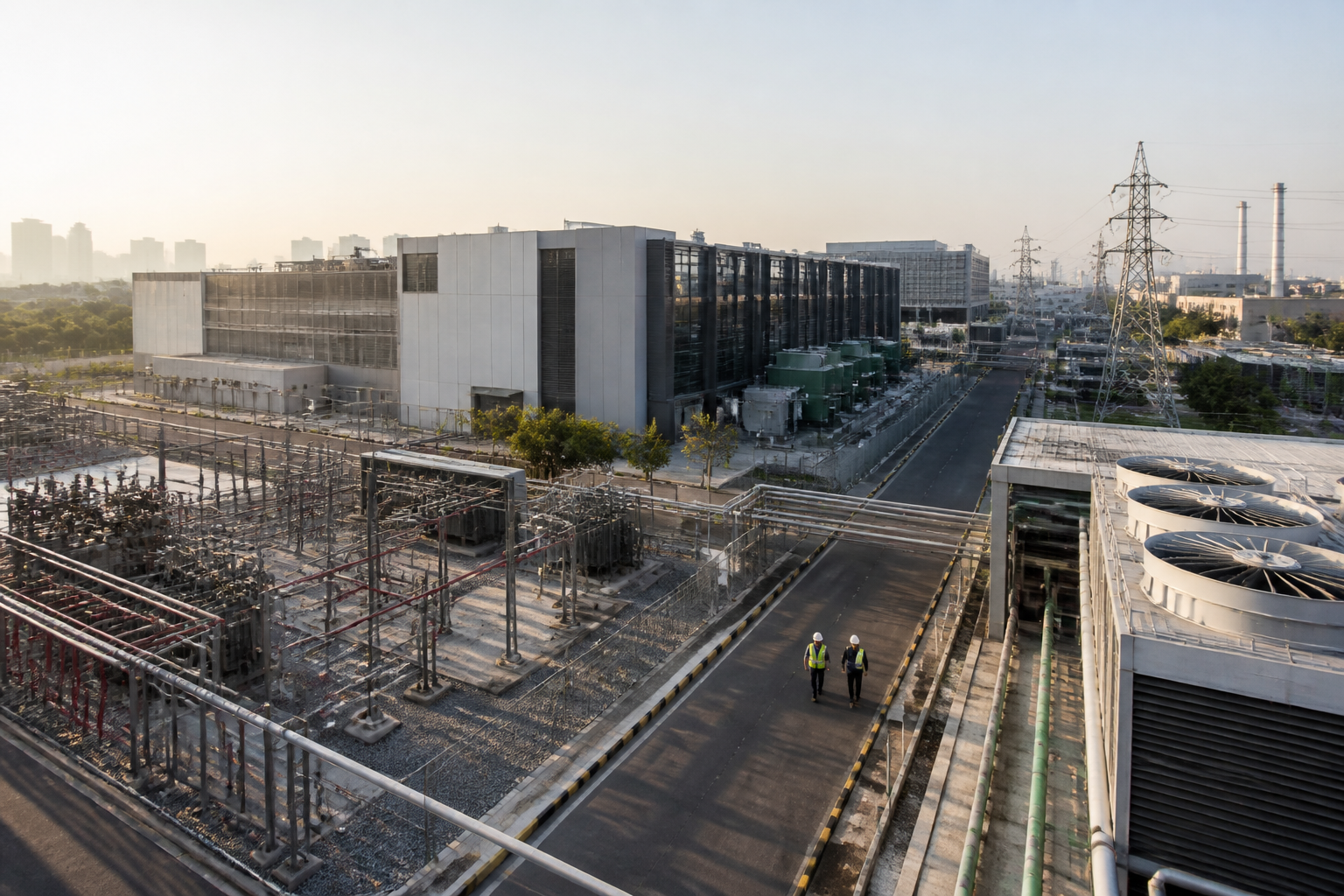
India’s data centre boom is beginning to look less like a narrow technology-sector expansion and more like a major infrastructure build-out. A KPMG report cited by the Times of India estimates that the sector could create a $90 billion opportunity for construction and infrastructure companies by FY35, up from $30 billion by FY30 as the country adds capacity.
The estimate covers much more than the buildings that house servers. It includes civil and engineering work, power systems, cooling, networking, security and infrastructure outside the data centre itself. That breadth is significant because data centres depend on a coordinated chain of urban and industrial systems: reliable electricity, specialised mechanical equipment, network connectivity, water or liquid-cooling systems, construction execution and timely approvals.
The report estimates that India’s data centre capacity could reach 7-7.5 GW by 2030. The capacity target provides the physical basis for the opportunity, but the value will not be distributed evenly across the infrastructure ecosystem. Different parts of the build-out will require different capabilities, supply chains and institutional coordination.
The largest identified segment is design and construction, which KPMG estimates could account for around $27 billion of the opportunity by FY35. This includes the creation and expansion of facilities as developers respond to rising demand for computing capacity. The scale of the estimate indicates that data centres are becoming a meaningful client segment for engineering and construction companies, rather than an isolated specialist market.
Cooling is the second-largest opportunity identified in the report, at approximately $24 billion. Power infrastructure inside data centres could account for another $18 billion, while power infrastructure outside the facilities is expected to add $12 billion. Network infrastructure and security are each estimated at about $5 billion.
Taken together, these figures show that the data centre market is also a market for industrial equipment, electrical systems, civil works and utility upgrades. The construction requirement is only one part of the value chain. A facility cannot operate at scale unless its internal power systems, cooling equipment and networks are designed and commissioned alongside the building, while external power infrastructure can deliver the required supply.
The shift towards artificial intelligence is making that coordination more demanding. According to the KPMG report, AI racks typically use 50-60 kilowatts of power per rack, compared with 8-12 kilowatts for non-AI workloads. That difference changes the engineering requirements of a facility. Higher rack density creates a greater need for electrical capacity, specialised equipment and cooling systems capable of removing more heat.
This is also pushing the sector beyond conventional air-based cooling. The report says data centres are moving towards water and liquid cooling, with liquid cooling emerging as a fast-growing opportunity because of AI workloads. The change is not simply a matter of replacing one piece of equipment with another. It affects the design of the facility, the systems that circulate and manage heat, the commissioning process and the capabilities required from contractors and suppliers.
The infrastructure implications extend outside the data centre boundary. A large facility requires dependable power, and delays in securing that connection can affect the overall construction and commissioning schedule. KPMG identifies delays in obtaining power as an issue that developers, engineering and construction companies, equipment manufacturers, utilities and regulators will need to address together.
This makes the data centre opportunity partly a question of execution and governance. The report describes a “decade long, structural opportunity” for the full engineering and infrastructure value chain, but it also indicates that market growth alone will not guarantee timely delivery. The ability to coordinate several technical and administrative systems will determine how much of the projected opportunity can be converted into operational capacity.
India already has capabilities that can support parts of this expansion. KPMG identifies a domestic base in civil construction, cooling towers and fibre-optic cable manufacturing. These existing capabilities could allow Indian companies to participate in the construction and connectivity segments as demand grows.
The report also identifies areas where India remains more dependent on imports. These include advanced grid systems, battery energy storage systems, precision cooling and active network hardware. The distinction matters because the projected opportunity is not only about the volume of construction. It is also about whether domestic suppliers can develop capabilities in specialised equipment and systems as the technical requirements of facilities become more demanding.
The resulting industrial opportunity is therefore uneven. Conventional civil construction and some cooling and connectivity segments have an existing domestic base, while advanced electrical, storage, precision cooling and network systems present more specialised challenges. The report does not quantify how much of the $90 billion could be captured domestically, but its breakdown highlights where capability gaps may influence project costs, timelines and supply-chain resilience.
The power requirement is particularly important because data centres are continuous users of electricity. The KPMG figures distinguish between power infrastructure inside data centres, estimated at $18 billion, and power infrastructure outside them, estimated at $12 billion. That separation reflects two different delivery problems: the internal systems that distribute and manage power within a facility, and the external infrastructure needed to connect it reliably to the wider power network.
The report’s treatment of AI also suggests that future capacity cannot be assessed only by counting facilities or floor area. AI workloads can require substantially higher power per rack than non-AI workloads. As a result, the performance of a data centre will depend on the relationship between its computing equipment, electrical systems and cooling architecture. Capacity expansion that does not account for these requirements could produce buildings that are completed but unable to support the intended workload efficiently.
The same issue applies to construction schedules. Data centre projects involve civil, electrical, mechanical, networking and commissioning work that must be integrated. KPMG says execution capability in electrical, mechanical and commissioning segments will be the primary differentiator as capacity expands. This places specialist project management and commissioning expertise alongside conventional construction capacity as a key part of the market.
The policy landscape described in the report is consequently broader than a technology or real estate policy alone. Developers need suitable sites and facilities; utilities need to provide power connections; engineering and construction firms need to coordinate complex works; equipment manufacturers need to supply specialised systems; and regulators need to support the processes that affect project delivery. The source material does not specify a particular government scheme, regulatory reform or funding model, so the institutional details of that coordination remain to be established beyond the KPMG assessment.
The $90 billion estimate should therefore be read as a projection of potential infrastructure activity, not as guaranteed revenue. Its realisation will depend on the pace at which India adds capacity, the mix of AI and non-AI workloads, the availability of power, the adoption of liquid cooling and the ability of domestic and international suppliers to meet technical requirements. The report provides the opportunity breakdown, but it does not establish the final allocation between Indian companies, imported equipment or different regions.
For cities and urban infrastructure systems, the central question is how this expansion will interact with existing utility and construction capacity. Data centres require large, reliable power systems and specialised buildings, while their delivery depends on coordinated approvals and network connections. Their growth can therefore create demand for new infrastructure, but it can also expose weaknesses in power delivery, equipment supply and project execution if those systems do not expand at the same pace.
The evidence currently confirms a substantial and diversified infrastructure opportunity linked to India’s projected data centre capacity of 7-7.5 GW by 2030. It also confirms that AI is raising power and cooling requirements, while domestic capability remains stronger in some segments than in others. The developments to monitor are the conversion of the projected opportunity into commissioned capacity, the speed of power connections, the adoption of liquid cooling and the development of Indian capabilities in advanced grid systems, energy storage, precision cooling and active network hardware.
