


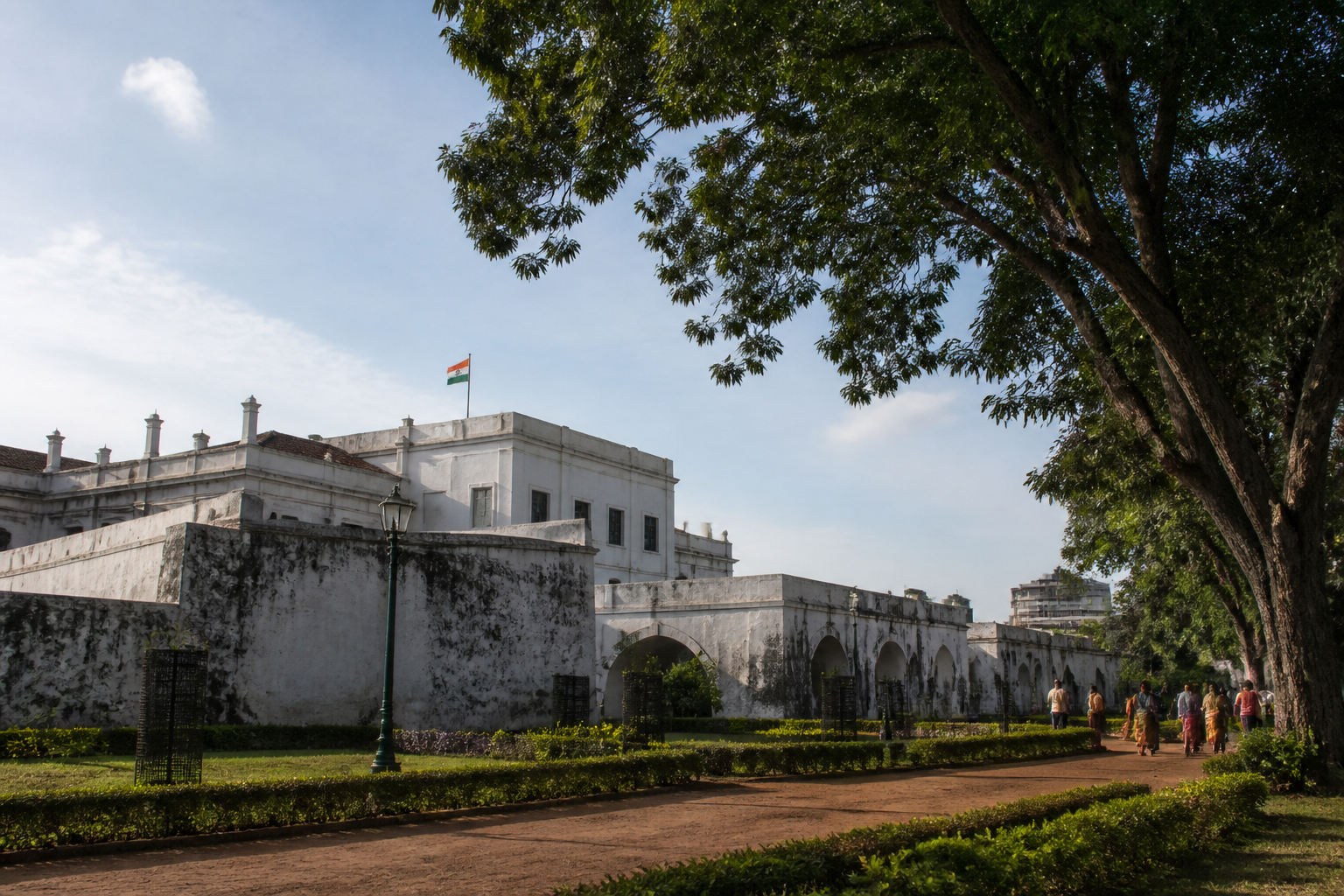
Fort St George’s history shows that Chennai did not begin as a fully formed city. It grew from a piece of land granted for English trade in 1639, a fortified commercial settlement, and the gradual joining of older and newer settlements around it. The story is significant not only because the fort survives as a historic site, but because it reveals how commerce, political power and civic administration can combine to create an urban centre.
According to the account published by the Times of India, Damarla Venkatapathy Nayak, an influential Nayak under the Vijayanagara rulers, granted the English land between the Cooum river and the Egmore river for trading purposes. The English established Fort St George on the site, completing its construction in 1644. The original purpose was commercial rather than civic or political. The fort was intended to support business, but its location and the expanding English presence gradually gave the settlement a larger urban role.
This distinction between an initial project and its later consequences is central to understanding Chennai’s formation. Fort St George was not planned as the centre of a major city. It became one because activities around it attracted houses, settlements, administration and political authority. The fort provided a fixed institutional and economic centre, while the town around it expanded in response to trade and the acquisition of surrounding areas.
The settlement did not grow in isolation. The area around Fort St George developed alongside an older settlement known as Madraspatnam, located to the north. As new houses and settlements emerged between the two, they gradually became one town. The fort remained the official centre of the English settlement, while Madras Patnam was used for the combined town. The settlement was also associated with the name Chennapatanam, in memory of Chennappa Nayak, the father of Venkatapathy Nayak.
This merging of settlements offers an early example of urban growth through connection rather than replacement. The city was not created by a single construction project that erased what existed before it. Instead, separate places developed around different functions and gradually became part of a wider urban settlement. One area was tied to the fort and English administration; another represented an older settlement; the spaces between them became the link through which the town expanded.
The fort’s importance increased as control over the region changed. In 1646, Golkonda forces under General Mir Jumla captured Madras and brought the city and surrounding areas under their control. After the fall of Golkonda in 1687, the region came under the Mughal Empire. The English later received permissions that allowed their activities in Chennai to continue. These changes show that the settlement’s future depended not only on its physical location, but also on the political permissions and institutional arrangements that made commercial activity possible.
By the late 17th century, the settlement was expanding through trade and the acquisition of surrounding areas. During the tenure of Governor Elihu Yale, from 1687 to 1692, a mayor and corporation were established for Chennai. This was an important shift in the city’s institutional development. The settlement was no longer only a place where trading activity took place. It was also acquiring formal civic structures to manage an expanding urban population and territory.
The emergence of a mayor and corporation matters because cities require administrative mechanisms as they grow beyond a compact commercial site. The source account does not provide details of the corporation’s powers, finances or boundaries, so the exact extent of its early responsibilities cannot be established from the supplied material. It does, however, identify the creation of the civic institution as part of the settlement’s transformation from a trading post into a town with a recognised administrative framework.
The pattern also highlights the relationship between economic activity and urban governance. Trade created the initial reason for the settlement. The fort helped protect and organise that activity. New residents and settlements followed. As the town expanded, civic administration became necessary. Political authority then became increasingly concentrated in the fort, giving the site a role that extended far beyond business.
Fort St George also became the centre of political and administrative power in the region. It withstood several assaults during the 18th century and was briefly captured by the French between 1746 and 1749 before being restored to British control under the Treaty of Aix-la-Chapelle. These events changed the fort’s political significance. A structure built for commercial security became part of a larger contest over territorial power and administration.
Its changing function is a reminder that urban buildings often outlive their original purpose. Fort St George began as a trading post, but its later role was shaped by conflict, government and the expansion of the settlement around it. Over time, it became closely associated with the government of Madras and eventually with the administration of Tamil Nadu. Its importance therefore lies not only in its architecture or defensive history, but also in the institutional continuity attached to the site.
The account of Chennai’s origins can be read as a sequence of urban transformations. First came the grant of land for trade. Then came the construction of the fort. Settlements grew around the commercial centre and joined with Madraspatnam. Political changes altered who controlled the area. Civic institutions emerged. Finally, the fort became a major administrative centre. Each stage added a new layer without eliminating the earlier ones.
This layered development is different from the image of a city emerging from a single master plan. The supplied history describes a more incremental process, in which commercial, residential, political and civic functions accumulated over time. The urban form that resulted was therefore shaped by both deliberate decisions and the pressure of settlement growth. The spaces between established settlements became as important as the original sites themselves because they enabled the two areas to function as one town.
The story also raises a broader question about the relationship between historic sites and present-day city administration. Fort St George remains an important historic site in Chennai, but it also houses government offices and a museum containing objects and relics from the colonial period. The fort is maintained as a protected monument. Its current use reflects the same functional layering that shaped its history: it is simultaneously a heritage site, an administrative location and a public repository of historical material.
That combination can make historic urban sites unusually important. They are not isolated monuments removed from city life. They remain connected to government, public memory and the functioning of the surrounding city. In Fort St George’s case, the site’s continued administrative association links the origins of the settlement to the present-day governance of Tamil Nadu, even as the city around it has changed dramatically.
The history also shows why urban growth cannot be understood only through later expansion. Modern Chennai is the result of nearly four centuries of accumulated decisions, territorial changes and institutional development. The initial commercial purpose of the 1639 land grant did not determine the entire future of the city, but it created a centre around which later changes took place. The fort’s endurance gave that centre a physical and political anchor.
What the supplied account establishes is the broad sequence: land was granted to the English for trade in 1639; Fort St George was completed in 1644; nearby settlements gradually merged; political control changed hands; civic administration was established by the late 17th century; and the fort later became an administrative centre. What it does not establish are the detailed boundaries, population changes, financial arrangements or planning decisions associated with each phase. Those questions would require historical records beyond the source material.
Even with those limits, the story offers a clear lesson about city formation. Chennai grew because a commercial site became an institutional centre, because settlements connected around it, and because administrative authority followed economic importance. Fort St George therefore represents more than the beginning of a colonial settlement. It is a physical record of how trade, territory and governance combined to create an urban core that still has a role in the city today.
