


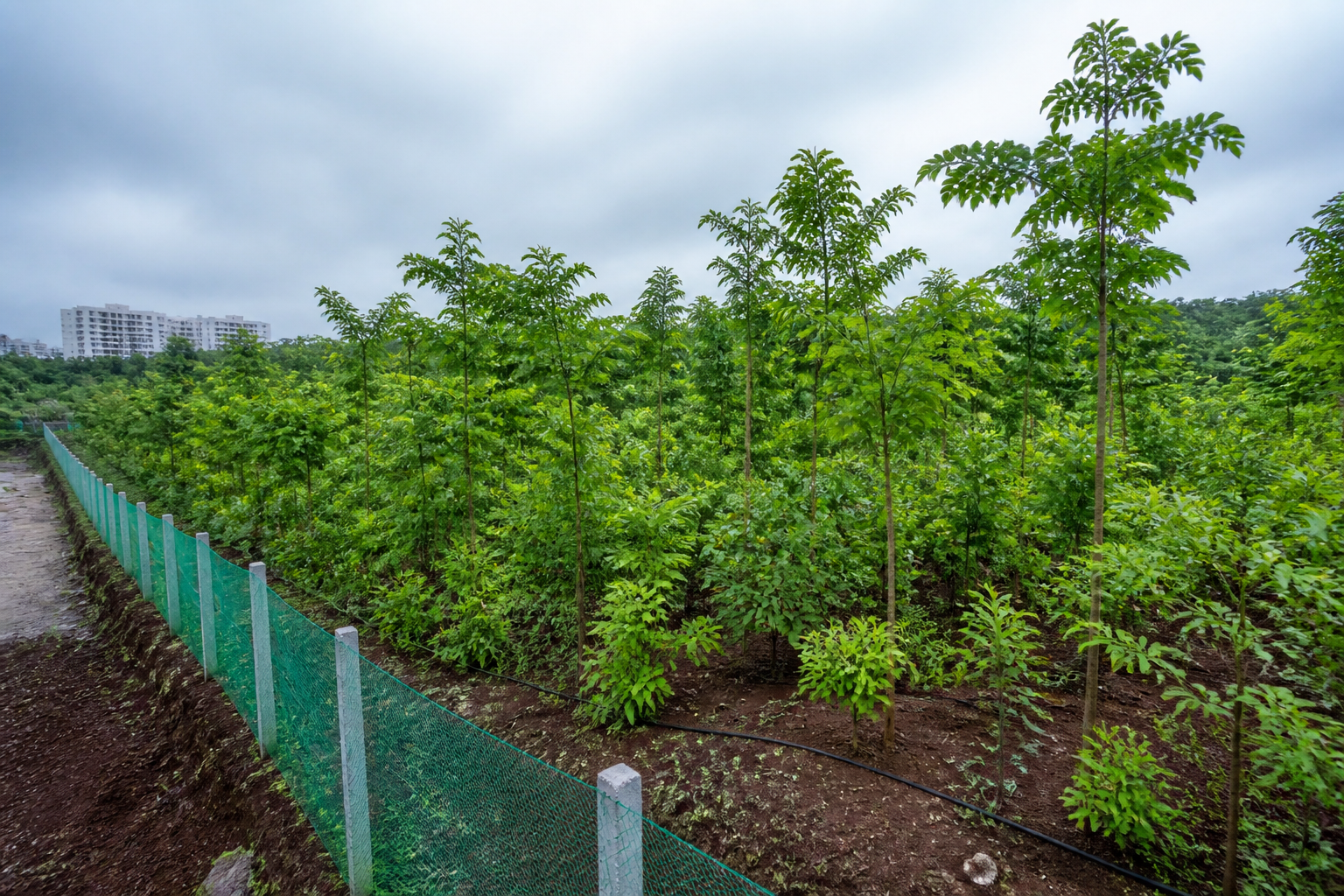
The transformation of a decades-old dump yard in Devlali into Nashik’s first Miyawaki urban forest shows how neglected urban land can become an ecological asset, but it also shifts the central question from planting trees to keeping them alive. Around 42,000 saplings representing more than 40 indigenous species have been planted across 1.40 hectares of land that was once covered with plastic, discarded clothes, footwear, broken glass and household waste.
The project is being implemented by the Social Forestry Department, Nashik, with support from the Devlali Cantonment Board and the Nashik district administration. Its significance lies not only in the number of saplings but in the chain of administrative decisions required before plantation could begin. The land belonged to the Defence Department, and obtaining a no-objection certificate was described by the forest officers involved as the project’s biggest hurdle.
The necessary NOC was received in March 2026. Only after that permission could the authorities begin clearing the site, preparing the soil and creating the plantation. The sequence is important because urban ecological restoration is rarely only a planting exercise. It depends on land ownership, permissions, waste removal, soil treatment, water access and protection from future encroachment or damage. At Devlali, each of those elements had to be addressed before the forest could be established.
The site had accumulated what the cantonment authorities described as legacy waste over several decades. During the monsoon, rainwater mixed with the waste to create stagnant pools of foul-smelling leachate. Several dumpers and other equipment were used to remove the accumulated material, including plastic, clothing, footwear and glass. The land was then excavated and the soil treated with cow dung manure, compost and wood husk before being filled and prepared for plantation.
This process places the project within a broader urban problem: the afterlife of waste. Even when a city or cantonment has a functioning solid-waste management system, older waste deposits can remain on land parcels for years. Such sites continue to occupy valuable urban space and can create sanitation and environmental risks. The Devlali project therefore addresses two different legacies at once: the physical waste left behind on the land and the institutional neglect that allowed the site to remain unused and dirty.
The Miyawaki method was selected because it allows dense plantations of indigenous species in relatively small spaces. The approach uses closely planted native species and a layered structure intended to replicate aspects of a natural forest. At Devlali, saplings have been planted on a one-metre-by-one-metre grid. The plantation includes canopy species, large trees, subtrees and shrubs, with the composition divided into approximately 20 per cent canopy species, 40 per cent large trees, 27 per cent subtrees and 13 per cent shrubs.
That composition indicates that the project is intended to create a multi-layered ecosystem rather than a single-species tree plantation. The inclusion of flowering and medicinal species is also meant to support biodiversity as the plantation develops. Forest department officials said the site could eventually provide habitat for several forms of biodiversity, although the supplied account does not establish how many saplings have survived so far or what species have begun to return to the site.
The distinction between planting and establishment is critical. The project has a headline figure of 42,000 saplings, but its long-term performance will depend on survival rates, maintenance and the development of a functioning ecosystem. The authorities have installed drip irrigation to provide water and fenced the site to protect the young plantation from stray cattle and trespassing. Forest staff are also supporting the saplings with wooden sticks and continuing care after plantation.
The institutional arrangement is notable. The Social Forestry Department led the ecological work, while the Cantonment Board controlled access to land under its jurisdiction and granted permission for the project. The Defence Department’s NOC enabled the use of the land for restoration. This is a layered governance model involving land ownership, local administration and forest management rather than a single civic agency acting alone.
The project also highlights the importance of administrative support for frontline officials. Range Forest Officers Savita Patil, Karuna Pagare and Suchita Patil, along with Range Forest Officer Sunita Deshmukh before her transfer, were identified as being closely associated with the work. Their role extended from securing permissions and clearing the land to preparing the soil and overseeing the saplings. The account presents the women forest officers as central to converting an approved idea into a functioning site.
For Nashik, the project is described as the first implementation of the Miyawaki model in the district. That makes the site a local experiment in using compact urban land for ecological restoration. It is also a test of whether a former dumping ground can be integrated into the city’s environmental infrastructure without treating plantation as a one-time beautification activity.
The numbers reveal both the scale and the constraint of the intervention. Forty-two thousand saplings have been planted on 1.40 hectares, with more than 40 indigenous species arranged in a dense grid. The land parcel is small compared with the scale of the city, but its previous use shows why the quality of urban land matters as much as its area. A compact site can impose sanitation costs when abandoned, or provide ecological value when restored and maintained.
The project’s next phase will determine whether the initial investment produces a durable public asset. The forest department has said that the site may develop into a dense urban forest over the next two to three years. That timeline is an official expectation, not yet an independently demonstrated outcome. The available account does not provide survival data, maintenance budgets, water consumption figures, details of ongoing monitoring or a formal biodiversity assessment. Those are the measures that will eventually show whether the plantation has moved beyond an ambitious planting drive.
The Devlali case also raises a question about how cities account for land that falls between administrative categories. The site was Defence land, located within the Devlali Cantonment Board area, and managed for ecological restoration through the Social Forestry Department. Such land can remain outside the everyday focus of municipal planning even while it affects sanitation, drainage, public health and the visual quality of neighbourhoods. Its restoration required the departments to treat the parcel as part of the urban system rather than as an isolated plot.
For residents, the immediate change is from an inaccessible and contaminated-looking dump yard to a fenced plantation under active care. The longer-term public value will depend on whether the site remains protected, receives adequate water and maintenance, and develops the ecological functions promised by the project. A green cover target alone cannot establish that outcome.
What the evidence confirms is that Nashik has cleared a long-neglected waste site, secured permission to use Defence land, prepared the soil and planted a dense mix of native species. What remains uncertain is the survival and ecological performance of the plantation. The next developments worth monitoring are the condition of the saplings, the continuity of maintenance, the management of irrigation and the extent to which the restored site becomes a functioning urban forest over the stated two-to-three-year period.
