


Subheadline: A student survey links distress at Bengaluru’s premier research institute to workload, financial pressure, weak support systems and the loss of informal campus spaces.
Standfirst: A survey of 1,035 IISc students, conducted after the suicide deaths of two students in August, presents mental health as more than a question of counselling access. Respondents identified academic workload, financial insecurity, inadequate psychiatric support, disruptions in basic amenities and limited participation in institutional decisions as interconnected sources of distress. Students also described the gradual contraction of places where they could socialise or decompress, including a ground converted into a bookable stadium and a swimming pool that has been drained. The findings do not establish a single cause for the deaths, nor do they independently assess the institute’s services. They do, however, show how a high-pressure academic institution can turn everyday systems—fees, attendance rules, laboratory culture, amenities and shared spaces—into part of the mental-health environment.
The survey conducted by the IISc students’ council is significant because it shifts the discussion from individual resilience to institutional conditions. Of the 1,035 respondents, 80% attributed their distress to their financial situation, while half said mandatory academic workload caused significant distress. Almost half, or 46%, said disruptions in the supply of basic amenities contributed significantly to their distress.
Those figures place financial and operational pressures alongside academic demands. The survey was carried out after two IISc student suicide deaths in August, but the reported findings do not claim that any single factor caused those deaths. Instead, they record how students understand the pressures surrounding them and what changes they want from the institute.
The strongest demand was for a better work environment. Seventy-four per cent of respondents identified improving the work environment for students as an urgent need. Greater financial assistance followed at 68%, while 64% sought a student-friendly attendance policy and changes to academic workload. Fifty-four per cent wanted greater student participation in decision-making.
Mental-health support itself was another area of concern. Forty-seven per cent of respondents said psychiatric support on campus was inadequate. Eighty-four per cent called for greater awareness and accessibility of existing support, while 85% said reimbursement for external mental-health support should be increased. The findings suggest that the presence of a wellness facility does not by itself resolve questions about access, trust, continuity of care or whether students can seek help without navigating burdensome institutional processes.
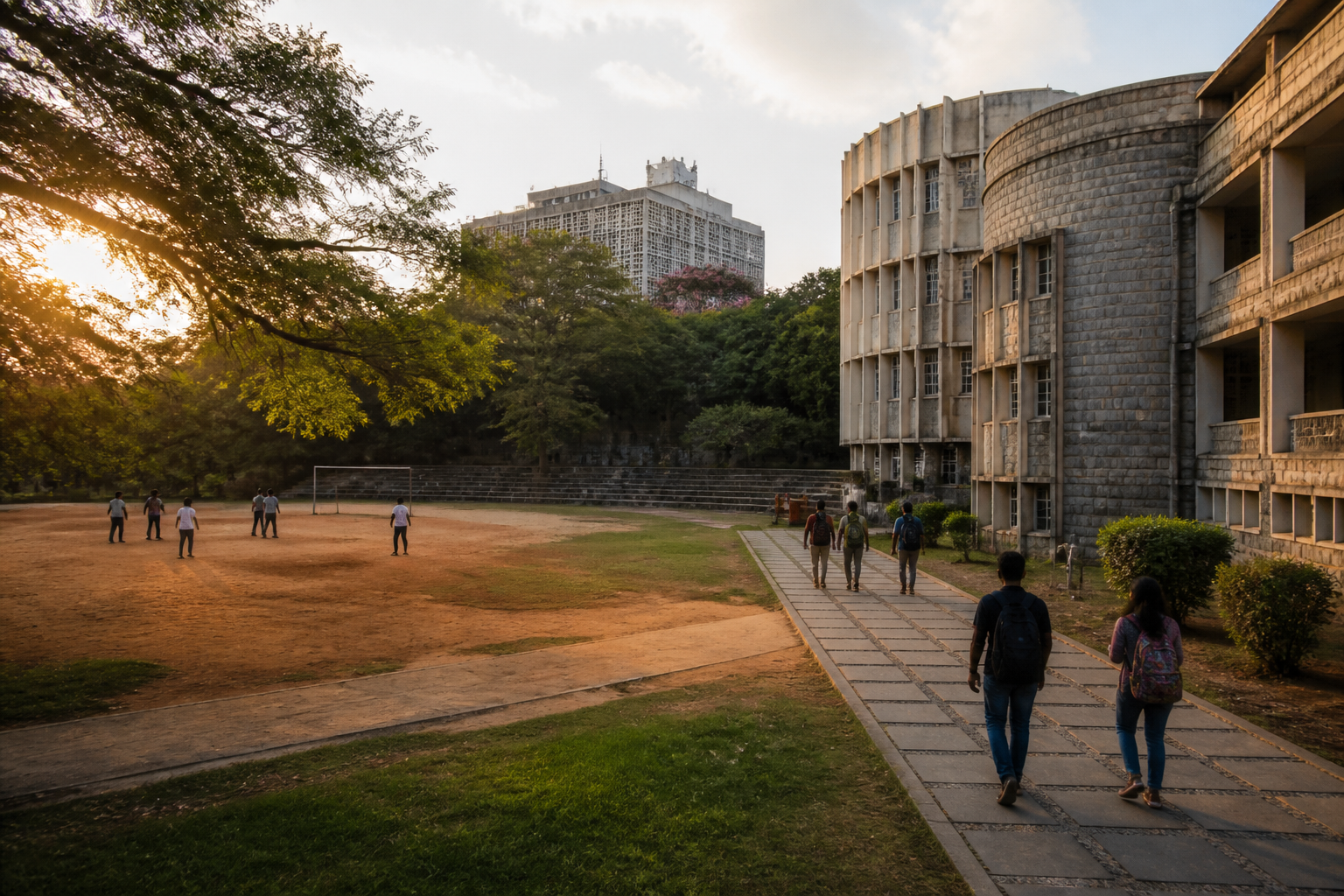
The survey also brings the campus’s physical environment into the mental-health conversation. Students told the Times of India that spaces that once enabled informal socialising had steadily diminished. A once-open ground, they said, had been converted into a bookable and partly commercialised stadium. The swimming pool had been drained, with water scarcity cited as the reason. Students also said security personnel restricted informal gatherings in some common areas.
These details matter because informal spaces function differently from scheduled facilities. A student does not need to plan, pay or obtain permission to walk into an open ground or meet others in a common area. When such spaces become bookable, restricted or unavailable, everyday opportunities for rest and social contact can become dependent on time, money and institutional approval. The report does not quantify the amount of open or recreational space lost, but student accounts indicate that access to these spaces has become an active concern.
One PhD student quoted in the report described a campus where packed schedules made spontaneous recreation difficult. The student contrasted earlier access to a playground with the current requirement to book and pay for a stadium that can also be used by outsiders. The account is not a campus-wide measurement, but it illustrates the practical difference between a shared commons and a managed facility.
The issue is therefore not simply whether IISc has sports or recreation infrastructure. It is who can use it, under what conditions and for what purpose. A space designed primarily as a revenue-generating or bookable asset may remain physically present while becoming less available as an everyday social resource. In a residential academic campus, that distinction can affect how students manage stress and maintain social ties.
Financial pressure appears to reinforce the problem. According to the report, undergraduate tuition has increased eight-fold, from Rs 10,000 a year to Rs 80,000 for the 2026 batch onwards. The amenities component of student charges has also risen from approximately Rs 2,000-2,500 to Rs 3,500. Students expect another 50% increase next year, although the report presents this as a student expectation rather than a confirmed institutional decision.
For PhD students, the report says fellowships have remained at Rs 37,000 since 2023-24, while monthly mess bills are projected to rise from around Rs 6,000-7,000 to Rs 10,000-11,000. Taken together, these figures describe a squeeze between relatively fixed support and rising recurring costs. The material supplied does not provide a full account of household incomes, scholarship coverage or the institute’s budget, so it cannot establish how widespread financial hardship is across the student population. It does show, however, that financial stress was the most frequently cited source of distress in the survey.
Students also pointed to the organisation of academic work. Some described what they called a toxic work culture in laboratories and rigid attendance policies. They said that even genuine medical or mental-health leave could become a prolonged process of seeking approval. These are reported student allegations, not independently verified findings. Their importance lies in identifying how institutional rules may be experienced by students who are already under pressure.
A campus mental-health policy that focuses only on counselling may therefore miss the systems that determine whether students can use counselling effectively. Workload, attendance, supervisory relationships, leave approval, financial aid and access to common spaces all shape the time and autonomy available to seek help. The IISc findings place these administrative and physical conditions next to formal psychiatric support rather than treating them as separate policy areas.
The survey’s demands also raise a governance question. More than half of respondents wanted greater participation in decision-making, while the report says students questioned the institute’s response to the suicides. Students described administrative messages urging them to “stay positive” and “talk to people”, but said these messages were not followed by sufficient policy changes. The report attributes these criticisms to students and does not include a detailed institutional response or an independent review of the institute’s actions.
That gap is important. Communication can acknowledge distress, but it cannot substitute for transparent procedures, accessible services or changes to the conditions students identify as harmful. The survey’s 50% call for greater awareness, accessibility and transparency in mental-health support indicates that students are asking not only for more services but also for clearer information about how those services work.
The broader lesson for urban institutions is that a campus is a small city. It has housing, mobility within the site, utilities, public and semi-public spaces, security rules, economic pressures, service providers and administrative authorities. Student wellbeing is shaped by the interaction of these systems. When basic amenities are disrupted, recreational areas become less accessible, fees rise or institutional procedures become difficult to navigate, the effects accumulate in the same daily environment.
IISc’s survey does not provide a causal model of student suicide, and it should not be read as one. It is a snapshot of student perceptions after two deaths, based on responses collected by the students’ council and reported by the Times of India. The survey’s value is different: it identifies the pressures students themselves want addressed and shows that mental-health support cannot be evaluated solely by counting counselling facilities.
The evidence reported so far confirms a broad set of concerns around workload, finances, support services, amenities and campus space. What remains unclear is how the institute will respond, whether the survey findings will be independently reviewed, and whether students will have a formal role in implementing changes. Those developments—along with the accessibility of psychiatric care, the future of financial assistance, and the management of shared campus spaces—will determine whether the survey becomes a record of distress or the basis for institutional reform.
