


A Bengaluru Urban consumer commission’s order against Tonique over a Rs 20 carry bag is a small-value dispute with a larger lesson for organised retail: when a customer is charged for packaging that also promotes the seller, the transaction may raise questions beyond the price printed on the bill.
The District Consumer Disputes Redressal Commission, Bangalore (Urban), held Tonique guilty of unfair trade practice and deficiency in service after it charged a customer for a carry bag bearing the store’s name, logo and promotional content. The commission directed the liquor retailer to refund Rs 20, pay Rs 5,000 as compensation and meet litigation costs of Rs 3,000.
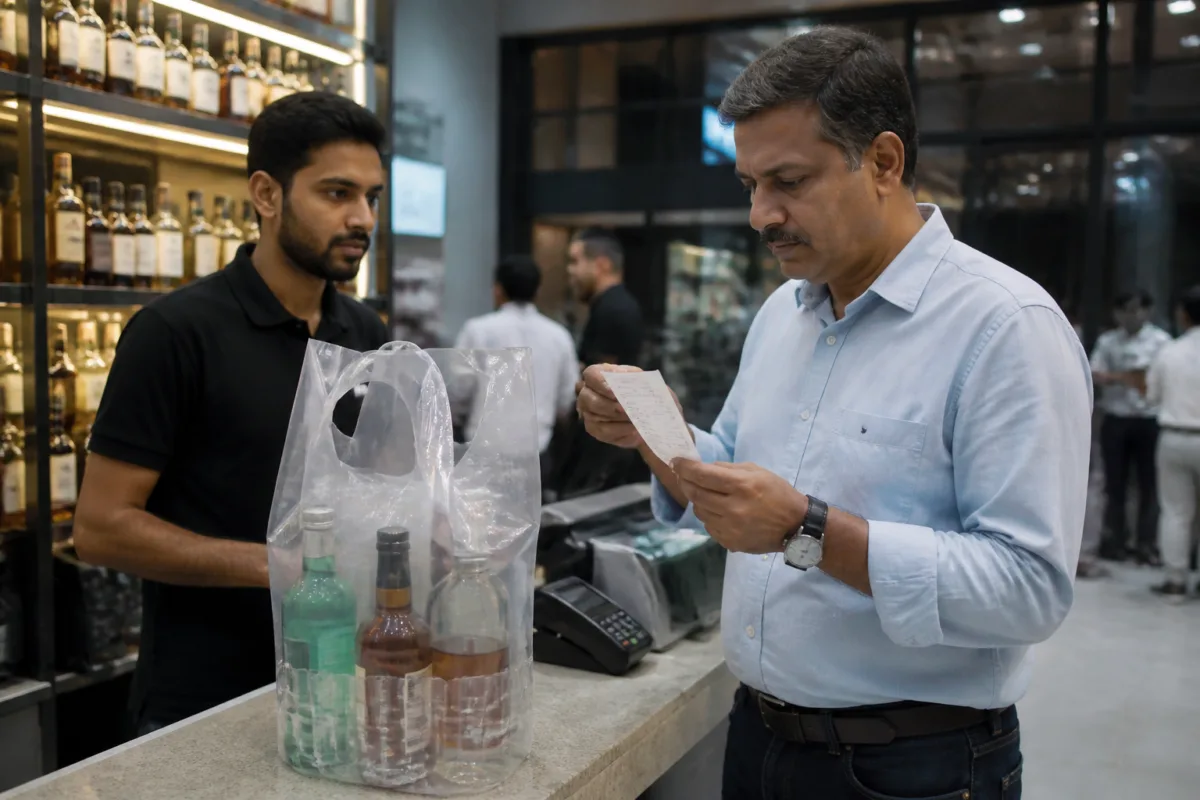
The order followed a complaint by Theerthesh BS, a 33-year-old resident of Bagalagunte. On June 3, 2025, he bought beverages worth Rs 2,170 from Tonique on Kasturba Road. Because the bottles were fragile, he asked for a carry bag. The store supplied one carrying its branding and billed him an additional Rs 20 on the same day and at the same time as the purchase.
The consumer’s objection was not simply that the bag had a price. His complaint was that the retailer was charging him for a bag that simultaneously functioned as the store’s own advertising and identification material. According to the report, staff refused his request to provide it without charge, leaving him to pay because he needed a safe way to carry the bottles.
That detail is central to the commission’s reasoning. A carry bag in this setting is not an optional product detached from the main transaction in the way an unrelated merchandise item might be. The commission noted that a seller of beverage bottles should know that customers will need a bag to transport such products safely. It applied the principle of “Caveat Venditor”, or “let the seller be aware”, shifting attention towards the seller’s responsibility in structuring the transaction.
The order therefore treats the bag as part of a service relationship rather than only as a separate commodity. Tonique’s position was that customers were informed about the charges when they requested a carry bag, that the charges were displayed on a board at its outlets and that a bill was raised. In effect, the retailer defended the practice through disclosure: the customer knew, or could know, that the bag cost Rs 20.
The commission did not accept that explanation as sufficient in the circumstances described. Its finding was that charging for a bag carrying the store’s own promotional material amounted to deficiency in service and unfair trade practice. This makes the branding significant. The dispute was not merely about whether a retailer may recover the cost of packaging; it concerned whether the customer should bear that cost when the packaging also delivers commercial value to the retailer.
The case also shows how retail transactions are increasingly mediated by small, separately billed components. A main purchase can be followed by charges for packaging, delivery, handling or other associated services. Each amount may appear minor in isolation. But the consumer commission’s approach indicates that the structure and purpose of the charge matter, not only whether a price was displayed.
The procedural history further shaped the outcome. The consumer filed his complaint on June 17, 2025, seeking a refund of Rs 20, compensation of Rs 25,000 for deficiency in service and unfair trade practice, and other relief. Despite receiving notice, Tonique’s manager did not initially appear or file its version, and the store was placed ex parte. The retailer’s counsel later filed written arguments.
The commission, comprising president Ramachandra MS and members Nandini H Kumbhar and Savitha Airani, treated Tonique’s failure to appear as a clear admission of the allegations, according to the report. That procedural circumstance is important when considering the reach of the order. The decision establishes the outcome in this complaint, but the supplied material does not indicate that it is a statewide rule, a national precedent or a blanket ban on all charges for carry bags.
The distinction matters for consumers and retailers alike. The order does not, on the evidence available here, say that every carry bag must always be free. Nor does the supplied report establish that all packaging charges are unlawful. Its reasoning is tied to the specific facts: a purchase of bottled beverages, a bag needed to carry fragile goods, the bag’s use of the retailer’s name and logo, the separate Rs 20 charge and the retailer’s failure to fully contest the complaint at the initial stage.
That fact-specific character is typical of consumer disputes, where the commission examines how a service was offered and what the consumer was required to pay. A display board may communicate a charge, but communication alone may not settle whether the charge is fair in context. The commission’s reasoning suggests that transparency and fairness are separate questions: a customer may be told about a fee and still challenge the basis for imposing it.
For urban retail, this is an institutional question as much as a billing question. Customers encounter packaged transactions at outlets across cities, often in busy environments where a decision to accept a bag takes place at the point of sale. In this case, the customer had purchased beverages in bottles described as fragile. The practical need to transport them safely narrowed the consumer’s ability to decline the bag without accepting the risk of carrying the goods differently.
The order places that moment of choice under scrutiny. If the seller controls the packaging, uses it for brand promotion and knows that the product requires safe transportation, the commission’s approach asks whether the customer is genuinely choosing an additional product or simply completing the original purchase. The distinction can affect how charges are understood, recorded and challenged.
It also raises a question about the commercial value of branded packaging. A bag bearing a store’s logo is not neutral packaging. It identifies the retailer in public and extends the store’s visibility beyond the premises. The commission’s finding, as reported, recognises that promotional function while assessing the fairness of making the customer pay for it.
The compensation ordered was substantially higher than the disputed amount. Along with the Rs 20 refund, Tonique was directed to pay Rs 5,000 for deficiency in service and Rs 3,000 towards litigation costs. The structure of the award shows that the consumer commission considered the dispute to involve more than the recovery of a small payment. The reported order does not, however, provide a broader estimate of how many consumers may have faced similar charges or how other retailers treat branded bags.
That missing information limits the conclusions that can be drawn. There is no evidence in the supplied material of a citywide survey, a sector-wide enforcement action or a separate direction to other liquor retailers. There is also no indication of whether Tonique has changed its billing or packaging practice after the order. The case therefore offers a documented signal about one retail transaction, not a complete picture of consumer packaging practices in Bengaluru.
Still, the dispute illustrates how consumer protection can operate at the edges of everyday urban commerce. The value of a complaint is not always measured by the amount on the bill. A small charge can test the allocation of responsibility between a seller and a buyer, especially where the seller’s operational choice creates both a service benefit for the customer and a promotional benefit for the business.
For retailers, the order highlights the need to distinguish between a genuinely optional packaging product and packaging that is closely connected to the safe delivery of the goods sold. For consumers, it demonstrates that a separately billed amount can be challenged when the surrounding circumstances suggest deficiency in service or unfair trade practice. Whether other commissions adopt the same reasoning will depend on the facts and the arguments placed before them.
The immediate outcome in this case is clear: Tonique must refund Rs 20, pay Rs 5,000 in compensation and contribute Rs 3,000 towards litigation costs under the October 14 order reported by The Times of India. What remains to be established is whether the reasoning will influence wider retail practices or remain confined to the particular transaction brought before the Bengaluru Urban commission.

