


LICO Materials’ plan to raise revenue to Rs 450–500 crore in 2026–27 is more than a company growth target. It offers a view into a less visible part of India’s electric-vehicle transition: the industrial system required to collect, process, refurbish and reintegrate batteries after they enter circulation.
The Bengaluru-based battery recycling and refurbishing company recorded revenue of approximately Rs 350 crore in 2025–26, according to its CEO and founder Gaurav Dolwani. Its latest target assumes higher material-processing volumes, improved capacity utilisation and greater availability of end-of-life lithium-ion batteries. The company’s current processing capacity is around 4 GWh, and it aims to increase that to approximately 10 GWh over the next three years.
Those numbers point to a basic condition of the battery economy. Recycling capacity can expand only when batteries become available in sufficient volume, and batteries become available for recycling only after they have moved through their first use. LICO’s account suggests that the recycling industry is now beginning to benefit from the growth of electric two- and three-wheelers, while still depending on a supply chain that is developing unevenly.
For cities, this matters because electric mobility is not only a question of vehicles and charging points. It also depends on what happens to batteries at the end of their first useful life, how recovered materials return to manufacturing, and whether firms can establish reliable collection and processing networks. The PTI report does not provide national recycling volumes or a city-level map of battery waste, but it shows how one operator is positioning itself within that emerging chain.
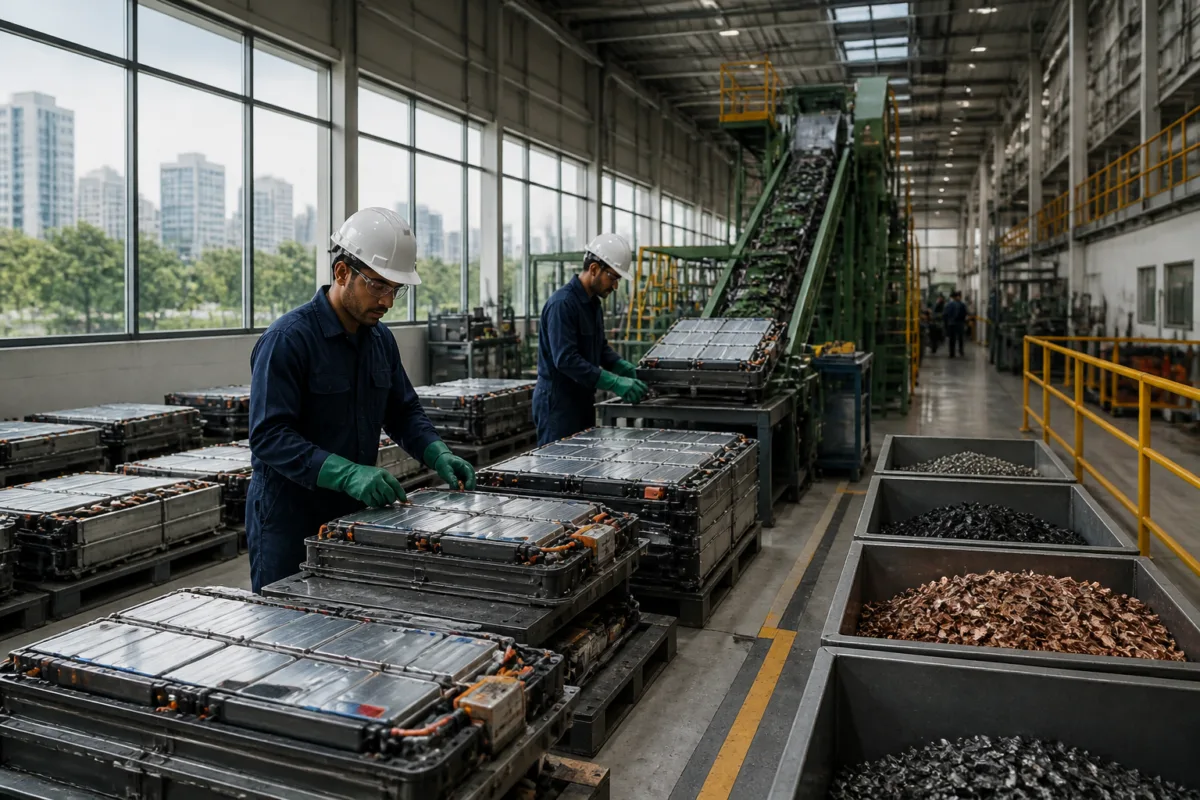
LICO Materials was founded in 2021 and works to recover, reprocess and reintegrate battery materials into the battery value chain. It processes end-of-life lithium-ion batteries at its facility in Bengaluru, Karnataka, recovers materials used in battery manufacturing and gives usable cells a second life through LiGRID, its battery energy storage system.
That combination is significant because battery recovery is not a single activity. Some batteries may be processed to recover materials, while usable cells can be repurposed for another application. The company’s description of its operations therefore covers both recycling and repurposing. The distinction is important: a battery that is no longer suitable for its original vehicle application may still have a role in stationary storage, although the supplied report does not quantify the proportion of batteries directed to either route.
The company’s stated expansion plan also reveals the infrastructure challenge behind the sector. LICO currently works with job-work partners in Uttar Pradesh and Haryana and wants to strengthen its presence in that region. It is also examining western India, including Gujarat. Over time, Dolwani said, the company may establish its own facility or acquire an existing business with relevant capabilities.
This approach indicates that geographical expansion is not simply a matter of opening another plant. It involves access to battery material, processing capability and partners with relevant technical capacity. The report does not specify the number of partners, the planned investment, the proposed locations of new facilities or the logistics arrangements involved. But the company’s reference to job-work partners shows that the sector can develop through a combination of owned assets and outsourced capacity.
The supply question is becoming more important as electric two- and three-wheeler adoption grows. Dolwani said more batteries are becoming available in the market, while the company has also been able to import batteries from other parts of the world despite the challenges involved. That access has helped it obtain material more successfully than some of its peers, he said.
The comment highlights a tension in the domestic battery-recycling ecosystem. India’s expanding electric-vehicle market can generate a future stream of end-of-life batteries, but the timing and volume of that stream depend on how quickly vehicles enter use and complete their first life. In the meantime, recycling companies may need to draw on imported material or develop partnerships across regions to maintain processing volumes.
This makes capacity utilisation as important as nominal capacity. LICO’s target of increasing processing capacity from around 4 GWh to approximately 10 GWh over three years will have commercial value only if sufficient batteries reach its facilities and can be processed efficiently. Dolwani specifically linked the revenue target to improved capacity utilisation, suggesting that installed capacity and actual throughput are separate measures of performance.
The report does not establish whether the proposed 10 GWh capacity will be concentrated in Bengaluru, distributed across multiple facilities or supported through partners. It also does not give the company’s current utilisation rate. These gaps make it impossible to assess how much of the proposed growth will come from new equipment, stronger collection networks, higher material availability or a combination of all three.
The other constraint is domestic cell manufacturing. Dolwani said cell manufacturing has taken longer than initially anticipated and involves significant technological challenges. He referred to companies establishing pilot lines, investing in research and development, and learning from earlier difficulties. In his assessment, developing cells is extremely difficult and the industry needs time to develop. He added that the policy intent is right, but execution remains the key challenge.
This observation places recycling within the wider battery value chain. Recycling firms can recover materials and return them to battery manufacturing, but the scale of that loop also depends on whether domestic cell production develops. If cell manufacturing remains limited, the domestic market for recovered materials may not expand at the same pace as processing capacity. Conversely, greater cell-manufacturing activity could create a stronger industrial destination for recovered inputs, although the supplied material does not quantify that relationship.
The institutional picture is therefore broader than the performance of an individual company. Battery recycling sits at the intersection of electric-vehicle adoption, industrial processing, manufacturing technology and materials supply. The company’s comments indicate that policy intent exists, but the report does not identify the specific policy measures, incentives or regulatory mechanisms involved. Nor does it specify how responsibilities are divided between central agencies, state governments, vehicle manufacturers, battery producers and recyclers.
That missing administrative detail is important for understanding how the sector will scale. A recycling facility requires material flows, technical processes and a market for recovered outputs. Regional expansion also involves permissions, logistics and relationships with businesses that handle used batteries. The PTI report establishes that LICO is pursuing partnerships and considering new or acquired facilities, but it does not provide the institutional framework governing those decisions.
The company’s revenue figures offer one measurable indicator of the sector’s commercial development. Revenue of approximately Rs 350 crore in 2025–26, followed by a target of Rs 450–500 crore in 2026–27, represents an intended increase of roughly Rs 100–150 crore. The company attributes that expected growth to processing volumes, capacity utilisation and battery availability rather than to a stated change in pricing or a specific acquisition.
The capacity figures provide a second indicator. Moving from around 4 GWh to approximately 10 GWh over three years would mean adding about 6 GWh of stated processing capacity. However, capacity is not the same as recovered material output. Without data on throughput, recovery rates, battery chemistry, operating utilisation or the material value recovered from each battery, the figures cannot be used to estimate the quantity of minerals that will return to manufacturing.
That distinction is central to the public discussion around battery recycling. A larger facility may improve industrial capability, but its contribution to reducing import dependence depends on what materials it recovers, how consistently it operates and whether those materials are reintegrated into the battery value chain. LICO’s stated business model is built around that reintegration, while the available report does not provide output-level data to measure it.
For urban India, the immediate lesson is that electric mobility creates infrastructure obligations beyond roads, charging stations and vehicle sales. Cities are where electric two- and three-wheelers are used at scale, but the end-of-life battery system can extend well beyond municipal boundaries. It may involve collection from dispersed users, movement to specialised facilities, processing in industrial locations and the return of recovered materials to manufacturing centres.
The company’s expansion plans across southern, northern and western India illustrate the geographical dimension of this system. Bengaluru is the current operating base, job-work partnerships are being developed in Uttar Pradesh and Haryana, and Gujarat is under consideration. These locations are mentioned as business priorities rather than as confirmed facility sites, so the eventual network remains unresolved.
What the evidence confirms is that India’s battery ecosystem is moving from a conversation about vehicle adoption towards a more complex question of industrial completion. LICO Materials is targeting higher revenue and a substantial increase in processing capacity while relying on growing battery availability, regional partnerships and the eventual expansion of domestic cell manufacturing.
What remains uncertain is whether battery supply, utilisation, technology development and policy execution will advance at the same pace. The company’s next phase will be measured not only by the capacity it announces, but by the volume it processes, the materials it recovers and the extent to which those materials re-enter India’s battery manufacturing chain.

