


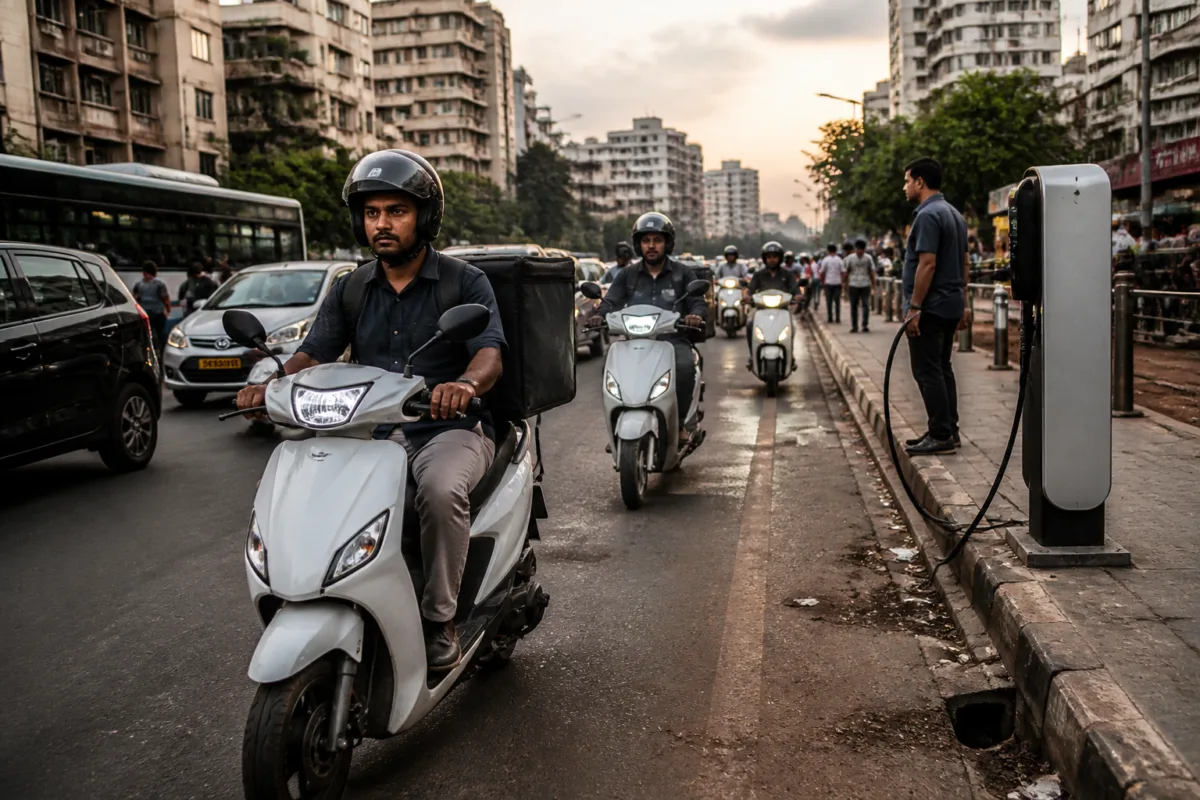
Eternal’s decision to reassess its 2030 target for a 100 per cent electric delivery fleet reveals a central difficulty in India’s urban transition to cleaner transport: electrification is not only a question of vehicle availability, but also of scale, affordability, policy coverage and livelihoods. The Zomato and Blinkit parent remains committed to electric mobility, but its own expansion has made the original deadline harder to achieve.
In an interview with PTI, Eternal Chief Sustainability Officer Anjalli Ravi Kumar said the company was working towards a revised timeline. The review will consider the availability of electric vehicles, supporting government policies and the transportation requirements of the group’s different businesses. Kumar said the company remained “deeply committed” to electrification because it still made economic sense, while acknowledging that the earlier target did not appear feasible.
The reassessment is significant because the original target was set for a much smaller operation. When it was announced, Zomato had about 1.5 lakh monthly active riders, Kumar said. The group now has 12 lakh riders across Zomato and Blinkit. That growth changes the nature of the target: the question is no longer whether a company can electrify a defined fleet, but whether an expanding platform can reliably provide access to suitable vehicles for millions of workers across a geographically dispersed network.
Kumar said Eternal needs to onboard about 30 lakh people a year to maintain a monthly base of 12 lakh riders. These workers operate across 900 cities, making uniform access to electric vehicles difficult to guarantee. The scale also means that the company cannot treat vehicle procurement as a single corporate purchase. Delivery partners generally arrange their own vehicles, so the transition depends on household finances, rental availability, local charging access, vehicle reliability and the economics of individual delivery work.
This is the first major structural lesson from the revised target: fleet electrification is partly an urban infrastructure problem and partly a labour-market problem. A company may set a group-wide objective, but the actual transition occurs through thousands of individual decisions made by workers. For a rider, choosing an electric vehicle involves an upfront financial commitment and a calculation about operating costs, maintenance, charging time and the availability of support in the city where the work is performed.
Eternal’s own figures indicate that its delivery fleet has adopted electric vehicles faster than the broader Indian two-wheeler market. Kumar said a previous estimate put market-wide EV penetration at about 6-7 per cent, while around 12-13 per cent of the company’s partners were already using electric vehicles. That placed the company’s fleet at almost twice the wider market penetration at the time of the estimate.
The comparison, however, also shows why early adoption does not automatically translate into a rapid path to complete electrification. Moving from a relatively small base to a majority-electric fleet is different from moving from majority adoption to 100 per cent. The remaining users may face the highest barriers: they may lack access to affordable vehicles, operate in cities with weaker support systems or require four-wheelers and commercial vehicles that are not interchangeable with electric two-wheelers.
Eternal’s incentive model reflects this complexity. The company does not mandate a particular vehicle choice. Instead, it encourages adoption through financial incentives, rental options and awareness initiatives. Under its equal-benefit policy, delivery partners using electric vehicles receive the same payments as those using petrol-powered vehicles, even though their operating costs may be lower. The company also provides access to rental options through its delivery partner app and organises initiatives such as EV Bazaar to familiarise partners with available models.
That approach treats electrification as a participation problem rather than only a compliance problem. A mandate could shift responsibility to workers without resolving the cost and access barriers that prevent adoption. Incentives and rentals can reduce some of those barriers, but the source material does not establish how many partners use these programmes, how much they cost or whether they are available uniformly across all 900 cities. Those unanswered questions are important because the effectiveness of a national fleet transition may depend on local implementation rather than on a single corporate policy.
The group-wide nature of the revised target adds another layer. Eternal’s businesses do not all use the same type of vehicle. Zomato and Blinkit rely heavily on two-wheelers for last-mile delivery, while Hyperpure uses trucks and smaller commercial vehicles for four-wheeler deliveries. A target designed around electric two-wheelers cannot simply be applied to the full group. The transition therefore involves different vehicle categories, operating patterns and infrastructure requirements.
This distinction matters for urban planning. Two-wheelers can serve dense neighbourhood delivery networks, while commercial vehicles may require different charging arrangements, loading spaces and operating schedules. The supplied material does not provide details of Eternal’s charging infrastructure or the share of its activity accounted for by different vehicle types. It does, however, make clear that a single percentage target must eventually cover more than one transport system.
Government policy is consequently part of the company’s timetable. Kumar said a revised date, possibly including a 2035 ambition, would depend partly on whether EV policies were rolled out sufficiently across the country. She did not commit to 2035, saying the company was actively working towards a date and remained hopeful about the policy environment.
The policy issue is not limited to purchase subsidies. For delivery workers, an effective policy framework must also address access to vehicles, rental and financing options, charging availability and the risk that a worker could be excluded from employment because an electric vehicle is unaffordable or unavailable. Kumar said Eternal was advocating worker-friendly EV policies so that cleaner mobility would not restrict employment opportunities for people who could not purchase electric vehicles.
That concern places delivery platforms at the intersection of climate policy and urban livelihoods. The expansion of app-based delivery has created a large, flexible workforce whose vehicles are often privately arranged. If policymakers focus only on vehicle sales or aggregate adoption rates, they may miss the operational conditions that determine whether workers can use those vehicles for long hours across multiple trips. Conversely, if companies absorb the full cost of transition, the economics of delivery services could change, although the supplied material does not quantify those effects.
Eternal’s reassessment also shows how corporate sustainability targets can be altered by business growth. The original 2030 goal was not abandoned because the company rejected electrification. It became harder because the scale and composition of the business changed. The rider base expanded from 1.5 lakh monthly active riders to 12 lakh across two major businesses, while the group’s transport needs now include Hyperpure’s four-wheelers and smaller commercial vehicles.
The same tension appears in Eternal’s packaging initiatives. Through Hyperpure, the company sold more than 3,000 metric tonnes of sustainable packaging to 50,000 restaurants last year. More than 10,000 restaurants across over 400 cities received Zomato’s low-plastic packaging tag after verification that the packaging used for their main menu was sustainable. The PackSwitch platform is intended to help restaurants identify alternatives to plastic packaging, improve supplier access and connect with startups developing new solutions.
These figures show the breadth of the company’s sustainability agenda, but they also underline the importance of distinguishing between participation and system-wide transformation. A packaging platform can help restaurants identify alternatives, while an EV programme depends on vehicles, finance, charging and worker decisions outside the company’s direct control. In both cases, the central challenge is reducing complexity, inconvenience and cost—the three barriers Kumar identified for sustainable packaging adoption.
For cities, the larger question is whether rapid digital-service growth can be matched by equally rapid investment in the systems that support it. Delivery workers are part of the everyday transport network, even though they are often treated as individual users rather than as a coordinated urban fleet. Their vehicles add to traffic, enable access to food and goods, and increasingly shape demand for charging, parking and curb space.
Eternal’s revised timeline does not establish that India’s EV transition is failing. It shows instead that corporate targets are sensitive to the conditions in which cities grow. The company has higher EV penetration in its delivery fleet than the broader two-wheeler market and remains committed to electrification, but it cannot yet guarantee reliable access to electric vehicles for the 30 lakh people it may need to onboard annually across 900 cities.
The developments to monitor are therefore concrete: the revised group-wide target, the policy measures adopted across states and cities, the availability of electric two-wheelers and commercial vehicles, and the extent to which rental and incentive programmes reach delivery partners. Until those systems expand alongside the fleet, a 100 per cent EV deadline will remain as much a test of urban institutions and worker access as of corporate ambition.

