


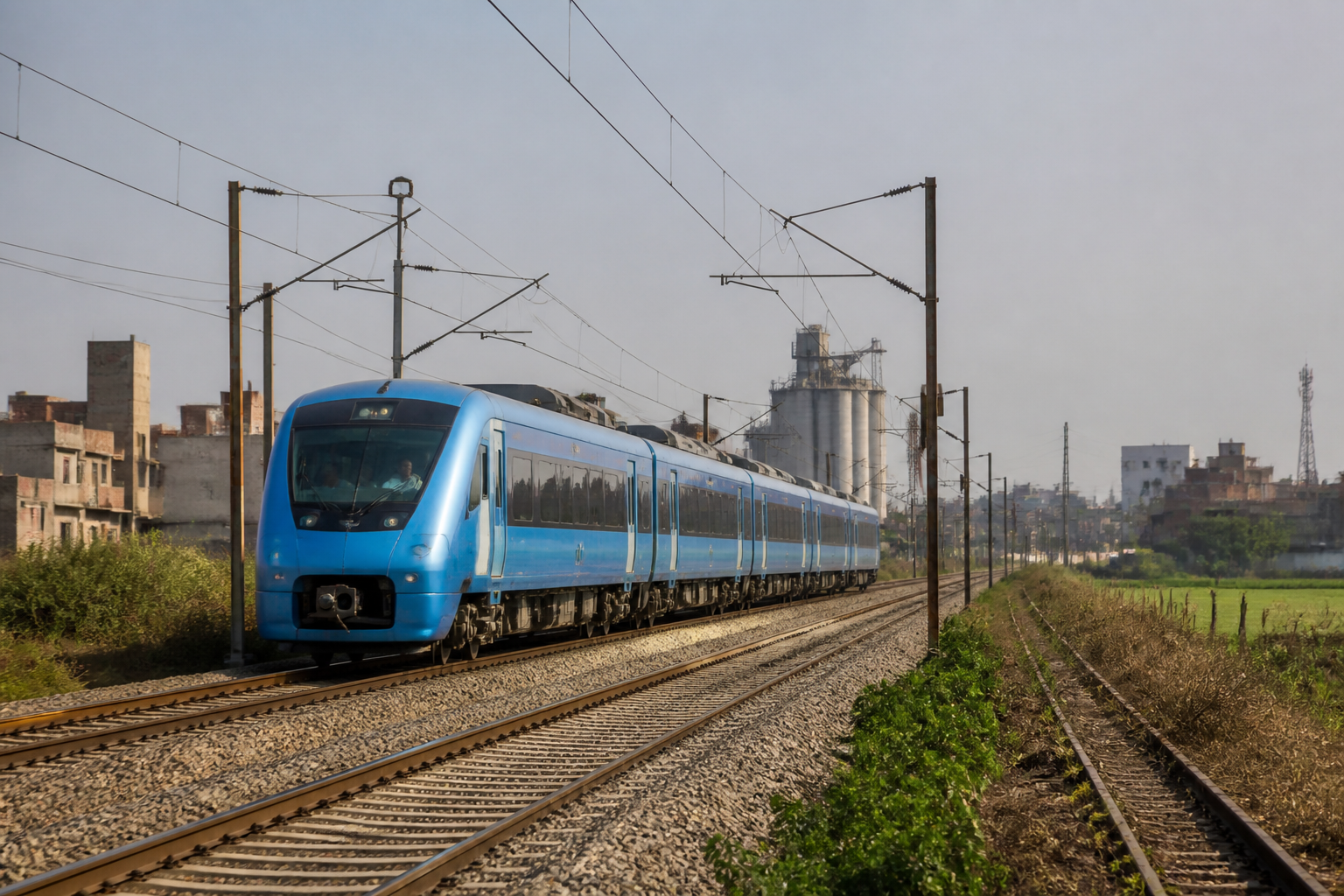
India’s first hydrogen train was introduced as a symbol of cleaner rail transport, but its early operation on the 89-kilometre Jind–Sonipat section is revealing a more basic problem: new technology cannot create demand where the transport network does not connect enough people, jobs and destinations. According to a report by Aaj Tak Business, the 2,600-passenger train is typically carrying only 40 to 60 passengers on its full journey. The low ridership has led Indian Railways to examine whether the service should be extended to Delhi’s Azadpur station or operated on a wider circuit through industrial and urban centres.
The reported numbers are stark. A train designed for a capacity of about 2,600 passengers is running with occupancy equivalent to only a small fraction of that capacity. The service is currently making one round trip a day, although the initial plan was for two daily round trips between Jind and Sonipat. Northern Railway has reportedly been operating the train for around two months, while a specialist team is monitoring both its operation and the new technology involved.
That contrast turns the hydrogen train from a technology story into a public transport planning story. The immediate question is not simply whether hydrogen propulsion works. It is whether the service has been placed on a corridor where enough passengers need to travel, whether it is integrated with larger commuter flows, and whether its capacity and operating pattern match the geography of demand.
The Jind–Sonipat corridor appears to have a limited base of daily commuters. Railway employees cited in the report said the earlier DEMU service on the same route also had low passenger numbers. Three other DEMU trains currently operate on the section, but they too are not reported to be heavily crowded. The stated reason is that the number of office commuters and industrial workers travelling daily between Jind and Sonipat is limited.
This detail is important because it separates the performance of the hydrogen train from the performance of hydrogen technology itself. If an older service on the same route also struggled to attract passengers, then replacing or upgrading the rolling stock does not address the underlying demand problem. The issue may lie in the corridor’s employment geography, station accessibility, timetable, competing travel options or the absence of a larger network into which the service can feed. The supplied report does not establish which of these factors is decisive, but it does show that the ridership challenge predates the hydrogen train.
The proposed extension to Delhi is therefore an attempt to alter the service’s catchment area. Azadpur is a major wholesale fruit and vegetable market and a significant urban destination. Bringing the train into Delhi could make it more useful to passengers who need to reach the capital rather than stop at Sonipat. Local residents have also reportedly been demanding an extension to Delhi. In transport terms, the proposal would connect the train to a larger metropolitan economy instead of leaving it within a relatively weak intercity demand corridor.
However, extending a train into a large metropolitan network is not automatically the same as improving its usefulness. The report identifies several operational constraints. The hydrogen train has 10 coaches and a stated capacity of about 2,600 passengers. Railway officials indicated that services originating in Delhi may need 18 to 20 coaches or more if they are to carry larger passenger volumes. That creates a mismatch between the train’s present configuration and the scale of demand expected on a Delhi-linked service.
The Delhi rail network also has much higher traffic intensity. Finding a suitable path for an additional service would require track availability and timetable coordination. The train cannot be treated as an isolated demonstration service once it enters a busy metropolitan network. Its timings, turnaround, platform use and interaction with existing trains would become part of a broader capacity-management problem. The supplied report does not provide a proposed timetable or confirm that a path has been allocated, so the extension remains an option under examination rather than an approved service change.
Fuel logistics present another institutional and operational question. Railway officials cited in the report said the train can travel approximately 250 to 300 kilometres on a full hydrogen tank. The distance between Delhi and Jind is about 130 kilometres, which suggests that the train could cover the journey on one tank based on range alone. But refuelling is currently available only at Jind. An extension to Delhi would therefore have to account for where and when the train is refuelled, how the service is scheduled around that requirement, and whether the existing arrangement is sufficient for regular operations.
This is a useful distinction in the debate over alternative-fuel transport. Vehicle range is only one part of a transport system. The location of fuel infrastructure, maintenance facilities, safety procedures and operational staff can determine whether a service is practical. In the case of the hydrogen train, the report indicates that the current fuelling arrangement was designed around Jind. A longer route would require the railway to incorporate that fixed facility into a service operating across a wider geography.
A second proposal comes from local passengers: instead of taking the train directly to Delhi, the railway could run it from Jind through Sonipat, onward to Panipat and then through Safidon before returning to Jind. The suggested circuit would cover approximately 180 kilometres and include Panipat, an important industrial centre. The argument behind this option is that the train could serve a larger set of employment and commuter destinations without entering Delhi’s congested rail network.
The two options represent different approaches to the same problem. The Azadpur extension seeks to connect the service with the scale and attraction of the National Capital Region. The Panipat–Safidon circuit seeks to build demand by linking more regional destinations, particularly an industrial centre. Neither option has been approved, and the report does not provide passenger forecasts for either route. Their significance lies in the planning choice they present: whether to concentrate on a major metropolitan destination or create a broader regional loop.
The hydrogen train began operations on 17 July and has been presented as an indigenous step towards cleaner and more sustainable railway technology. Unlike a conventional diesel engine, the train uses hydrogen to generate electricity for propulsion. The report places India among a limited group of countries working on hydrogen-based rail transport. That technological achievement has a symbolic value, but the service’s early performance shows why demonstration projects need to be judged on more than technical novelty.
A public transport service has to work as a system. It must have a viable route, suitable frequency, convenient access, reliable connections and a passenger base large enough to justify its operation. A high-capacity train running on a lightly used corridor can produce an impressive technology image while delivering limited mobility value. Conversely, a smaller or differently scheduled service may provide greater public benefit if it is matched to actual travel patterns. The supplied evidence does not establish the financial cost of the hydrogen service or its emissions performance compared with the DEMU trains it replaced or supplements, so those questions remain open.
The decision-making structure is also significant. Northern Railway is operating the train, a specialist team is monitoring the technology, and the final decision on any extension will depend on safety, technical requirements and operational feasibility. This places the service at the intersection of several responsibilities: railway operations, infrastructure capacity, alternative-fuel safety and regional mobility planning. The railway’s stated position is that there will be no haste because hydrogen is a new technology and passenger safety is the first priority.
That caution is appropriate to the evidence available. The low ridership is clear, but the solution is not. Extending the train to Delhi could enlarge its passenger base, yet it could also expose limitations in coach capacity, track availability and refuelling arrangements. A regional circuit could bring the train closer to industrial and commuter demand, but its effectiveness would depend on station access, timings and the actual volume of travel between the proposed destinations.
The central lesson from the Jind–Sonipat experiment is that clean mobility transitions are not only engineering projects. They are also exercises in network design and demand assessment. The hydrogen train has demonstrated that India can deploy a new propulsion technology in passenger service. It has not yet demonstrated that the technology has been placed on the right corridor or that the existing operating model can attract enough passengers.
Indian Railways is now weighing two possible responses: a Delhi extension to Azadpur and a longer circuit through Panipat and Safidon. The final decision is expected to follow further review of safety, technical requirements, track availability, fuelling arrangements and operational practicality. Until that review is complete, the train’s empty seats remain less a verdict on hydrogen than a warning that infrastructure innovation must be tied to the everyday geography of urban and regional travel.
