

HomeCitiesHyderabadHyderabad Traffic Congestion Tests Urban Mobility

Hyderabad Traffic Congestion Tests Urban Mobility

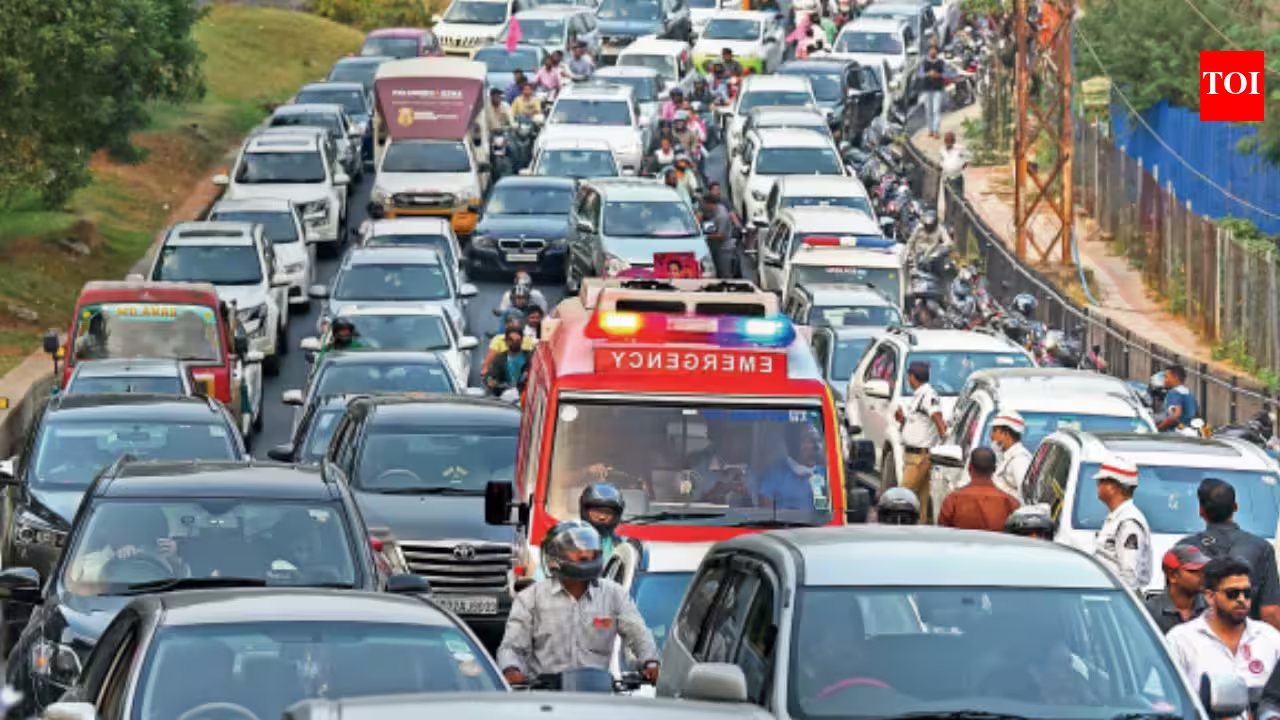
HYDERABAD: Hyderabad is facing a growing mobility challenge as longer travel times and persistent peak-hour delays increase the daily cost of moving across the city. TomTom’s 2025 Traffic Index shows that a 10-km journey in Hyderabad took an average of 32 minutes 37 seconds, placing the city fourth among major Indian cities by average travel time for that distance.

The figure is more significant during rush hour. TomTom recorded an average morning travel time of 34 minutes 53 seconds for 10 km, while the evening journey stretched to 39 minutes 28 seconds. Average speeds during these periods fell to 17.2 kmph and 15.2 kmph respectively. Across the year, commuters lost about 123 hours to rush-hour traffic. (TomTom) The data also shows that Hyderabad’s congestion problem is not simply about slow-moving vehicles. The city recorded a 55.5% average congestion level in 2025, although that was 1.3 percentage points lower than the previous year. On the broader Indian ranking based on congestion level, Hyderabad stood eighth, indicating that its position as a slow city depends on the measure being considered rather than a single overall ranking.  For households and businesses, the impact extends beyond time spent behind the wheel. Longer journeys can affect employee productivity, delivery schedules, operating costs and access to jobs and services. For a city whose economic expansion is increasingly spread across western and northern growth corridors, unreliable journey times can also influence where people choose to live and work.

Vehicle growth is adding to the pressure. Recent traffic data indicates that Hyderabad has close to 88 lakh registered vehicles, with roughly 1,500 new vehicles being added each day. The primary road network, however, has not expanded at the same pace, intensifying pressure on major corridors. The problem becomes sharper when road capacity is treated as the main answer to rising demand. Expanding carriageways can provide temporary relief, but continued dependence on private vehicles can eventually recreate the same bottlenecks. Urban planners increasingly point to the need for reliable public transport, safer walking and cycling networks, better interchange facilities and coordinated land-use planning. That approach is particularly relevant for Hyderabad’s emerging employment and residential districts. A more connected public transport system could reduce dependence on private vehicles while making access to employment less dependent on household vehicle ownership.

Hyderabad’s traffic numbers therefore point to a wider urban planning question: whether the city can accommodate economic and population growth without allowing longer commutes and rising vehicle dependence to become a permanent feature of daily life. Future mobility investments will need to focus not only on moving more vehicles, but on helping more people reach work, education and essential services efficiently and sustainably.

Read More: Hyderabad Commuters Face Disruption From Auto Strike
Hyderabad Traffic Congestion Tests Urban Mobility
RELATED ARTICLES

Most Popular

Latest News