


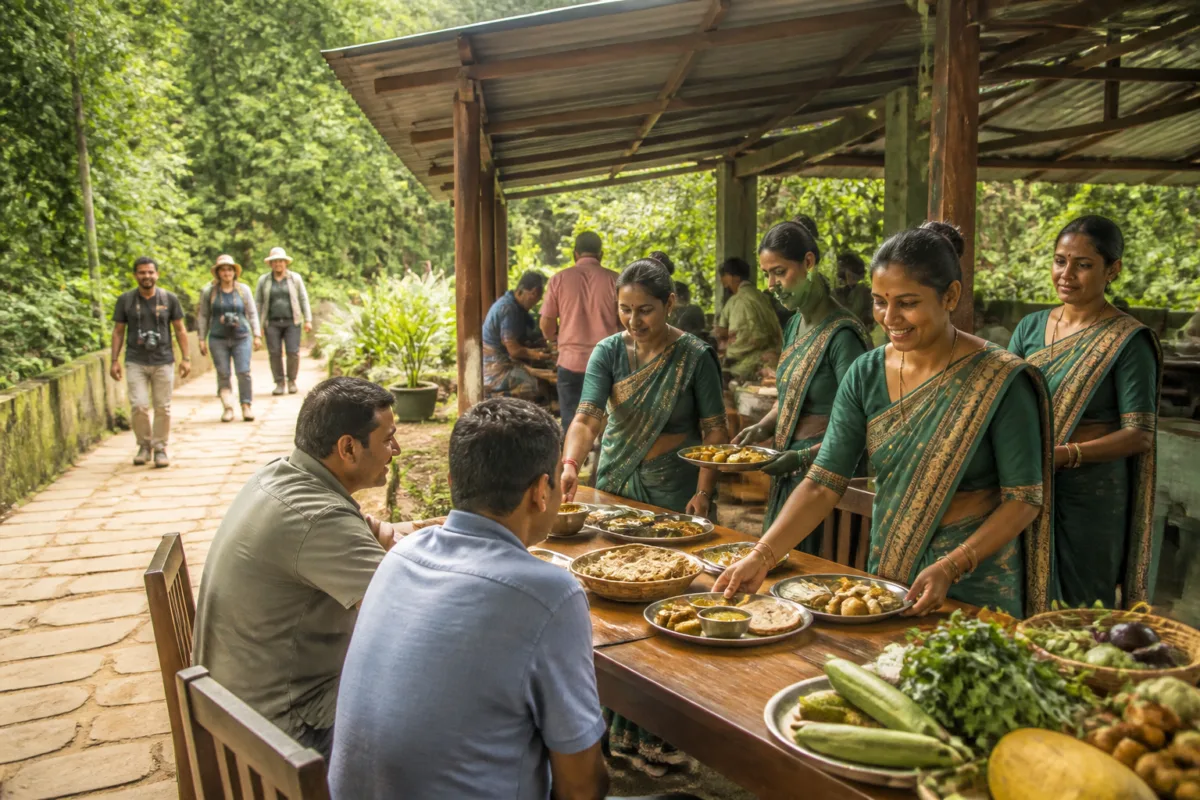
Gujarat’s Vanashree model is showing how a small tourism facility can become more than a place for visitors to eat. In the state’s Vyara forest division, four restaurants operated by tribal women’s self-help groups have together recorded annual turnover of more than Rs 1 crore and supported around 100 families, according to a state government statement reported by Times of India. The initiative links forest tourism with local food, women’s enterprise and the sale of agricultural produce.
The reported figures are significant not because they establish a universal formula for rural tourism, but because they illustrate a less visible part of the built environment: the economic infrastructure around a destination. A restaurant, a visitor route, a supply chain for local produce and a self-help group may appear separate in administrative files. In practice, they can function as one livelihood system when visitors create demand and local communities retain a meaningful role in meeting it.
That connection is central to understanding the Vanashree initiative. The restaurants do not only provide food to tourists. They serve traditional tribal cuisine, including nagli rotla, traditional pulses and nagli laddoos, while also promoting local agricultural produce. The model therefore combines a visitor-facing commercial activity with the preservation and sale of regional food practices. The government’s account describes this as forest tourism and livelihood generation operating together.
The four restaurants are run by women’s self-help groups, with more than 50 women directly involved in their operation. This organisational structure matters. The reported shift is not simply from unemployment to employment, but from daily-wage labour to an enterprise model in which women participate in running establishments, serving customers and managing a local product economy. The supplied report does not provide the precise ownership, revenue-sharing or management arrangements, so the extent of decision-making power within the groups cannot be independently assessed from the available material. It does, however, identify the self-help groups as the operating institutions behind the restaurants.
The distinction between daily-wage work and enterprise is important in regions where incomes can be irregular. A daily-wage worker is generally dependent on the availability of work on a given day. An enterprise linked to a steady visitor flow can create a different income pattern, although the report does not establish how seasonal demand, operating costs or profits are distributed. The state government said the Vanashree restaurants have helped improve financial security for tribal families, enabling them to support children’s higher education and meet medical expenses without depending on others.
Those outcomes are reported claims rather than independently audited findings in the supplied material. Still, they point to the kind of impact that standard tourism counts often miss. Visitor numbers and revenue are usually treated as the main measures of a destination’s success. The Vanashree account adds another measure: whether tourism income reaches households, strengthens women’s economic roles and supports spending on education and healthcare.
The annual turnover figure also needs to be read carefully. More than Rs 1 crore across four restaurants indicates gross business activity, not necessarily net income for the women’s groups or the families connected to them. The report does not provide expenditure, wages, procurement costs, margins or the proportion of revenue retained locally. Nor does it specify whether the four establishments operate throughout the year or whether the turnover is concentrated during particular tourism periods. These details would be necessary to evaluate the model’s financial durability.
Even with those limitations, the reported scale is useful. Around 100 families are said to benefit from the initiative, while more than 50 women are directly involved in running the restaurants. This suggests that the restaurants’ local economic reach extends beyond the people working at the counters or in the kitchens. Families may benefit through food supply, agricultural produce, transport, preparation and other associated activities, although the supplied report does not break down these links.
This is where the initiative connects to a larger planning question. Tourism infrastructure is often designed around the visitor: access, parking, accommodation, attractions and consumption. A livelihood-centred approach asks a second question: who participates in the destination’s economy, and what local systems are strengthened when visitors arrive? In the Vanashree model described by the government, the answer includes women’s groups and producers of traditional food. That gives the tourism facility a role in local economic organisation, not merely visitor servicing.
The model also demonstrates the value of anchoring tourism in place-specific culture. The restaurants serve food associated with the tribal communities of the region rather than relying only on standardised menus. This can make the visitor experience more distinctive while creating a market for local agricultural and culinary practices. The report does not claim that the initiative has preserved particular crops or increased farm incomes by a measured amount, so those conclusions cannot be drawn. The supported point is narrower: the restaurants promote traditional food and the sale of local agricultural produce.
For government, the institutional lesson is that livelihood outcomes depend on more than constructing or designating a tourism site. They require an operating mechanism through which local groups can access customers. In this case, the state government presents self-help groups as the delivery structure and the forest tourism setting as the source of demand. The initiative’s success, if sustained, would therefore depend on the relationship between public forest administration, tourism activity, community organisations and local suppliers.
The supplied report does not identify the programme’s capital cost, the role of the forest department, the terms under which the restaurants use forest land or facilities, or the training and procurement support provided to the women’s groups. It also does not state whether the model is being considered for replication in other forest divisions. Those are important administrative questions because community-run tourism can be affected by permissions, maintenance responsibilities, visitor management, food safety requirements and the stability of institutional support.
There is also a physical planning dimension. Forest tourism can bring economic opportunity, but it must operate within the carrying capacity and environmental conditions of a forest landscape. The available material does not provide visitor numbers, waste-management arrangements, water use, energy systems, access-road details or ecological monitoring. It would be premature to describe the Vanashree model as environmentally sustainable on the basis of the reported livelihood outcomes alone. What can be said is that the initiative places economic activity within a forest tourism setting, making the management of that setting relevant to its future performance.
The same caution applies to the language of empowerment. The reported movement of women from daily-wage labour to entrepreneurship is an important institutional claim, but entrepreneurship can take different forms. It may involve ownership, collective management, paid work or a combination of these. Without details of governance and earnings, the precise nature of the transition remains unclear. The report establishes the government’s description of the model, not a complete assessment of its internal power structure.
Nevertheless, the numbers provide a clear basis for seeing the initiative as more than a promotional announcement. Four restaurants, annual turnover above Rs 1 crore, more than 50 women directly involved and around 100 families benefiting together describe a functioning local economic network, according to the state government. The information is not sufficient to compare Vanashree with other tourism or livelihood programmes, but it is sufficient to identify the model’s central proposition: community-operated food enterprises can connect visitors to household incomes.
For cities and larger urban regions, that proposition matters because the economic relationship between urban visitors and rural or forest destinations is often treated as a one-way flow of spending. A visitor leaves a city, consumes services at a destination and returns. A locally operated tourism model can retain more of that spending in the host community, provided the institutions managing it are transparent and the operating economics remain viable. The Vanashree report offers evidence of that intended connection, though not yet the detailed data needed to measure its full distribution.
The immediate significance of the Gujarat example is therefore institutional. It shows how a public tourism setting can be used to create a market for local cuisine and agricultural produce, while placing women’s self-help groups at the centre of service delivery. The larger question is whether such models can maintain income, protect the ecological setting and give communities durable control over the activity. The next evidence to watch would include detailed revenue and cost data, the terms of group participation, visitor trends, procurement links and environmental management arrangements.
Based on the supplied report, the Vanashree model has generated more than Rs 1 crore in annual turnover across four restaurants and is benefiting around 100 tribal families in Gujarat’s Vyara forest division. Its reported achievement is the creation of a livelihood link between forest tourism, women-led enterprise and local food. Its longer-term performance remains dependent on operational, financial and environmental details that have not been provided.

