


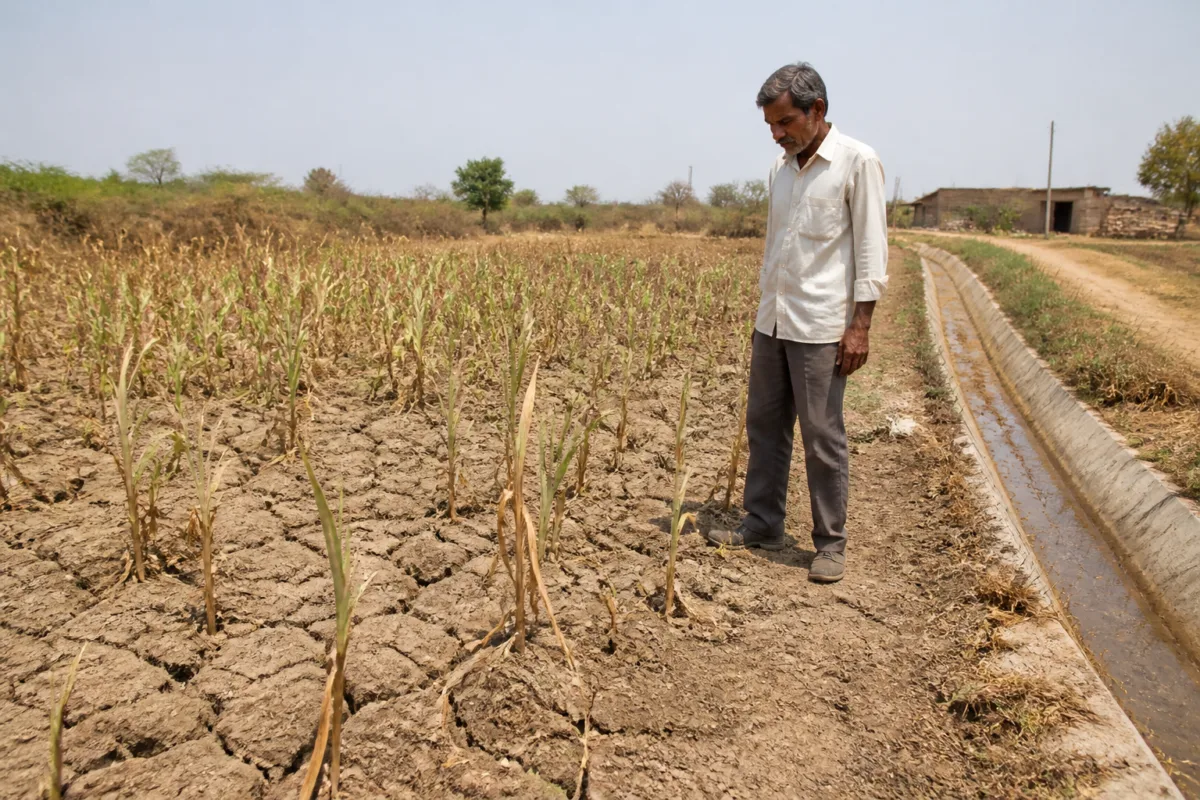
Gujarat has declared Devbhumi Dwarka, Kutch, Porbandar and Jamnagar drought-hit after the four districts recorded sharply deficient monsoon rainfall, triggering crop-loss assistance, subsidised fodder and expanded rural employment for affected communities.
Chief minister Bhupendra Patel said the declaration was made after the monsoon ended and followed the Centre’s 2016 drought guidelines. The status will remain in effect for six months, he said at a media briefing in Gandhinagar.
Although Gujarat received 89% of its overall seasonal rainfall, the four affected districts recorded substantially lower levels. Devbhumi Dwarka received 16.5% of its seasonal rainfall, followed by Porbandar at 30.9%, Jamnagar at 43.3% and Kutch at 57.6%.
The deficit is more severe in several talukas. Kalyanpur in Devbhumi Dwarka received 8% of its seasonal rainfall, while Khambhaliya received 15%, Porbandar taluka 19% and Dwarka taluka 20%. In Kutch, Abdasa received 38% of seasonal rainfall, Lakhpat 48% and Nakhatrana 47%.
Under the relief package, farmers whose crops have failed will receive Rs 8,500 per hectare through the State Disaster Response Fund, subject to a maximum of two hectares. The state has also begun supplying fodder at a discounted rate of Rs 2 per kilogramme. Patel said there was no shortage of fodder stock in Gujarat.
The government will provide 150 days of employment under the Viksit Bharat–Guarantee for Rozgar & Ajeevika Mission (Gramin) in the affected districts. The employment component will begin on November 1, according to the chief minister.
Livestock owners and cattle shelters are also included in the response. The government will provide Rs 80 per cattle to cattle shelters for animal upkeep, Patel said, while reiterating that farmers and livestock owners would receive state support during the period of distress.
The drought declaration also affects the management of irrigation and drinking water. The state government said water had been supplied to the command areas of 44 dams during the kharif season based on demand. Gujarat’s 206 major dams currently hold 66% of their storage capacity.
For the rabi season, irrigation supply has been planned for the command areas of 76 dams. These areas are expected to receive between one and four rounds of watering, depending on available water. Drinking water has been reserved until June 30, 2027, with domestic consumption receiving priority.
The declaration is Gujarat’s first involving multiple districts since 2018, when the state classified 51 talukas, mainly in north Gujarat and Saurashtra, as drought-hit. The current decision is based on district-level rainfall deficits but includes talukas where the recorded shortfall is considerably deeper.
The assistance package has already drawn criticism from the Gujarat Kisan Congress. Its president, Pal Ambaliya, described the Rs 8,500-per-hectare support, capped at two hectares, as inadequate for farmers who had lost their entire crop. He said the organisation had asked the government to substantially increase the assistance.
The immediate response now depends on the rollout of crop-loss compensation, fodder distribution, rural employment and planned irrigation. The drought declaration will remain operational for six months under the state government’s stated framework.

