


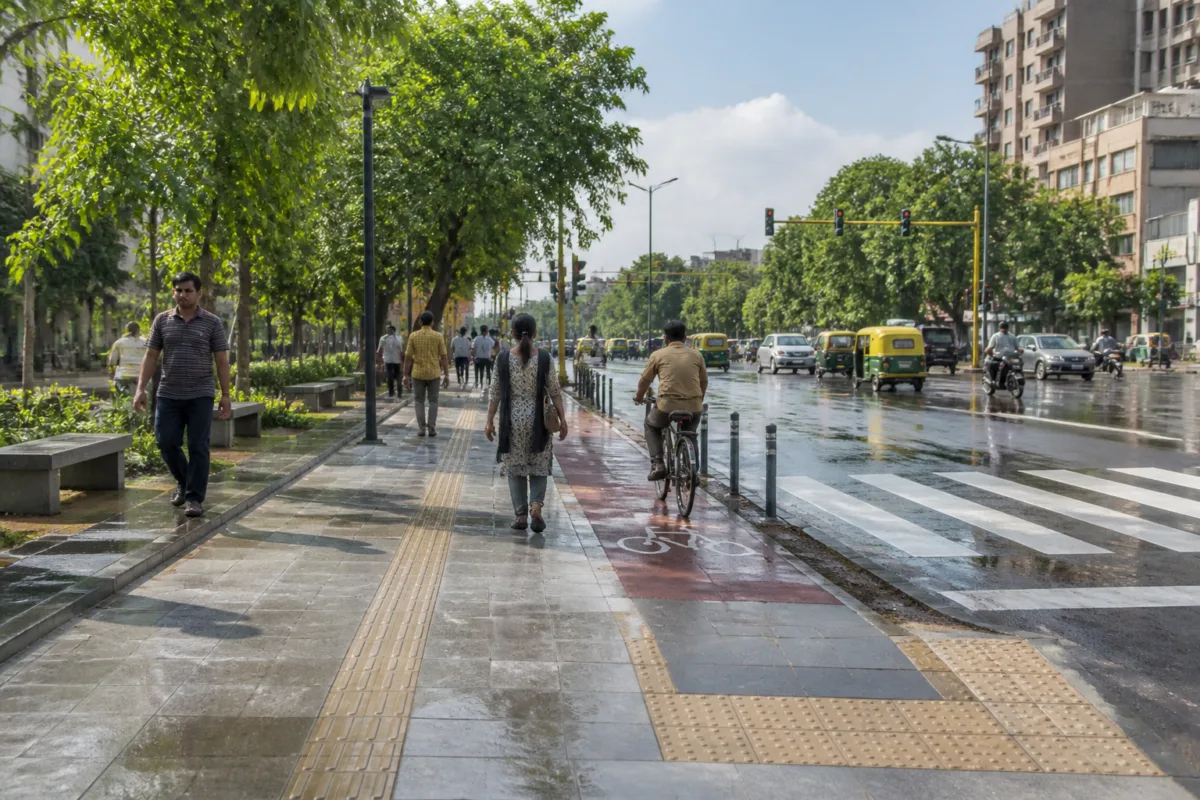
Gujarat’s new urban street design rules place pedestrians at the top of a five-tier road-user hierarchy and private car owners at the bottom, while making continuous footpaths, safer junctions, cycling infrastructure and time-bound road repairs mandatory across 169 urban local bodies.
The Urban Development Department’s Guidelines for Road Construction, Street and Junction Design and Signage in Urban Areas apply to municipal corporations and other urban local bodies, including Ahmedabad, Surat, Vadodara and Rajkot. The guidelines require footpaths on both sides of every urban street and state that engineers cannot remove them from a road design.
Walking zones must be continuous and free of obstructions. The prescribed clear width is 3 metres on arterial roads, 2.5 to 3 metres on sub-arterial roads and 2 metres on local streets. Shared streets are required to have a continuous level surface. The guidelines also cap turning radii at 6 to 9 metres on local streets and 12 to 15 metres on arterial roads, measures intended to control vehicle speeds at junctions.
The rules specify that medians must be at least 1.2 metres wide and refuge islands 2 metres wide. Kerb ramps must have a maximum slope of 1:12, a minimum width of 1.2 metres and tactile pavers for visually impaired pedestrians. Traffic signals must provide pedestrian crossing time based on a walking speed of 1 metre per second, followed by a clearance interval of three to seven seconds.
Cycle tracks must be 2 metres wide when designed for one-way movement and 3 metres wide for two-way movement. They must be kept clear of parked vehicles and vendors. A 1.5-metre multi-utility zone is prescribed for vendors’ stalls, benches, bins, tree pits and streetlights, keeping those uses outside the main walking path. Signboards must be installed at specified intervals and cannot be placed in the middle of footpaths, on ramps, zebra crossings, trees, poles or stalls.
The guidelines also connect street design to drainage and road maintenance. No street project will be approved without a functioning drainage network. Cross-slopes are set at 2.5% for bitumen roads and 2% for concrete roads, while cement concrete is required where groundwater is within 1.5 metres of the surface or annual rainfall exceeds 800mm. Verges are to be made dust-free using concrete kerbs and shrubs.
New main roads must include 300mm RCC NP-3 cross-ducts at four-sided junctions. Road-opening permits will not be issued during a contractor’s three-year defect liability period, and contractors will have to repair damage at their own cost. Monsoon damage must receive base filling within 24 hours, while hazardous defects must be removed within 48 hours.
The guidelines require engineers to upload geotagged before-and-after photographs within 72 hours of repair work. Each civic body must also operate a citizen reporting app modelled on the Roads and Buildings Department’s Guj Marg platform, allowing residents to submit geotagged photographs of damaged road infrastructure.
Urban local bodies must publish details of roads under contractor liability twice a year, on July 1 and November 1. The disclosures are to include contractor names, project costs and inspection scores. The state is preparing to host the Commonwealth Games in 2030 and is also preparing a bid for the 2036 Olympics, according to the report.

