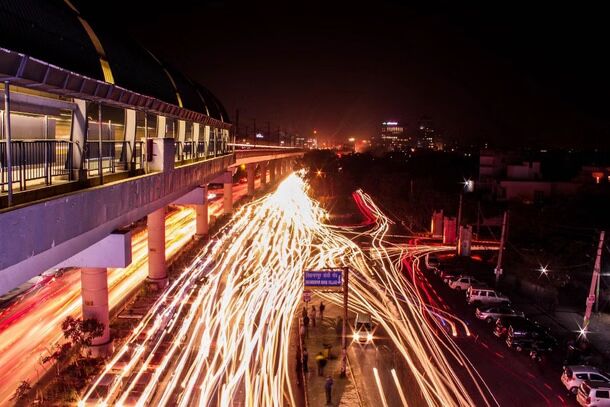
Gurugram is preparing a targeted expansion of its internal road network along the Southern Peripheral Road (SPR), with plans for new service lanes and the completion of a long-delayed connector expected to ease mounting traffic pressure in one of the city’s fastest-growing urban corridors. The Gurugram Metropolitan Development Authority (GMDA) is drafting a proposal to construct nearly 3.5 km of service roads across key sectors adjoining the SPR, particularly between sectors 70–70A and 70–75.
These stretches are designed to separate local and through traffic, a longstanding gap in the city’s road planning that has contributed to daily congestion on the arterial route. In parallel, authorities have moved to complete a critical 900-metre “missing link” between sectors 68 and 69—an incomplete segment that has disrupted connectivity for years. Once finished, the stretch will connect Sohna Road to multiple residential and commercial sectors, creating an alternative corridor to the heavily burdened SPR. Urban planners view the intervention as a shift from large-scale highway expansion to more granular, network-based mobility solutions. Instead of funnelling all vehicles onto a single arterial road, the plan aims to distribute traffic across parallel routes and internal connectors. This approach is increasingly seen as essential in rapidly urbanising districts where real estate growth has outpaced infrastructure provisioning.
The SPR itself, a key east–west spine linking NH-48 with Sohna Road, has witnessed intense development over the past decade, with residential clusters, office spaces and retail hubs expanding along its length. However, the lack of continuous service lanes and internal road integration has forced local traffic to merge with high-speed vehicles, creating persistent bottlenecks and safety concerns. The proposed upgrades attempt to address this imbalance. Design elements for the sector-dividing road include dual carriageways, service lanes, cycle tracks and pedestrian pathways, signalling a gradual move towards more complete street planning. While still road-centric, such features could improve last-mile accessibility and reduce dependence on informal mobility solutions. For residents, the immediate benefit lies in improved access. The completion of the missing link is expected to unlock a roughly 5 km alternative route, reducing travel time between sectors and easing pressure on major junctions that currently experience peak-hour gridlock. Yet, the project also reflects a deeper structural challenge. Gurugram’s growth has been largely driven by private development, often without synchronised investment in public transport and street-level infrastructure. As a result, car dependency remains high, and road expansions risk becoming reactive responses rather than long-term solutions.
Mobility experts argue that while service roads can improve traffic flow in the short term, sustained decongestion will depend on integrating these upgrades with public transport systems, non-motorised mobility, and land-use planning. Without such alignment, new capacity may quickly be absorbed by rising vehicle volumes. As the DPR moves towards approval and tendering, the initiative will test whether incremental infrastructure—often overlooked in favour of large expressways—can deliver meaningful improvements in urban mobility. For Gurugram, where growth continues to outpace planning, the effectiveness of such interventions may shape the next phase of its transition towards a more balanced and accessible city.