


A memorandum from the South Goa Advocates’ Association has put Goa’s land-record administration under scrutiny, alleging that delays in partition, amalgamation and related survey proceedings are forcing lawyers and litigants into repeated visits to government offices, while unclear timelines make it difficult to establish responsibility for pending files. The demands are not limited to faster disposal. They seek a more predictable system for notices, hearings, record updates, fee payments, file tracking and grievance redressal.
The association submitted its memorandum to the director of settlement and land records after protesting delays in mutation and partition proceedings. It represents about 900 advocates in South Goa and Khushavati district, according to the Times of India report. Its intervention highlights how a seemingly administrative process can become a major urban issue: land records determine whether property can be transferred, divided, consolidated, developed or regularised with confidence.
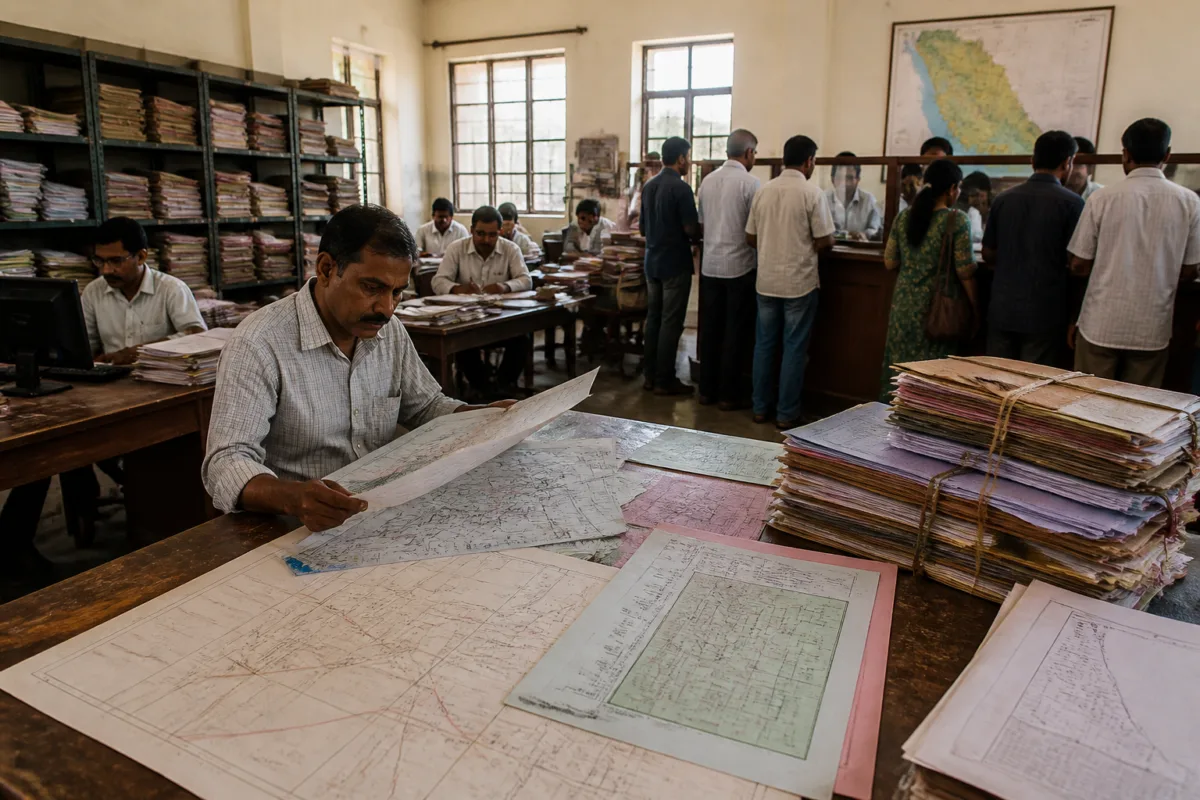
For residents, the problem begins after an application is filed. The association said applicants and lawyers are required to visit the offices of the inspector of survey and land records and the city survey repeatedly. On some visits, files are allegedly described as “untraceable”. The association also cited prolonged scrutiny, repeated objections and the absence of fixed timelines. These complaints were presented by the association and are not independently established in the supplied report, but they identify the points at which a land-record process becomes opaque for the public.
The proposed standard operating procedure is therefore significant because it would convert a discretionary and difficult-to-track process into one with defined administrative steps. The association wants a public checklist of required documents, a timeline for issuing notices, fixed periods for hearings and final orders, and acknowledgements carrying inward numbers and expected completion dates. Such measures would make it easier for applicants to know whether a file has been properly received, what stage it has reached and which office is responsible for the next action.
The demand for notice timelines is particularly specific. The association has proposed that notices to respondents be issued within 14 days of an application being inwarded. In land matters, notices are not a minor procedural detail. They determine whether affected parties know about a proposed partition, amalgamation or other proceeding and whether they have an opportunity to respond. A defined period would give applicants a measurable administrative milestone and reduce uncertainty about whether the process has actually begun.
The memorandum also seeks status tracking and accountability for unjustified delays. The report does not provide a government response or an existing department-wide dataset showing the scale of the backlog. That absence is important. Without published case numbers, age-wise pendency data, disposal rates and office-level timelines, it is difficult for citizens to assess whether delays are concentrated in particular offices, linked to certain types of applications or caused by staffing, documentation or procedural requirements.
The association has asked for a nodal officer to monitor pendency across offices and for a grievance-redressal mechanism. These demands point to a coordination problem. A land-related application may involve the survey office, city survey authorities and records that are also relevant to civil-court proceedings. When no single official is visibly responsible for tracking a case across these stages, applicants may be left navigating several offices without a clear escalation route.
The proposed reforms also include electronic and cash fee payment and electronic issuance of notices where legally permissible. These measures would not, by themselves, resolve questions about title, boundaries or competing claims. They could, however, reduce avoidable dependence on physical visits and create transaction records for payments and communications. The association’s emphasis is on process transparency rather than changing the substance of land law.
A related issue concerns the relationship between civil-court decrees and survey-office procedures. The association said that even after a civil court passes a preliminary decree and the survey department prepares area adjustment statements, parties are often asked to submit fresh applications after the final decree. It wants a certified copy of the final decree to be sufficient to trigger an update of records, without altering the decree.
This demand raises a basic institutional question: how should administrative records respond when a competent court has already determined the legal position? The association’s proposal does not seek to change the court’s decree. It seeks a clearer administrative route for incorporating the final decision into land records. That distinction matters because repeated applications can add delay without necessarily adding a new legal determination. At the same time, the supplied report does not establish the legal reasons for the current practice or whether changes would require a formal amendment, departmental instruction or coordination between judicial and survey authorities.
The land-record system sits at the intersection of private property, public administration and urban development. A delay in updating a record can affect a family seeking to divide inherited land, parties trying to consolidate plots or owners attempting to demonstrate a clear administrative history. The consequences may also extend to construction and redevelopment decisions, although the supplied report does not quantify those effects or identify specific projects affected by the alleged delays.
Goa’s urban areas are shaped not only by new infrastructure and building approvals but also by the reliability of the underlying land administration. Survey records, mutation entries and partition proceedings provide the administrative foundation on which later transactions and permissions depend. If applicants cannot obtain clear acknowledgements, track their files or understand the next procedural step, the uncertainty becomes part of the cost of dealing with land.
The association’s reference to the Goa Right of Citizens to Time-Bound Delivery of Public Services Act, 2013 adds a legal-administrative dimension to the dispute. SGAA has sought strict implementation of the Act in these proceedings. The report does not specify which services, deadlines or designated officers would apply to each type of survey-office application. That information would be necessary to determine how the association’s demand aligns with the existing statutory framework.
The proposed mega camps to clear pending cases represent a short-term disposal measure. The association has also offered its cooperation in such an exercise. Mega camps could address accumulated cases, but they would not necessarily solve the reasons for future pendency unless accompanied by standard procedures, case tracking and clear responsibility. The association’s memorandum appears to recognise this distinction by combining a request for special camps with demands for an SOP, a nodal officer and a grievance system.
It has further sought an inquiry under a senior officer into the reasons for pendency at the inspector of survey and land records office in Margao. The report does not state whether the inquiry has been ordered. Nor does it provide the number of pending matters at the Margao office, their average age or the department’s explanation for the delays. These are the facts that would determine whether the issue is primarily one of capacity, workflow, record management, legal complexity or oversight.
The allegations about “apprehensions of improper practices and corruption” should also be read as the association’s concern, not as an established finding. The strongest institutional response would be one that makes routine progress visible: a documented inward number, a published checklist, an enforceable notice timeline, a record of hearings, a reasoned order and a defined appeal or grievance channel. Transparency can reduce uncertainty without prejudging the outcome of any individual land dispute.
The larger urban question is whether land administration is being treated as basic infrastructure. Roads, water systems and public transport are recognised as essential urban systems because their failures affect daily life. Land records are less visible, but they perform a similar enabling function for property transactions, legal compliance and development. When the system is slow or opaque, the city’s formal processes become harder to access, particularly for people who cannot repeatedly take time away from work or pay for continued professional assistance.
The memorandum establishes that South Goa’s legal community is seeking procedural reform, faster notices and stronger monitoring. It does not establish that the government has accepted the demands, ordered an inquiry or approved the proposed SOP. The next significant developments will be the directorate’s response, any decision on a Margao pendency inquiry, publication of case data and clarification of how time-bound service rules apply to survey proceedings.

