


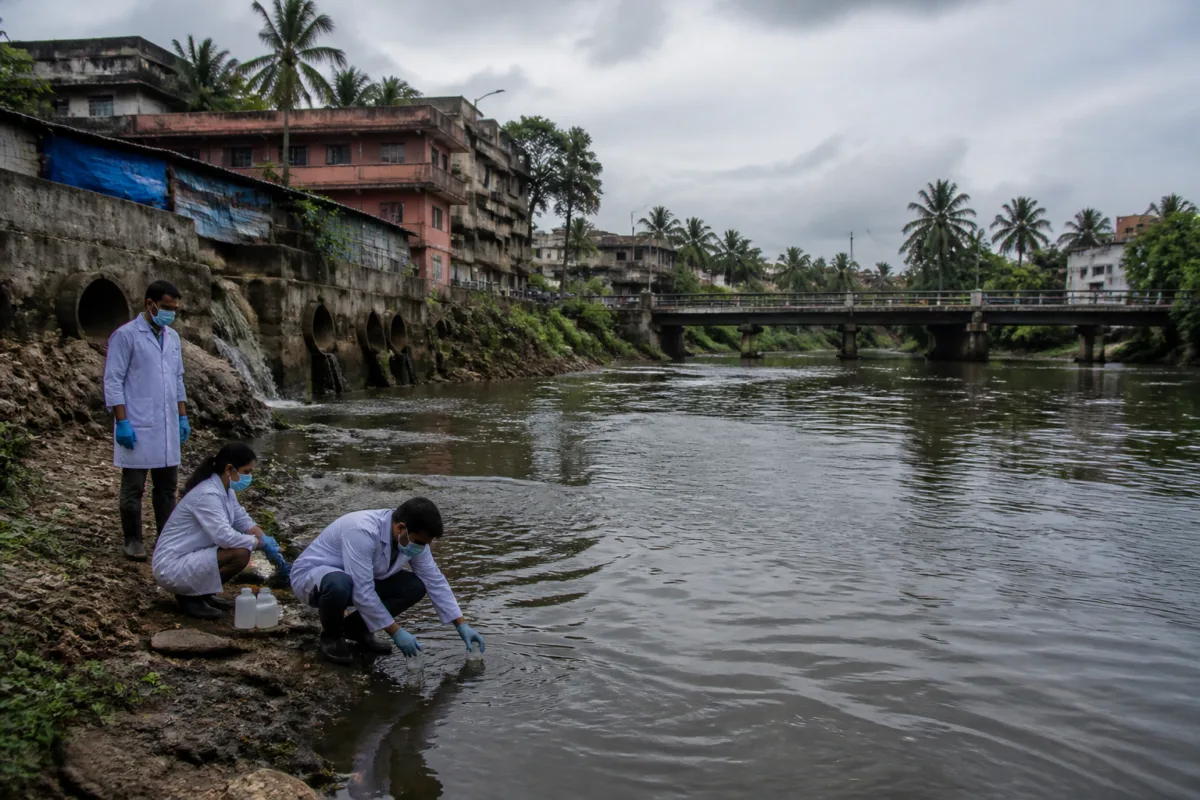
The latest water sampling at Khareband is not only a response to blackish water reported in the Sal river. It is also a test of whether Margao’s pollution-control system can move from identifying discharge points to stopping them. The Goa State Pollution Control Board collected samples near the Khareband bridge after residents raised concerns, while official data cited in the report showed dissolved oxygen at a downstream monitoring point remained close to zero for five consecutive months.
That combination matters because water colour is only the visible part of the problem. The more serious signal is the apparent collapse of the river’s capacity to support aquatic life. Residents have identified sewage-laden nullahs as major contributors, while studies cited in the report point to several additional sources: poorly maintained soak pits, laundry effluents, slaughterhouse runoff and fish waste from the SGPDA wholesale fish market. The river’s condition therefore reflects not one isolated discharge, but a network of urban activities entering a shared water system.
The GSPCB’s samples will be sent for laboratory testing to assess water quality and the extent of possible contamination. That process can establish the immediate condition of the river at the sampling location. It cannot, by itself, resolve the institutional question residents are raising: whether the authorities are addressing the sources of pollution or repeatedly documenting its consequences.
Margao’s pollution problem is distributed across municipal infrastructure, public facilities, commercial areas and riverbank settlements. The report identifies five major nullahs in the city, including the Old Market nullah, as contributors to the Sal. Such channels often become the final route through which wastewater leaves neighbourhoods and commercial areas. Once they discharge into the river, responsibility becomes harder to assign because the water body receives the combined impact of multiple local systems.
This is why a clean-up programme can produce limited results if it is not linked to a source-control plan. Removing visible waste or treating a stretch of the river does not prevent contamination from entering through nullahs, soak pits or commercial premises. Residents have specifically argued that the river cannot be revived unless sewage-bearing nullahs are tackled first. Their concern places the emphasis on the urban drainage network rather than only on the river as a polluted endpoint.
The institutional landscape described in the report is correspondingly broad. In April, the GSPCB, Public Works Department, water resources department, Directorate of Health Services and Margao Municipal Council conducted a three-day joint inspection of nullahs and discharge points along the river in Margao. The inspection included the SGPDA markets and the South Goa district hospital. The involvement of several departments indicates that the problem cuts across pollution regulation, drainage, water resources, public health and municipal administration.
Yet multi-agency inspection also creates a risk of fragmented accountability. A joint visit can map discharge points and record deficiencies, but implementation still requires each authority to act within its mandate. The municipal council may be responsible for local sanitation and enforcement against unauthorised structures; departments managing public facilities may need to control waste and wastewater from their premises; and the pollution control board has a regulatory role in assessing water quality and pollution sources. The report does not establish that the April inspection findings have been fully implemented.
The dispute over illegal hutments along the Khareband riverbank illustrates this gap. Cavelossim sarpanch Dixon Vaz accused the Margao Municipal Council of failing to act against structures that, he alleged, lacked sanitary facilities and discharged raw sewage into the river. Citing a health department report, Vaz said the structures did not have the required no-objection certificates or proper sanitation arrangements. He has called for the civic body to be held accountable and urged Chief Minister Pramod Sawant to intervene.
These claims are attributed to Vaz and should not be treated as an independently established finding beyond the cited health department report. Their significance lies in the type of control failure they describe. If structures along a riverbank operate without adequate sanitation, the river becomes an informal wastewater outlet. Enforcement then becomes a question not only of pollution but also of land use, public health, municipal permissions and the state’s ability to prevent settlement and commercial activity from expanding without basic services.
The dissolved oxygen reading offers a different kind of evidence. Oxygen dissolved in water is essential for aquatic organisms. The report states that official data presented during a recent assembly session showed levels at a downstream monitoring point had remained close to zero for five consecutive months, indicating a near-total collapse of aquatic life. The duration is important: this was not described as a single abnormal reading after heavy rain or a short-lived incident. It points to sustained stress at that monitoring location.
At the same time, the supplied material does not provide the exact dissolved oxygen readings, the applicable water-quality standard, the laboratory results from the new samples or a complete map of the river’s monitoring points. It also does not establish whether the blackish appearance was caused by one specific pollutant. Those gaps make the laboratory testing a significant next step. The results can distinguish between visual reports and measured contamination, and may help determine whether conditions have changed across locations or over time.
The sources listed in the report show how urban pollution can accumulate through ordinary economic and civic activity. A wholesale fish market can generate organic waste; slaughterhouse runoff can add another pollutant load; laundry effluents can carry chemicals and suspended matter; and poorly maintained soak pits can allow wastewater to seep into surrounding soil and water channels. None of these sources is necessarily sufficient on its own to explain the river’s condition. Together, however, they demonstrate why river restoration cannot be separated from the management of markets, sanitation systems and local drainage.
This is also a capacity question. Where sewerage networks are incomplete, poorly maintained or not connected to all premises, wastewater is likely to find alternate paths through open nullahs, soak pits and informal outlets. The report does not specify the extent of sewerage coverage in Margao or the treatment capacity available to the city. Without those figures, it is not possible to quantify the gap between wastewater generated and wastewater safely treated. But the repeated identification of nullahs and other discharge points indicates that the city’s pollution burden is reaching the river through infrastructure that remains active and insufficiently controlled.
The April inspection could have provided an administrative opportunity to convert the problem into a source-wise action plan. Such a plan would need to identify each discharge point, assign responsibility, record the remedial measure required and establish a follow-up timeline. The supplied report does not say whether such a public action plan was issued. That absence is important because inspections without transparent follow-through can leave residents with recurring sampling exercises but no clear account of which sources have been closed, connected, treated or prosecuted.
The Khareband episode therefore reveals a familiar urban governance tension. Authorities may have the ability to measure pollution, but measurement alone does not guarantee remediation. Regulatory agencies can test water; civic bodies can inspect properties; public works departments can manage drainage assets; and health authorities can document sanitation risks. The river improves only when these functions are connected at the point where wastewater enters the system.
For residents, the consequences extend beyond the appearance of the water. A severely degraded river affects environmental health, aquatic life and the quality of the public realm around the waterway. It also raises questions about exposure for people living or working near discharge points, though the supplied material does not provide a health assessment linked to the latest incident. Any such risk must therefore be evaluated through the laboratory findings and health authorities’ formal assessment rather than inferred from colour alone.
The immediate evidence confirms three things: blackish water was reported near Khareband; the GSPCB has collected samples for testing; and the Sal river is facing a wider pollution problem associated with multiple urban discharge sources. It also shows that the issue has already entered the state’s institutional system through assembly data and a multi-department inspection. What remains unclear is whether the findings from those processes have produced enforcement, infrastructure repairs or source-level pollution control.
The next meaningful milestone is the release and interpretation of the laboratory results, alongside a clear account of what happened after the April inspection. Until then, the central question is not whether the Sal river can be sampled again. It is whether Margao’s nullahs, markets, riverbank structures and sanitation systems will be managed well enough to stop the pollution from reaching the river in the first place.

