


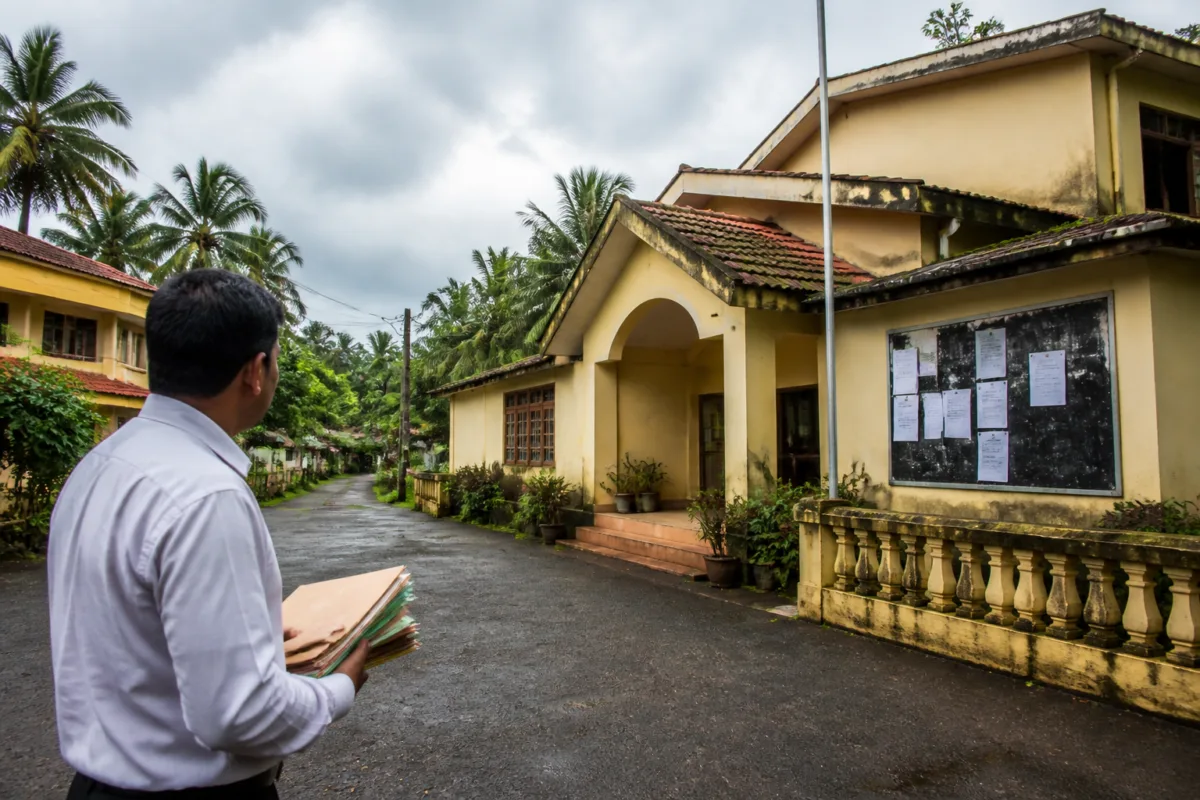
A police complaint over Rs 1.8 lakh in alleged unpaid panchayat dues in Goa’s Santa Cruz has brought a routine administrative question into public view: who is responsible when an event is held, permissions are disputed, liability is acknowledged and local revenue still remains uncollected? The complaint filed by elected panchayat member Inacio Pereira against sarpanch Jennifer de Oliveira and others alleges financial irregularities and abuse of official position. It also places the spotlight on the enforcement capacity of village panchayats, which depend on clear records, timely notices and the recovery of charges to perform their local-government functions.
According to the report, the dispute relates to a sports tournament held at Dr Shyama Prasad Mukherjee Stadium. Pereira alleged that the tournament was advertised as taking place in Santa Cruz even though the venue falls outside the jurisdiction of the village panchayat. That distinction is central to the case. A local body’s authority to issue permissions or collect charges depends on the location of an activity and the legal powers assigned to it. When the advertised location, the actual venue and the authority responsible for permissions do not align, the resulting administrative trail can become difficult to establish.
Pereira said inquiries with the Sports Authority of Goa and the event organiser indicated that the organiser had obtained the necessary local permissions. However, he alleged that the panchayat secretary confirmed that no no-objection certificate had been issued by the village panchayat. The report does not establish whether the permissions referred to by the organiser were issued by another authority, whether they covered all required local approvals or whether the panchayat had a separate legal basis for the claimed charges. Those questions will be important to any investigation because permission from one agency does not automatically settle the jurisdiction or revenue rights of another.
The sequence described in the complaint shows how a compliance issue became a revenue and accountability dispute. Pereira said he submitted a written complaint to the panchayat on July 22, alleging that the event had been conducted without mandatory permission. Following this, the sarpanch allegedly issued a notice directing the organisers to comply with legal requirements and pay Rs 1.8 lakh in panchayat NOC charges. The amount was stated to cover the period from September 7, 2025, to July 26, 2026.
The dates indicate that the alleged liability was not limited to a single event day. The charge was linked to a period extending from September 2025 to July 2026, although the supplied report does not explain how the amount was calculated, what schedule of charges was applied or whether the panchayat had formally approved that schedule. Without those details, the amount can be reported as the sum claimed by the panchayat and cited in the complaint, but not independently assessed as legally recoverable.
Pereira further claimed that at a panchayat meeting on July 28, the dues had still not been recovered, despite the organisers reportedly admitting liability. He accused the sarpanch and others of deliberately failing to collect the money, causing financial loss to the panchayat and extending undue benefit to the organisers. These are allegations in a police complaint, not established findings. The sarpanch and panchayat secretary declined to comment, and the report does not record a response from the event organisers.
The institutional significance of the dispute lies in the gap between issuing a notice and enforcing it. A notice creates a formal demand, but it does not by itself ensure payment. Recovery requires a documented decision, a responsible official, a record of the amount due, a process for follow-up and, where necessary, escalation under the applicable law. The complaint alleges that this chain broke down after the notice was issued. Whether that happened through administrative delay, a disagreement over jurisdiction or deliberate inaction remains to be determined.
Village panchayats operate close to the activities they regulate. Events, construction, commercial use of public or private premises and temporary gatherings can affect local roads, waste management, public safety and neighbourhood administration. The report does not state that the tournament caused any such operational problem. It does, however, show how an event can raise questions about the boundaries of local authority and the collection of charges intended to compensate or regulate activity within a panchayat’s jurisdiction.
The case also illustrates why permissions need a unified documentary trail. An organiser may deal with a venue owner, a sports authority, the local police and a village panchayat, each with different responsibilities. If those permissions are not cross-referenced, an event can appear compliant from one agency’s perspective while remaining unresolved from another’s. The supplied material does not establish whether Goa has a common system linking these approvals for events of this kind. It does show that the parties relied on different accounts of what permissions had been obtained.
The geographical issue is equally important. Pereira alleged that the stadium lies outside the village panchayat’s jurisdiction, while the tournament was advertised as being in Santa Cruz. If the venue is outside the panchayat area, the legal basis for collecting an NOC charge would require examination. If the event’s advertising, access arrangements or associated activity brought it within the panchayat’s regulatory role, that too would need to be documented. The complaint raises the issue but does not resolve it.
The police action sought by Pereira is registration of a first information report under the Bharatiya Nyaya Sanhita and other applicable laws. That request is a demand for investigation, not evidence that an offence has been registered or proved. The next stage will depend on how the police assess the complaint, the documents submitted, the panchayat’s records and the statements of the officials and organisers involved. The report does not say whether an FIR had been registered at the time of publication.
For citizens, the immediate issue is not only the disputed Rs 1.8 lakh. It is whether local authorities can explain how public dues are assessed, collected and accounted for. A panchayat’s finances are tied to its ability to maintain services and administer local activity, even though the supplied report does not identify a specific service affected by the alleged shortfall. When a revenue demand remains unpaid after an official notice, residents are entitled to know what process governs recovery and who is answerable for the delay.
The Santa Cruz complaint therefore remains a matter of allegation and investigation, but it points to a wider administrative test: whether local permissions are clearly allocated, whether charges are transparently calculated and whether elected representatives can track recovery after a demand is issued. The facts that remain to be established include the stadium’s jurisdiction, the legal basis for the NOC charge, the calculation of Rs 1.8 lakh, the nature of the organisers’ alleged admission and whether any police case has been registered. Those records, rather than the competing claims alone, will determine what happened to the panchayat’s dues.

