


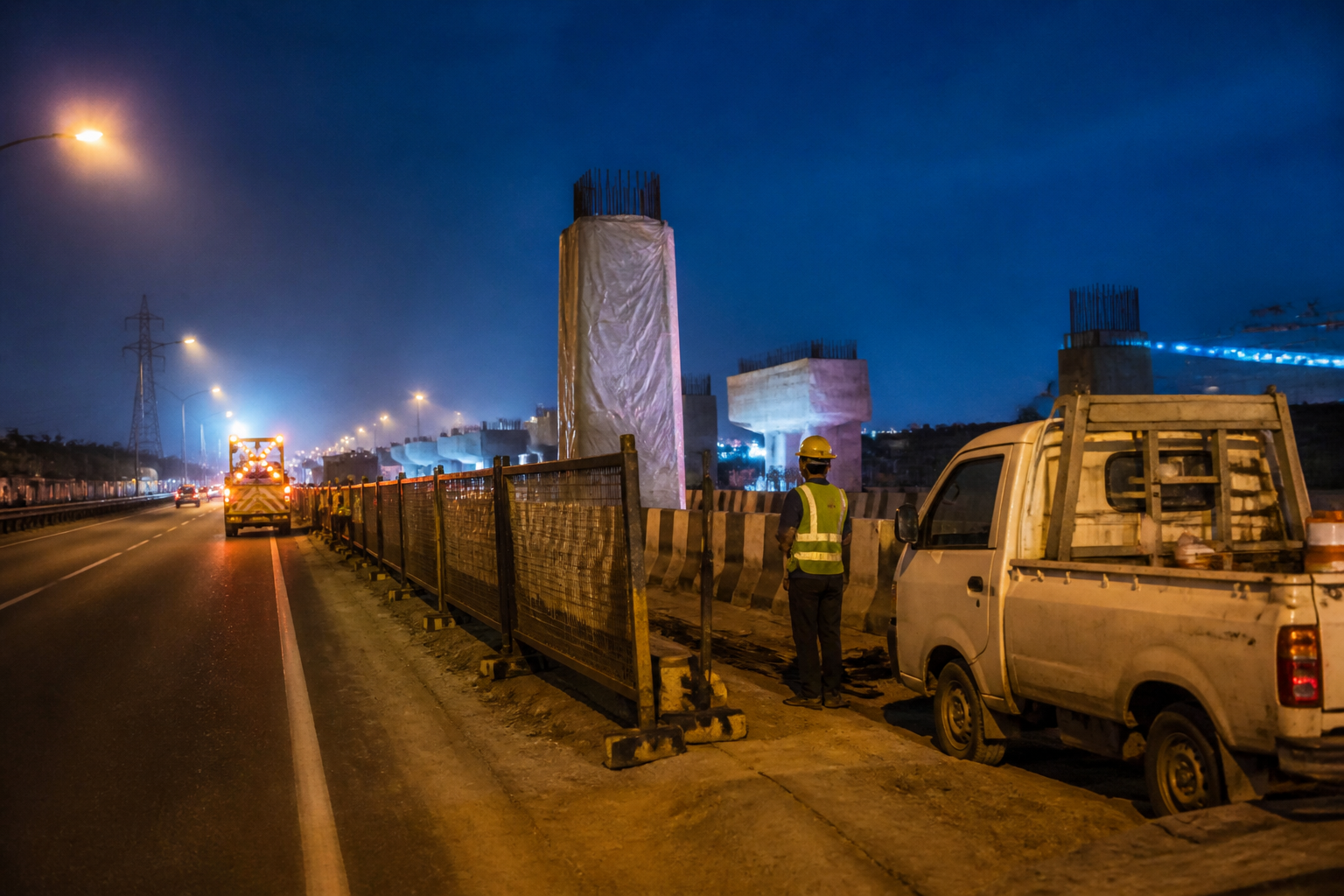
The Dwarka Expressway crash that killed three men and left a fourth critically injured was not only a collision between a speeding car and a roadside worksite. It was also a reminder of how the functioning of expanding cities depends on workers who remain exposed to traffic, incomplete infrastructure and weak financial protection when construction activity continues alongside live roads.
The victims were not visitors passing through Gurugram. Bijender Singh, 58, his cousin Pappu Singh, 55, and contractor Satish Chand, 43, had moved from rural Uttar Pradesh and Delhi to find work and support their families. They were installing iron railing panels near Ram Chowk on the Gurugram-bound surface corridor of the Dwarka Expressway when a hatchback allegedly breached roadside safety barriers and struck the site in the early hours of Thursday.
Police said the incident occurred between 1.50 am and 2.30 am. According to the FIR registered at Bajghera police station, the car was allegedly being driven recklessly. The complaint was filed by Satish Chand’s brother, Jitender Kumar, who was present at the site. The complaint also alleged that the driver appeared intoxicated, but police said blood samples were still awaited to establish whether the driver was intoxicated at the time of the crash.
The available account shows a work zone operating beside an active urban transport corridor. The workers were installing roadside infrastructure when the car allegedly crossed the barriers. The impact threw the workers across the asphalt, struck an idling utility pickup truck and pushed it forward by nearly 100 metres before the car mounted the central divider and stopped. Bijender and Pappu were declared brought dead at Civil Hospital. Satish died shortly afterwards from his injuries. Ram Kumar, Bijender’s 28-year-old son, remained on ventilator support at a private hospital, according to the report.
That sequence matters because it places the crash within a familiar but often underexamined condition of fast-growing cities: infrastructure is built in spaces where construction, traffic and everyday livelihoods overlap. A road project does not become safe merely because barriers have been installed. Safety depends on how those barriers are positioned, how visible the worksite is at night, how traffic is channelled, whether vehicles can penetrate the protected area and whether workers have a safe separation from moving traffic. The report establishes that barriers were present, but it does not establish whether the worksite complied with every applicable safety requirement or whether any authority had identified shortcomings before the crash.
The FIR and police account establish the immediate mechanics alleged in the case. They do not, by themselves, answer the larger administrative questions. The supplied report does not identify the contractor responsible for the roadwork, the agency managing that section of the expressway, the approved traffic-management plan, the speed limit at the location or whether the worksite had lighting, warning signs and crash-resistant protection. Those details will be important in determining whether this was solely a case of alleged reckless driving or whether the road environment also failed to adequately protect workers.
The human consequences are especially severe because the men were part of a mobile labour network that supports urban construction. Bijender and Ram Kumar had moved from Sarbhanna village in Bulandshahr to Gurugram earlier this year and had begun working as construction labourers. Bijender had lost his wife the previous year and was saving for his son’s future. The family now faces the cost of keeping Ram Kumar in intensive care while also dealing with the loss of his father.
Satish Chand’s family illustrates another layer of vulnerability. He had moved to Delhi nearly eight years ago and was survived by his wife and four children. Relatives told the Indian Express that his income had provided stability and supported the children’s education. His wife, Dolly Devi, has no independent income, according to the report. The family’s fear is that the loss of his earnings could force them to leave the city and withdraw the children from school once their limited savings are exhausted.
Pappu Singh had taken up labour work after his two adult sons continued managing marginal agricultural plots in the village. He was reportedly saving for the marriage of his 18-year-old daughter and hoped to bring his wife and sons to the city after the marriage. His death therefore removes not only an income but also a planned transition from rural work to a more permanent urban livelihood. These accounts show that the workers’ presence at the expressway was connected to household strategies extending across villages, towns and metropolitan construction sites.
This is why road-worksite safety cannot be treated as a narrow engineering issue. For a city such as Gurugram, construction labour is part of the urban operating system. Workers build, repair and maintain the roads and buildings that enable the city’s growth, but many live with limited control over the conditions under which they work. The report does not provide information on compensation, insurance, employer support or statutory relief for the families. It does, however, show relatives borrowing money and moving between institutions to keep an injured worker alive, indicating how quickly a road crash can become a household financial crisis.
The location also highlights the difficulty of managing a rapidly changing transport corridor. The Dwarka Expressway has sections where road construction, surface corridors, access routes and local movement coexist. At the reported site, workers were installing iron railings while traffic continued to move nearby. The presence of a utility pickup at the work zone further indicates that multiple vehicles and work activities were operating in the same corridor during the night. Without the full traffic-management record, it is not possible to determine whether the arrangement met prescribed standards, but the crash demonstrates the consequences when a moving vehicle enters a work area.
Responsibility in such cases is usually distributed across several actors: the driver, the police investigating the alleged offences, the road-owning or road-managing authority, the contractor executing the work and the agency responsible for approving or monitoring traffic diversions. The FIR addresses the alleged conduct of the driver. A complete public account would also need to establish how the worksite was authorised and protected, who was responsible for the barriers and night-time arrangements, and what steps were required after the collision.
The report records that police were awaiting the accused driver’s blood samples. It also states that the driver, identified as Vedant Khanna, a third-year B A (Honours) Economics student at St Stephen’s, suffered severe injuries and was receiving treatment at a private hospital. These details are part of the ongoing investigation, and the allegation of intoxication should not be treated as established until the forensic process and investigation are complete.
The case therefore contains two parallel accountability tracks. One concerns the alleged speeding and driving conduct that caused the vehicle to enter the worksite. The other concerns the protection of workers operating beside a live road. Focusing only on the first could leave the infrastructure conditions unexamined; focusing only on the second could overlook the individual conduct under investigation. The available evidence supports asking both questions without prejudging either.
The larger urban issue is the distance between the value cities derive from construction labour and the protection offered to the people performing it. Migrant workers often move to cities because urban employment promises more reliable income than rural livelihoods. Yet the families described in the report remain financially exposed to a single crash, with medical expenses, lost earnings and possible displacement arriving together. The city benefits from the infrastructure they build, while the risks of building it are borne by workers and their households.
What happens next should be measured not only by the criminal investigation but also by the response to the worksite itself. The key milestones are the police findings, the blood-test results, the determination of liability, and any examination by the relevant road or civic authority of the barriers, lighting, traffic controls and contractor arrangements at the site. The supplied report does not state whether such a safety audit or compensation process has been announced.
The Dwarka Expressway crash has already altered four families. Its wider significance will depend on whether the incident remains an individual traffic case or prompts a documented examination of how workers are protected when cities build and operate roads at the same time.
