


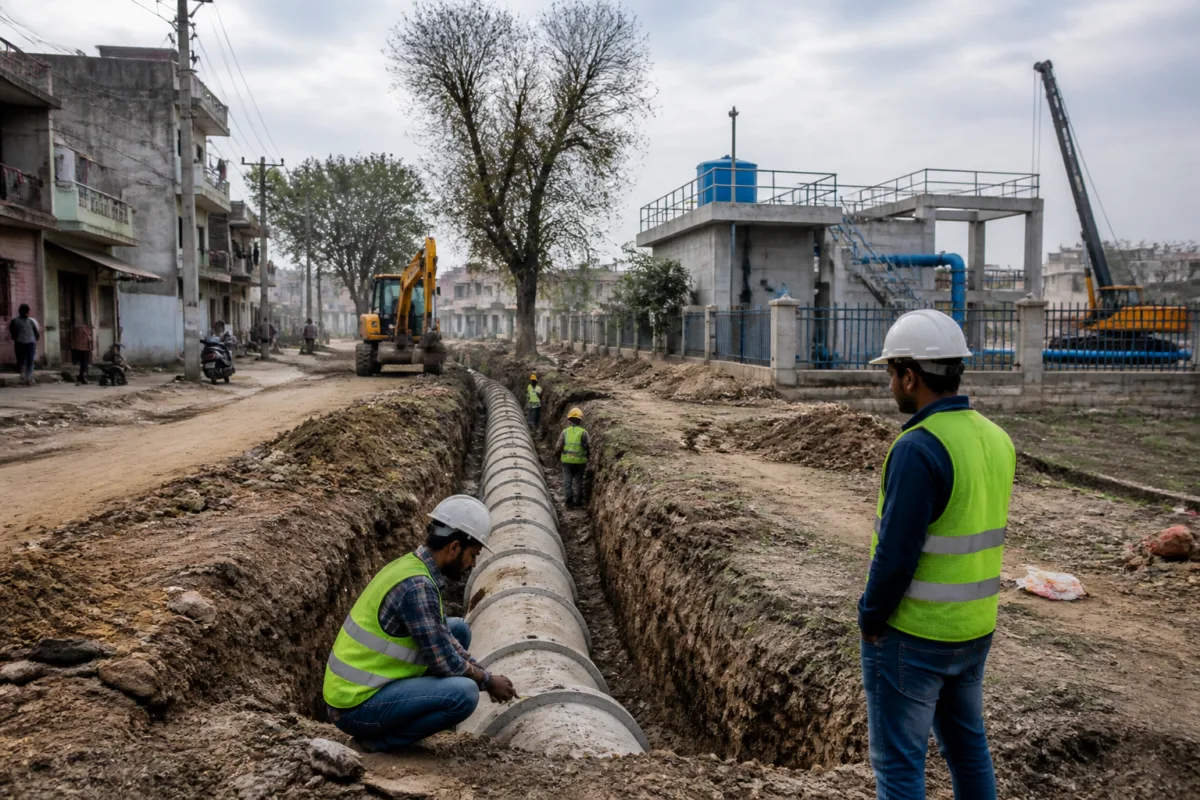
Delhi’s 1,000-kilometre sewer plan is intended to extend the city’s sanitation network to underserved colonies and villages, but its success will depend on what happens after the pipes are laid. The Delhi Jal Board says 10 major projects, estimated to cost ₹1,629.76 crore, are being implemented across areas including Chhatarpur Extension, Mahipalpur, Tikri Kalan, Kanjhawala and several villages. The programme also includes two sewage pumping stations at Rajpur Khurd and Maidan Garhi.
The announcement addresses a basic urban infrastructure gap: parts of Delhi remain outside a sufficiently connected sewer network even as the city’s built-up areas expand. The locations identified by the DJB include settlements on the urban edge, colonies and villages such as Tajpur Khurd, Tajpur Pahari, Chhatarpur Extension, Jaunapur, Aligaon, Palla, Khera Khurd, Bajidpur Thakran, Auchandi and Mohammadpur Majri. The source report, citing information shared by the DJB on X, says eight villages will receive sewer-network development under the projects.
The scale of the planned network is significant because sewerage is not simply a road-side utility. It is a chain that begins with a household connection, carries wastewater through local pipelines, moves it through trunk infrastructure and pumping facilities where required, and ends at a sewage treatment plant. A break at any point can leave untreated wastewater in open drains or local water channels. For residents, that can mean persistent odour, stagnant wastewater and exposure to polluted surroundings even when a major sewer line has been constructed nearby.
The two proposed pumping stations illustrate why network expansion requires more than underground pipes. In areas where terrain, distance or the physical alignment of the network prevents wastewater from moving by gravity, pumping stations push it towards the treatment system. The DJB has identified Rajpur Khurd and Maidan Garhi for such facilities. Their stated function is to help carry wastewater from homes through pipelines to sewage treatment plants, making it possible to connect areas that cannot be served effectively through gravity-based flow alone.
This is an important distinction in assessing the value of the project. A sewer line can be physically complete while remaining underused if properties are not connected. Similarly, a household connection does not by itself guarantee pollution control if wastewater is not conveyed to a functioning treatment plant. The source material itself identifies these links as necessary: homes must be connected, sewage must reach treatment facilities, and the wastewater must be treated properly before the network can deliver its intended environmental benefit.
The Yamuna is central to the project’s stated purpose. The DJB says the works are expected to reduce the amount of dirty water reaching the river. In areas without adequate sewerage, domestic wastewater can enter drains and eventually flow into the Yamuna. Extending the sewer network therefore creates the possibility of intercepting some of those flows and directing them towards treatment. But the infrastructure’s environmental outcome will depend on operation as much as construction. The reported project announcement does not establish how many household connections will be completed, the treatment capacity available for each package, or the implementation schedule for the individual locations.
That information gap matters because Delhi’s sewerage challenge is distributed across different levels of responsibility. The DJB is responsible for planning and delivering the network and associated infrastructure, while the performance experienced by households also depends on local access, connection work and the functioning of treatment facilities. In villages and peripheral settlements, the distance between a newly laid public sewer and individual properties can determine whether the investment produces a real sanitation service. The project’s stated inclusion of eight villages makes that last-mile question particularly important.
The ₹1,629.76-crore estimate covers 10 major projects and more than 1,000 kilometres of new sewer lines, according to the DJB information cited in the report. The available material does not provide a project-wise cost breakup, construction timetable, contractor details or location-wise length. It also does not specify how much of the network is already under construction, how much remains to be tendered, or when residents in each listed area will receive operational connections. Those details will be necessary to track delivery against the announcement.
The project also shows why urban infrastructure should be evaluated as a service rather than as a completed asset. For roads and buildings, physical completion is often visible. Sewerage is less visible because most of the system is underground. Its performance has to be measured through indicators such as the number of properties connected, the volume of wastewater reaching treatment plants, treatment performance and the reduction of untreated discharge into drains. None of those outcomes can be assumed solely from the announced length of pipeline.
For residents in the identified areas, the immediate benefit promised by the project is improved access to a formal wastewater network. The longer-term public benefit is the possibility of reducing untreated discharge and improving the flow of sewage to treatment facilities. However, the source does not report any completed connections or measured reduction in pollution yet. The announcement therefore represents an infrastructure intervention and a stated environmental objective, not evidence that the Yamuna impact has already been achieved.
The larger urban question is whether Delhi can close the gap between network expansion and sanitation outcomes. The 1,000-kilometre plan brings peripheral colonies and villages into the city’s sewerage conversation, but its success will be determined at the interface between public infrastructure and individual properties. The next meaningful evidence will be the completion of the listed projects, the commissioning of the Rajpur Khurd and Maidan Garhi pumping stations, household connections and confirmation that wastewater is reaching treatment plants for proper treatment.

