


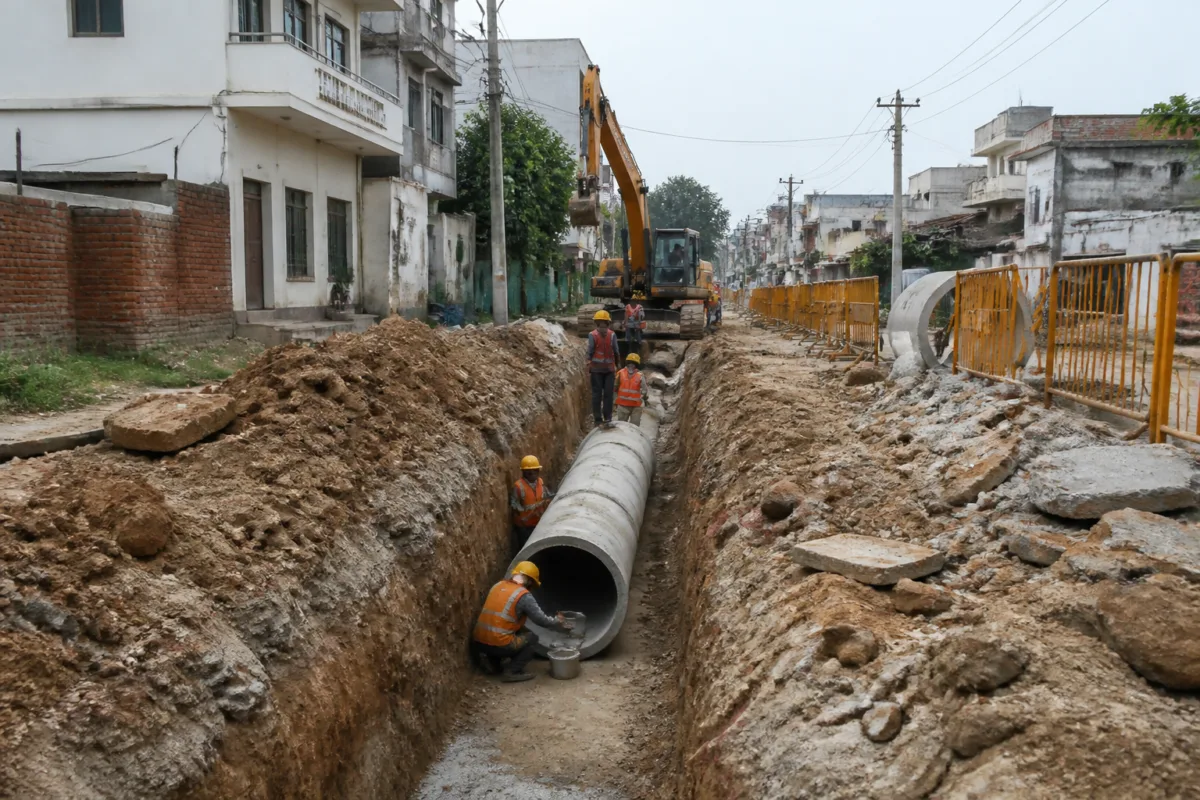
The Delhi Jal Board is laying more than 1,000 kilometres of new sewer lines under 10 major projects, with work estimated to cost Rs 1,629.76 crore. The programme will connect several colonies and villages to Delhi’s sewer network and includes two new sewage pumping stations at Rajpur Khurd and Maidan Garhi.
The details were shared by the Delhi Jal Board on its official X account. According to the board, the projects cover areas including Tajpur Khurd, Tajpur Pahari, Chhatarpur Extension, Jaunapur, Mahipalpur, Ali Gaon, Tikri Kalan, Palla, Khera Khurd, Bajidpur Thakran, Auchandi, Kanjhawala and Mohammadpur Majri.
The programme will also develop sewer networks in eight villages. The projects are intended to extend formal sewerage infrastructure to areas where households currently have limited or no access to underground sewer lines. The report does not specify the completion schedule for the full network or provide a project-wise breakdown of the planned work.
Two new sewage pumping stations will be built at Rajpur Khurd and Maidan Garhi. Such stations are used to move wastewater through pipelines when sewage cannot flow by gravity because of local terrain, distance or the elevation of the network. The stations are expected to help carry wastewater from connected households to sewage treatment plants.
The Delhi Jal Board said the expansion is also aimed at reducing the volume of untreated wastewater entering drains and eventually reaching the Yamuna. In colonies and villages without adequate sewerage, domestic wastewater can flow into open drains. Connecting these settlements to a sewer network is the first part of the process, but it must be followed by household connections, functioning pumping infrastructure and treatment at sewage treatment plants.
The project therefore places implementation beyond the simple laying of pipelines. Residents will need to be connected to the new network, and the collected wastewater will have to reach treatment facilities and be treated properly before discharge. The supplied report does not include details of the treatment plants linked to each project, the number of households expected to benefit or the current status of land acquisition and construction.
The sewer expansion comes as Delhi continues to address gaps in wastewater collection across unauthorised colonies, urban villages and peripheral settlements. For the areas named by the board, the next measurable milestones will be the completion of the pipelines, commissioning of the two pumping stations, household connections and the movement of sewage into treatment systems. The Delhi Jal Board’s project updates will determine how quickly the planned network becomes operational.

