


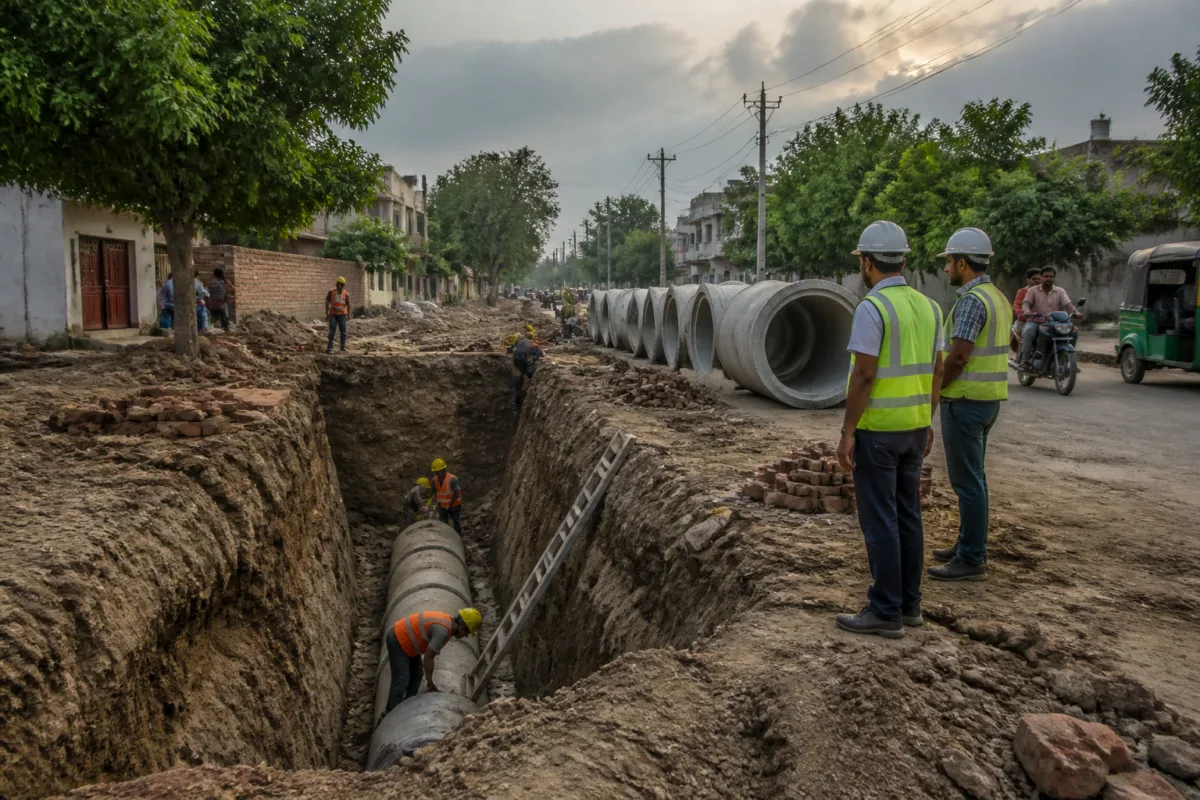
The Delhi Jal Board is laying more than 1,000 kilometres of new sewer lines under 10 major projects, a reported intervention that shows how unevenly Delhi’s wastewater network has expanded across colonies and villages. With an estimated cost of ₹1,629.76 crore, the work is intended to connect areas outside the adequately served sewer system and route household wastewater towards sewage treatment plants.
The projects, described by the Delhi Jal Board in a post on its X account and reported by Live Hindustan, include several settlements in south-west, north and outer Delhi. The list includes Tajpur Khurd, Tajpur Pahari, Chhatarpur Extension, Jaunapur, Mahipalpur, Aligaon, Tikri Kalan, Palla, Khera Khurd, Bajidpur Thakran, Auchandi, Kanjhawala and Mohammadpur Majri. The plan also includes sewer network development in eight villages.
The scale of the proposal matters because sewerage is not only a question of laying underground pipes. It is a connected system in which household connections, trunk lines, pumping infrastructure and sewage treatment plants must work together. If any part of that chain is missing, wastewater can continue to flow into open drains or other channels even after a new pipeline has been constructed.
That dependency is central to the Delhi Jal Board’s reported plan. Two new sewage pumping stations are proposed at Rajpur Khurd and Maidan Garhi. Their stated function is to move wastewater from homes through the sewer network towards sewage treatment plants in places where the terrain, distance or network configuration prevents sewage from flowing forward by gravity.
In a gravity-based sewer system, the slope of the land helps wastewater move through pipes. Where that slope is insufficient, or where a settlement is located at a distance from the main network, pumping stations provide the pressure needed to transfer sewage onwards. The proposed stations therefore represent an attempt to close a critical operational gap between local sewer lines and treatment infrastructure.
The plan’s stated environmental objective is to reduce the volume of untreated wastewater reaching the Yamuna. The source report notes that, in areas without adequate sewerage, household wastewater enters drains and can eventually reach the river. Connecting these locations to a treatment system could alter that pathway, but only if the network is actually used and the wastewater reaches a functioning treatment plant.
This is why the project should be read as a network expansion exercise rather than simply a pipeline-laying programme. A sewer line outside a property does not automatically mean that the property is connected to it. The final link between a house and the public network determines whether wastewater is diverted from local drains. The treatment stage determines whether the collected sewage is processed before discharge or reuse.
The reported cost of ₹1,629.76 crore covers the 10 major projects identified by the Delhi Jal Board, although the supplied report does not provide a project-wise cost split, construction schedule or completion date. It also does not specify the length of the network assigned to each locality. Those details will be important for assessing how the investment is distributed and which settlements are expected to receive service first.
The geographical spread of the listed locations suggests that the intervention is directed at areas where urban growth and formal network coverage have not advanced at the same pace. The locations include village settlements, extensions and peripheral areas, rather than a single compact redevelopment zone. That makes coordination more complex because the network must connect dispersed settlements to larger sewerage and treatment systems.
The institutional responsibility rests with the Delhi Jal Board, which is the agency identified in the report as announcing and implementing the work. Its role, as described in the material, extends beyond civil construction. The board must also ensure that the new network can receive wastewater from households, that pumping stations operate reliably and that treatment plants have the capacity and operational systems needed to handle the additional flow.
The source material does not establish whether all eight villages already have partial sewer networks, whether land acquisition is required for any part of the work, or whether the pumping stations have entered construction. It identifies the projects and their intended benefits, but not their tender status, contractual agencies or implementation milestones. These gaps limit what can be concluded about delivery timelines.
The numerical picture available so far is clear but narrow: more than 1,000 kilometres of new sewer lines, 10 major projects, an estimated cost of ₹1,629.76 crore, two proposed pumping stations and eight villages to be brought into the sewer network. The data indicates substantial planned physical expansion, but it does not yet measure the number of households to be connected, the expected sewage volume or the reduction in untreated discharge.
Those missing indicators are important because sewerage performance cannot be judged only by pipe length. A longer network may still produce limited environmental improvement if household connections are delayed, pumping capacity is insufficient or treatment plants do not process the additional inflow. Conversely, targeted connections in areas currently sending wastewater into drains could produce benefits that are larger than the raw length of pipe suggests.
The project also highlights the difference between access to a sewer network and effective sanitation service. Access depends on whether a connection is available and affordable. Effective service depends on the network’s ability to carry wastewater away, pumping stations’ ability to operate, treatment plants’ ability to process the flow and authorities’ ability to maintain the system over time. The supplied report establishes the planned infrastructure but does not provide performance data for these later stages.
For Delhi’s peripheral settlements, the practical impact will depend on how construction interacts with existing streets, homes and local drainage. New underground lines may require road excavation and subsequent restoration, while connections to individual properties may need coordination with residents. The source does not provide details on construction methods, disruption management or household connection procedures, so these aspects remain to be established.
The Yamuna objective similarly depends on implementation beyond the pipeline itself. The reported plan acknowledges that new lines alone will not clean the river. Wastewater must be collected from homes, conveyed through the network and treated correctly. This makes the pumping stations strategically significant: without reliable transfer from local networks to treatment plants, newly laid lines may not achieve the intended reduction in pollution.
The next stage of public scrutiny should therefore focus on measurable delivery information. That includes project-wise costs, construction and commissioning dates, the number of households and villages targeted, household connection plans, pumping station capacity, treatment plant linkages and evidence of reduced untreated wastewater. None of these figures is provided in the supplied announcement, but they will determine whether the investment becomes a functioning sanitation network or remains primarily a construction achievement.
The Delhi Jal Board’s announcement confirms a significant planned expansion of sewer infrastructure in underserved parts of the city. It also makes clear that the central urban challenge is not merely the absence of pipes. The outcome will depend on whether the entire chain—from household connection to pumping, treatment and final discharge—works as one system. The project’s eventual effect on local sanitation and the Yamuna will become assessable only as those implementation details emerge.

