


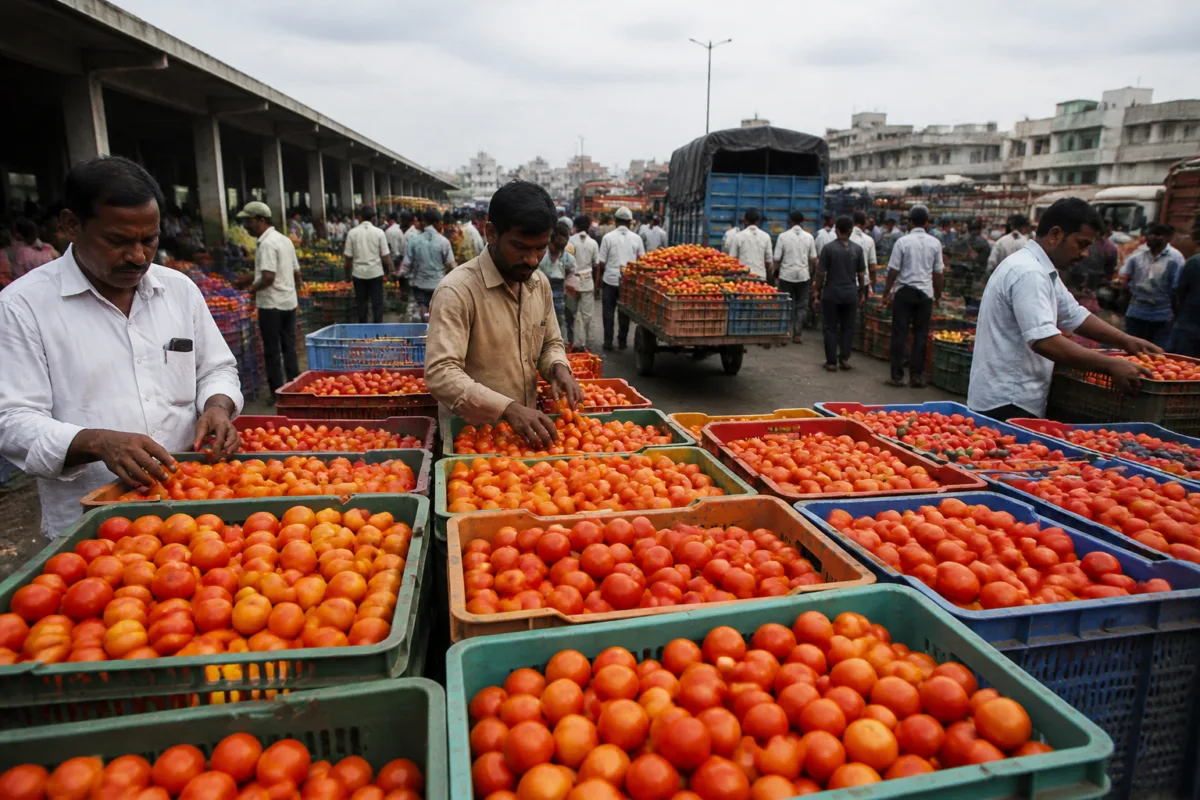
Maharashtra tomato prices have fallen to ₹8–10 per kilogram in the Bawda area of Pune district, leaving growers unable to recover production and transport costs as arrivals rise sharply at Pune’s Market Yard.
The price collapse is affecting farmers in and around Bawda and Nira Narsingpur, where tomatoes are being harvested at the same time as crops from several districts in Maharashtra and from other states. The resulting increase in supply has reduced demand for incoming produce, according to traders quoted in the report by Sakal – Pune.
Pune’s Market Yard is currently receiving an average of 7,000 to 8,000 crates of tomatoes. The market normally distributes tomatoes not only within Pune but also to other markets in Maharashtra and to destinations outside the state. However, a good crop in several producing regions has increased arrivals across markets at the same time, weakening the demand available for each consignment.
The impact is being felt most directly by growers, for whom the current price does not cover the cost of cultivation and transport. Farmer Firoz Attar has reportedly abandoned a tomato plot along the Narsingpur road in Bawda after market prices fell. He said tomatoes had reached harvesting stage simultaneously across Maharashtra and other states, leaving the market with more produce than it could absorb. Attar added that he expected the weak-price situation to continue for the next few days.
The fall in prices has increased purchases by hotels and small eateries, providing some support to the trade. Household demand, however, remains at its usual level, according to tomato commission agent Sameer Bagwan. The increase in commercial purchases has not been enough to offset the wider imbalance between arrivals and demand.
Bagwan said the large volume reaching Pune’s Market Yard, combined with lower demand relative to supply, had caused prices to decline. He also expected the same market conditions to persist for a few more days. Trader Firoz Bagwan attributed the heavy arrivals and market slowdown partly to changes in weather conditions.
The situation highlights the dependence of growers on wholesale market conditions that extend beyond their immediate locality. Although tomatoes from Pune district can move to markets elsewhere in the state and outside Maharashtra, simultaneous harvesting in multiple regions has limited the ability of that distribution network to absorb the crop at remunerative prices.
For Pune’s urban food system, the episode also shows how the same supply chain can produce sharply different outcomes for sellers and buyers. Hotels and eateries are able to purchase tomatoes in larger quantities at lower rates, while growers bear the immediate loss when wholesale demand fails to keep pace with arrivals. The report did not indicate any confirmed intervention or price-support measure. Traders said the weak market was likely to continue over the coming days.

