


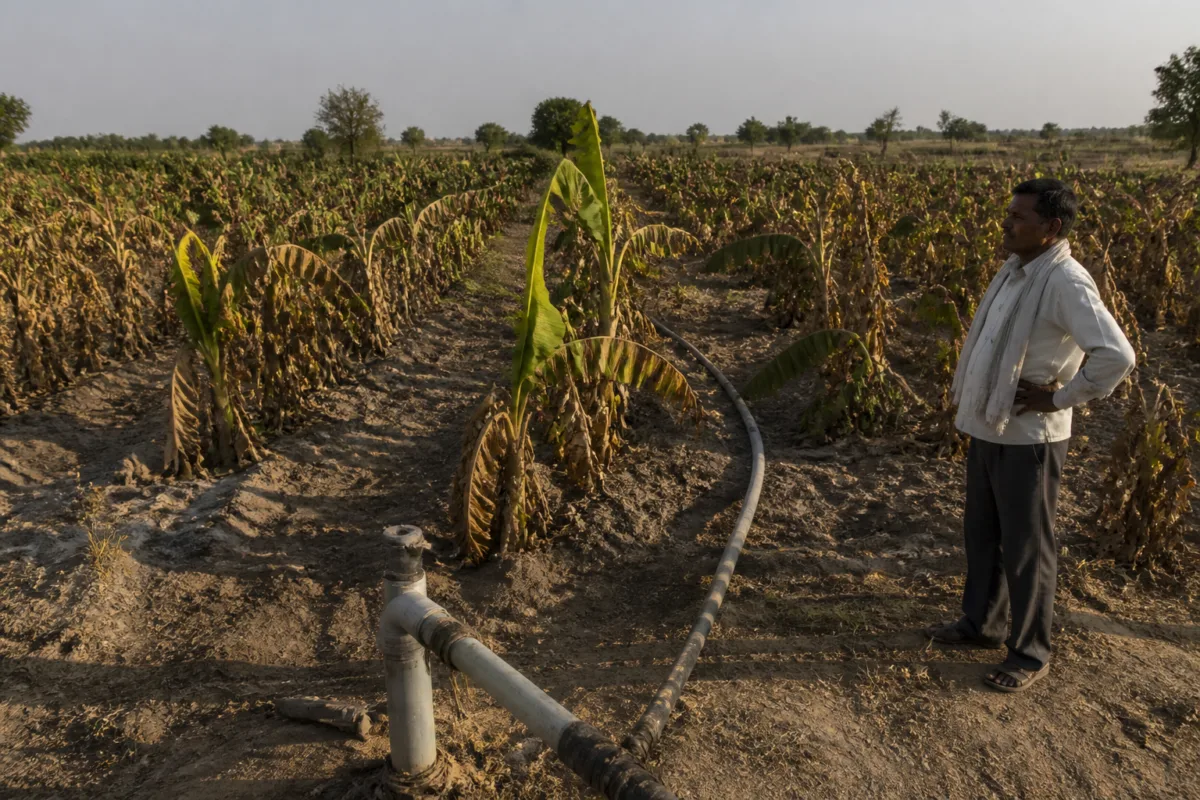
A banana farm in Karmala taluka of Maharashtra has become a clear example of how drought can convert a high-value agricultural investment into a direct financial loss. Farmer Nagesh Dada Kate of Fisare village is reportedly preparing to run a rotavator over his one-and-a-half-acre banana plantation after groundwater levels fell, his borewell weakened and the cost of buying water became unaffordable.
The immediate event is local, but the underlying problem is broader than one damaged crop. Kate’s experience shows how farms dependent on wells and borewells remain exposed even after a crop has grown successfully. The plantation initially developed well because the borewell had sufficient water. As rainfall failed and groundwater levels declined, the same farm could no longer receive the regular supply needed to sustain bananas approaching harvest.
That sequence matters because the economic risk begins well before a crop visibly dries. Kate had invested in planting the Jain variety of banana across 1.5 acres, expecting a good return. The report says the plantation became lush in its early stages, raising hopes of production and income. By the time water became scarce, however, much of the cultivation expenditure had already been committed. The farmer was left with a crop that required more water, a borewell that could not provide enough, and limited room to recover the investment.
The case also exposes the fragile economics of private water solutions. Kate attempted to obtain a new borewell, but the effort did not produce the expected water. He then tried to keep the plantation alive by purchasing water for several days. That option, according to the report, was undermined by rising water costs and the money already spent on cultivation. For a farmer whose income depends on the final quality and sale of the crop, purchased water can delay the loss without necessarily eliminating it.
The report does not provide measurements of the decline in the water table, rainfall totals, the total cost of cultivation, the price paid for purchased water or the value of the expected harvest. Those figures are important for assessing the full scale of the loss. What is established in the account is the chain connecting insufficient rainfall, falling groundwater, reduced borewell output, escalating water expenditure and the possible abandonment of a mature plantation.
The market adds another pressure. Water stress may affect the quality of bananas, and the report says traders have begun seeking the produce at low prices. This creates a difficult relationship between production and pricing. The farmer needs water to protect the quality of the crop, but the cost of securing that water may exceed what the market is willing to pay. If the crop is sold at a reduced price, the farmer may not recover the original cultivation expenditure. If it is not adequately watered, its quality may deteriorate further. If the plantation is abandoned, the investment is lost without a harvest.
This is why the story is not simply about a failed borewell. It is about the risk created when an agricultural business is built on a water source whose reliability cannot be guaranteed through the crop cycle. In Kate’s case, the water source was adequate at the beginning of cultivation. Its later decline transformed an apparently promising plantation into a liability. The report does not establish whether the borewell decline is temporary or permanent, but it does show that the farm’s production plan could not withstand the change.
### The groundwater dependency problem
The Karmala account places groundwater at the centre of the farm economy. Wells and borewells are not described merely as supplementary sources; they are the operating foundation for fruit orchards and cash crops in the affected area. When the groundwater level falls, the impact is therefore not limited to drinking-water access or a single irrigation cycle. It reaches crop selection, cultivation expenditure, labour decisions, market quality and household income.
The vulnerability is especially visible in crops that require continued care after planting. A farmer can lose more than the value of the water already used when irrigation fails late in the crop cycle. The expenditure on planting material, preparation and cultivation has already been incurred, while the revenue remains dependent on the crop reaching a saleable condition. The supplied report does not quantify these individual costs, but Kate’s account describes the result: the prospect of recovering the investment has weakened even though the plantation had once grown well.
The unsuccessful attempt to find additional water through a new borewell also shows the limits of treating groundwater scarcity as an individual infrastructure problem. A farmer may try to deepen or replace a borewell, but that decision requires more money and does not guarantee a usable water source. In the reported case, the new borewell did not yield the expected water. A private response therefore added uncertainty and cost without solving the irrigation requirement.
### When water becomes a market risk
The water shortage is also changing the commercial value of the crop. According to the report, traders are seeking lower prices because water scarcity may affect banana quality. This shifts part of the drought burden from production to the market. The farmer pays more to keep the crop alive while simultaneously facing the possibility of receiving less for the final produce.
That pressure can create a damaging feedback loop. Higher water expenditure increases the minimum price needed to make cultivation viable. Concerns about quality reduce the price traders are prepared to offer. The resulting gap makes it rational, from a strictly financial standpoint, to stop spending on a crop that is unlikely to cover its costs. Running a rotavator over the plantation is therefore not presented as a farming preference. It is the final step in a calculation shaped by water availability, sunk costs and weak price expectations.
Kate described the situation as one in which a plantation raised before his eyes may have to be abandoned despite the expenditure already made. His question—what is a farmer supposed to do—captures the administrative gap revealed by the case. The report records the immediate distress but does not identify any relief measure, compensation decision, irrigation support or official response connected to the plantation.
### The policy questions left unanswered
The supplied account does not establish whether Karmala has received a formal drought declaration, whether emergency water assistance is available to farmers, or whether any government agency has assessed the affected crop. It also does not state whether the farmer qualifies for crop insurance, input support or compensation. These are not minor omissions. They determine whether the loss remains an individual burden or becomes part of a recognised public response to water scarcity.
The story also leaves open questions about local water governance. If farms are increasingly dependent on borewells, the relevant issue is not only how many wells exist, but how groundwater use is monitored and how competing demands are managed when recharge falls. The report does not supply data on the number of affected wells, the area under banana cultivation, the extent of crop damage in Karmala or the status of local reservoirs and irrigation systems. Without that information, the scale of the crisis cannot be measured beyond the reported case.
Still, the case provides a grounded view of how drought operates at household level. A rainfall shortfall becomes a falling groundwater level. That becomes a weaker borewell. The weaker borewell creates a need to purchase water. Purchased water raises production costs. Water stress threatens crop quality. Lower expected quality weakens the sale price. The farmer then faces a choice between spending more on an uncertain crop and abandoning it before further losses accumulate.
### What the evidence confirms
The evidence supports three conclusions. First, the plantation was initially productive in appearance because the borewell supplied enough water, but that early success did not ensure water security until harvest. Second, an additional borewell did not provide a reliable solution, while purchased water became financially difficult. Third, the water shortage affected not only crop survival but also the expected selling price and the possibility of recovering cultivation costs.
The evidence does not establish how many other farmers face the same situation, whether rainfall patterns will improve, or whether the plantation will ultimately be destroyed. Those developments require further reporting. The next significant information would be an assessment of groundwater conditions, crop losses, the availability of state or local assistance and the response of agricultural and water-management authorities.
For now, the Fisare plantation illustrates a structural problem in drought-hit agriculture: when water access is uncertain, the financial risk travels through the entire crop system. It reaches the borewell, the farm budget, the quality of the produce and the trader’s price. By the time the farmer considers using a rotavator, the crisis is no longer only an irrigation failure. It is a breakdown of the economic assumptions on which the crop was planted.

