


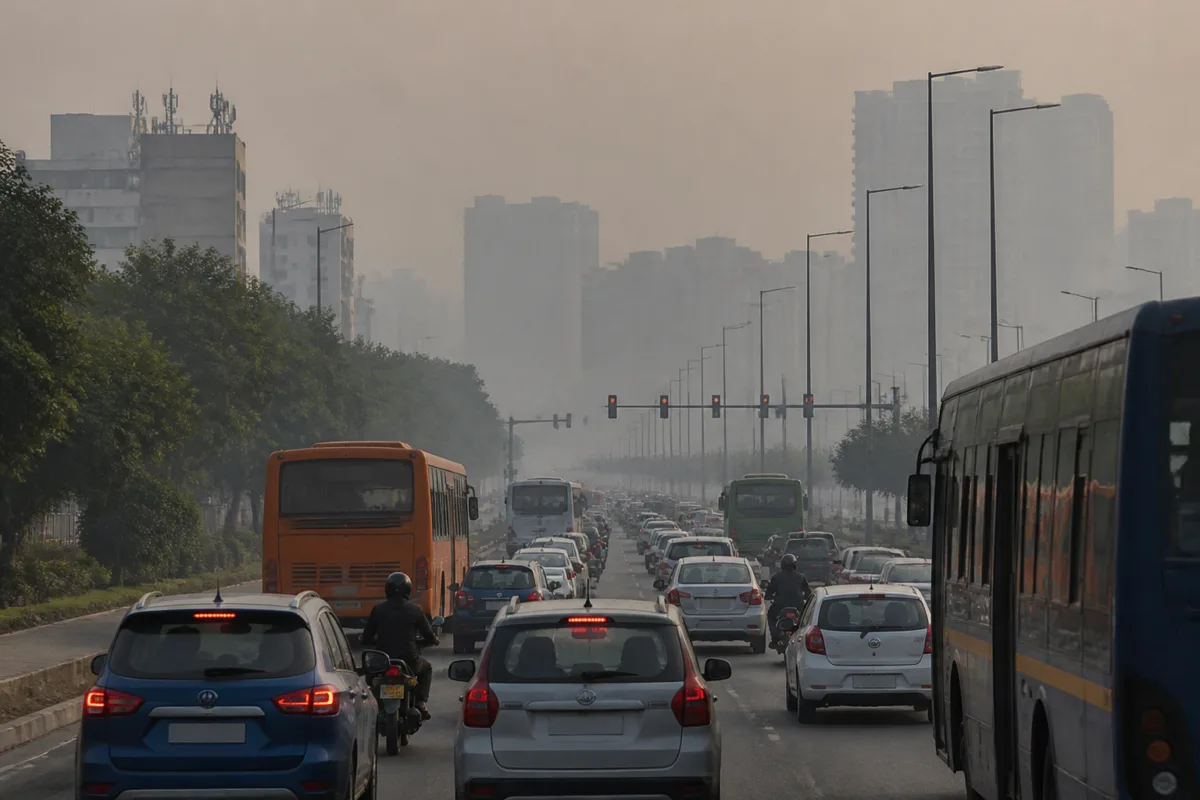
Delhi-NCR air quality worsened after Dussehra celebrations, with reported AQI readings reaching 284 in Delhi, 315 in Noida and 388 in Ghaziabad on Wednesday morning. Gurugram and Manesar also recorded a deterioration after fireworks, traffic congestion and large public gatherings during the festival.
According to a report by Jagran, Delhi’s AQI stood at 284 on Wednesday morning after Ravan burning events and Dussehra celebrations across the region on Tuesday night. The report said the deterioration followed extensive fireworks, increased road movement and traffic congestion at several junctions.
The reported readings varied sharply across the region. Noida’s AQI was recorded at 315, while Ghaziabad’s reading reached 388, according to figures displayed by the AQI.in website and cited in the report. The readings indicate a more severe deterioration in these locations than the level reported for Delhi.
Gurugram’s AQI was recorded at 205 at 7.05 am on Wednesday, while Manesar recorded 235. Both readings fall in the poor category under the commonly used AQI classification. The report said Gurugram’s reading had risen by 73 points in 72 hours, from 132 two days earlier.
The deterioration followed a night of public celebrations across Delhi-NCR. Fireworks were used during Dussehra events, while large crowds travelled to Ravan burning venues and other festival locations. The report linked the combination of fireworks, road congestion and vehicle emissions to the fall in air quality, while noting that the precise contribution of each source was not established in the supplied material.
In Gautam Buddh Nagar, police said events included Ravan burning at 35 locations and the immersion of Durga idols at 200 locations. The district had deployed 250 fire personnel and 26 fire engines as part of fire-safety preparations. The report also described heavy public movement and roads remaining busy until late at night.
The latest readings have renewed concern ahead of Diwali, when fireworks and changing weather conditions can place additional pressure on the region’s air quality. The report said October rainfall had kept the AQI somewhat better than last year, but the post-Dussehra readings showed how quickly pollution levels could worsen after a concentrated burst of emissions.
The figures also underline the regional nature of Delhi-NCR’s pollution problem. Air quality deteriorated simultaneously across Delhi, Noida, Ghaziabad, Gurugram and Manesar, although the reported levels differed by location. This makes local traffic conditions, event density, weather and monitoring coverage relevant to how residents experience pollution across the wider urban region.
The report did not provide a fresh official forecast or a detailed government response to the readings. The next reported air-quality measurements will indicate whether the deterioration is temporary or continues through the days following Dussehra.

