


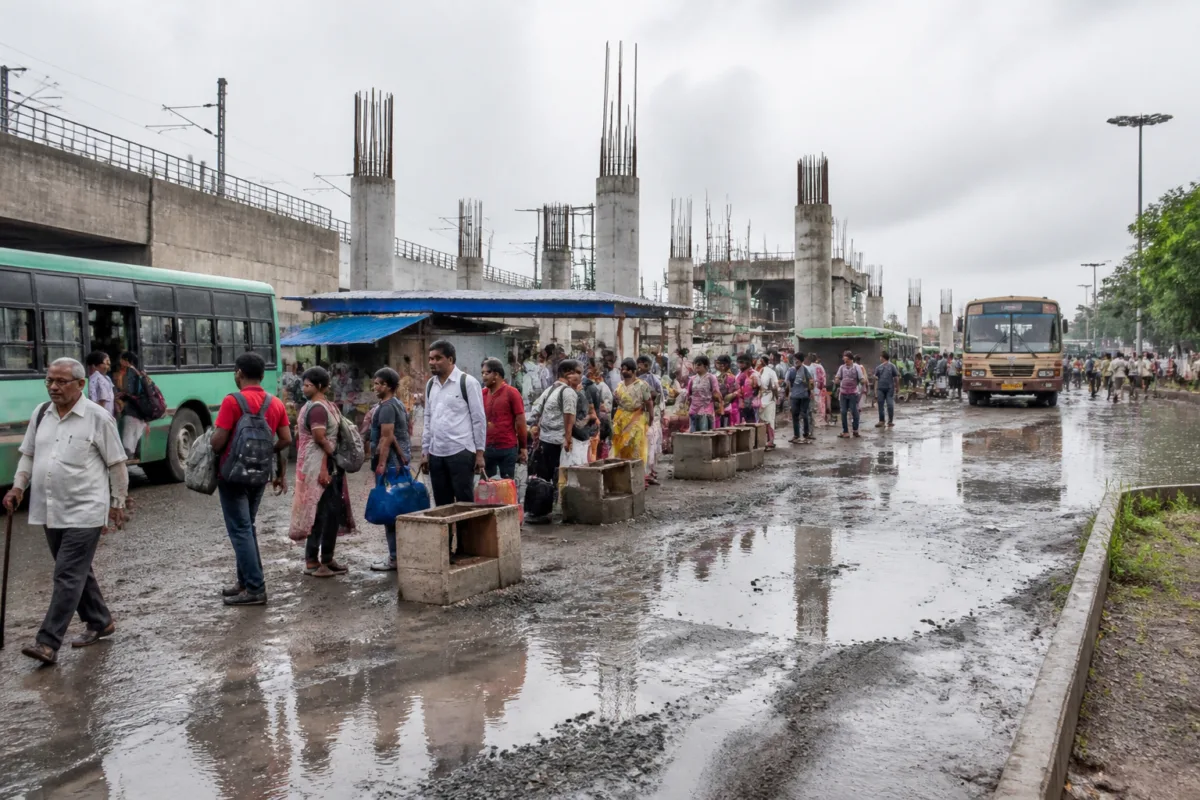
The Avadi bus terminus is meant to become a major interchange linking bus and rail services in the western Chennai metropolitan region. Instead, commuters are continuing to use a temporary facility that floods after light rain, lacks a proper paved platform and offers inadequate basic amenities. The gap between the planned terminus and the temporary arrangement shows how an infrastructure project can remain incomplete while its operational costs are transferred to passengers and transport workers.
The Chennai Metropolitan Development Authority (CMDA) began constructing the new terminus on CTH Road in August last year. To make room for the work, the Metropolitan Transport Corporation (MTC), in coordination with the Avadi Corporation, shifted bus operations to private land near Avadi railway station. The temporary site was intended to support bus operations while construction progressed. However, the arrangement has now become an extended phase of daily travel for commuters.
A senior MTC official told The Hindu that the private property had been rented until October this year and that the corporation was planning to renew the contract for another six months. This means the temporary facility could remain in use even as the new terminus is still being completed. The arrangement also leaves the duration of the disruption dependent on both the construction schedule and the continuation of the private land lease.
For commuters, the most immediate problem is not the future design of the terminus but the condition of the facility they use today. S. Murugaian, an Avadi resident, said the temporary terminus did not have a proper paved platform and became flooded even after light rain. He also pointed to the difficulties faced by senior citizens. These conditions affect the basic act of boarding and leaving a bus, particularly for passengers who require stable walking surfaces or protection from standing water.
The issue illustrates a common weakness in urban transport construction: the temporary arrangement is treated as an operational necessity, but not always as a passenger facility requiring equivalent attention. Once bus services are moved, commuters still need safe access, usable waiting areas, drainage and clear movement paths. A temporary site may not provide the capacity or amenities of a permanent terminal, but its deficiencies become significant when the construction period extends and thousands of passengers continue to depend on it.
The permanent Avadi bus terminus is being built as a three-storey facility at a cost of ₹36.06 crore. CMDA has completed 60% of the work, according to the report. The building will have a built-up area of 65,000 sq. ft. and is planned to include a food plaza, shopping area, public conveniences, a water purification plant and restrooms for bus crew. Its ground floor will contain bus bays with space for 22 buses at the same time. A waiting area of nearly 5,000 sq. ft. and offices for timekeepers and other administrative staff are also part of the plan.
These details are important because they show that the project is not simply a replacement shelter or a modest roadside facility. It is being developed as a structured transport hub, with passenger services, operational spaces and vehicle circulation built into one complex. The planned amenities also indicate an attempt to address the wider needs of a bus terminus, including waiting, sanitation, water access and staff facilities.
The location gives the project significance beyond Avadi’s immediate neighbourhood. The terminus is close to Avadi railway station, allowing it to function as an interchange between rail and bus services. Commuters travelling towards Poonamallee, Tiruvallur and Arakkonam use the facility. That catchment makes the quality of the terminus relevant to passengers moving across several parts of the metropolitan region, rather than only those boarding buses within Avadi.
The present arrangement therefore creates a mismatch between Avadi’s role in the transport network and the standard of its temporary facility. A transport interchange is valuable not only because buses stop there, but because passengers can transfer, wait and move through it with reasonable predictability. When access paths flood or platforms remain unpaved, the interchange function becomes more difficult even if bus services continue to operate.
Parking is another part of the planned project. Commuters have asked for parking facilities, and CMDA has made arrangements for 500 vehicles, including cars, in the new terminus. The provision is intended to support passengers who reach the transport hub by private vehicle before continuing their journey by bus or rail. It also reflects the pressure placed on a major interchange, where different modes compete for limited space around the station and bus operations.
However, the report does not establish when the permanent facility will be completed or when bus operations will move back from the private property. The stated 60% progress figure provides a measure of work completed, but not a confirmed commissioning date. For commuters, that distinction matters. Construction progress and service resumption are separate milestones: the building must be completed, services and passenger facilities must be made operational, and buses must be shifted without creating another disruption.
The institutional structure further complicates the transition. CMDA is responsible for constructing the new terminus, while MTC operates the bus services. Avadi Corporation was involved in coordinating the relocation of bus operations. The temporary facility is on private land rented by MTC. This places the project across multiple agencies, each with a different responsibility: construction, bus operations, local coordination and land access.
Such an arrangement requires the construction schedule and transport operations to remain aligned. If the building work takes longer, MTC must continue paying for or renewing the temporary site. If the temporary site remains unsuitable, passengers bear the practical consequences. The report does not provide the rental cost or explain whether improvements to drainage, paving or passenger facilities have been proposed at the temporary location. It does, however, establish that the contract may be renewed, indicating that the operational arrangement is likely to continue beyond the original rental period.
The demands from residents are focused on completion and improved connectivity. T. Sadagopan, a resident of Pattabhiram, called for the CMDA to complete the bus terminus-cum-depot as early as possible so that Avadi could gain greater prominence, similar to the Poonamallee bus terminus, and support more services to larger destinations in the city. That expectation links the building project to the future role of the location within the wider bus network.
The planned facility’s capacity, proximity to the railway station and provision for parking all point towards a more prominent interchange. But the evidence supplied so far confirms the project’s design and partial progress, not an expansion of services or a firm operational plan. Any assessment of increased connectivity will therefore depend on what MTC ultimately decides after the new terminus becomes available.
The Avadi case raises a basic question about urban infrastructure delivery: who safeguards the quality of everyday service while the permanent asset is being built? Construction projects are often measured through financial outlay and percentage completion. Commuters experience them through access, waiting conditions, safety and reliability. At Avadi, the 60% completion figure coexists with a temporary terminus where light rain can make movement difficult.
The immediate facts are clear. A ₹36.06-crore, 65,000-sq.-ft. terminus is under construction; 60% of the work has been completed; the temporary facility near Avadi railway station lacks a proper paved platform and can flood; and MTC is planning to renew its private-land lease for another six months. What remains to be established is the completion date, the date of operational handover and whether the temporary site will receive improvements during the extended period of use. Those milestones will determine when Avadi’s planned transport hub becomes a functioning public facility rather than a project under construction.

