


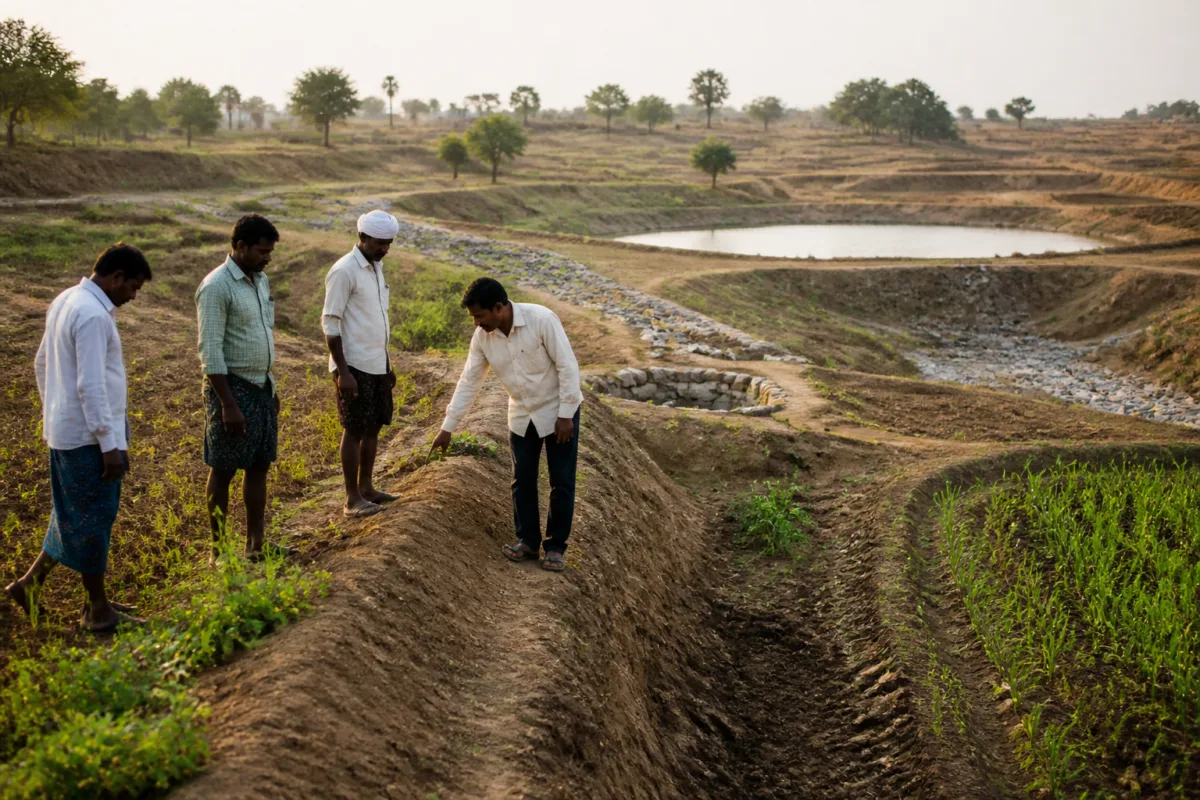
Telangana watershed conservation work in Gottigarpally village, in Sangareddy district’s Kohir mandal, has helped farmers maintain groundwater availability and cultivation during a reported period of rainfall deficits and water stress, according to farmers and local observers cited by Deccan Chronicle.
The village’s approach relies on a network of contour trenches, earthen bunds, percolation pits and small farm ponds. These structures capture rainwater, slow runoff and encourage infiltration into the ground while helping reduce soil erosion. The system is described locally as the Four Waters Concept, which treats rainwater, surface water, groundwater and soil moisture as part of an integrated ridge-to-valley management approach.
### Telangana watershed conservation built around local water retention
Farmers told the newspaper that the conservation works have allowed the village to continue cultivation even as reservoir levels fall and some areas experience water stress. Kishan Nayak, a 70-year-old farmer, said the initiative began in 2001 and had enabled farmers to grow three crops a year, including water-intensive crops such as sugarcane.
Villagers carried out trenching and bund construction themselves, using locally available earth, stones and vegetation. The works were spread across about 2,000 acres. According to villagers cited in the report, the initiative received Rs 30 lakh under the erstwhile Drought Prone Areas Programme, or DPAP, while expenditure on individual check structures was limited.
The reported groundwater difference is one of the clearest indicators of the system’s local impact. Farmers in Gottigarpally said water is available at depths of about 15 to 45 feet. In several neighbouring villages, borewells reportedly need to be drilled 40 to 80 feet or deeper. These figures are based on farmers’ accounts in the report and are not presented as an independent hydrogeological assessment.
The conserved water has supported crops including sugarcane, ginger, potatoes and bananas, according to the farmers. The benefits were also reported in nearby Lethamamidi, Sajjaraopet, Siddapur thanda and Gopinayak, where cultivators are said to have benefited from better-protected tanks and wells.
The example illustrates how relatively small water-retention structures can form a distributed rural infrastructure network. Rather than depending only on large reservoirs or deeper borewells, the approach seeks to retain rainfall across the landscape and improve recharge closer to farms. Its reported results also show the importance of maintenance and community participation, since villagers themselves dug trenches and built bunds over several years.
However, the available evidence is limited to a single reported account and statements from local residents and an activist. It does not establish the precise contribution of each structure, provide long-term groundwater measurements or compare crop yields with those in neighbouring villages under consistent conditions. Those gaps matter when assessing whether the model can be replicated elsewhere.
For now, Gottigarpally’s experience offers a documented local example of watershed conservation being used to improve water security and sustain cultivation during a dry spell. Deccan Chronicle’s original report is available at https://www.deccanchronicle.com/southern-states/telangana/watershed-work-helps-telangana-village-withstand-dry-spell-2009214.

