


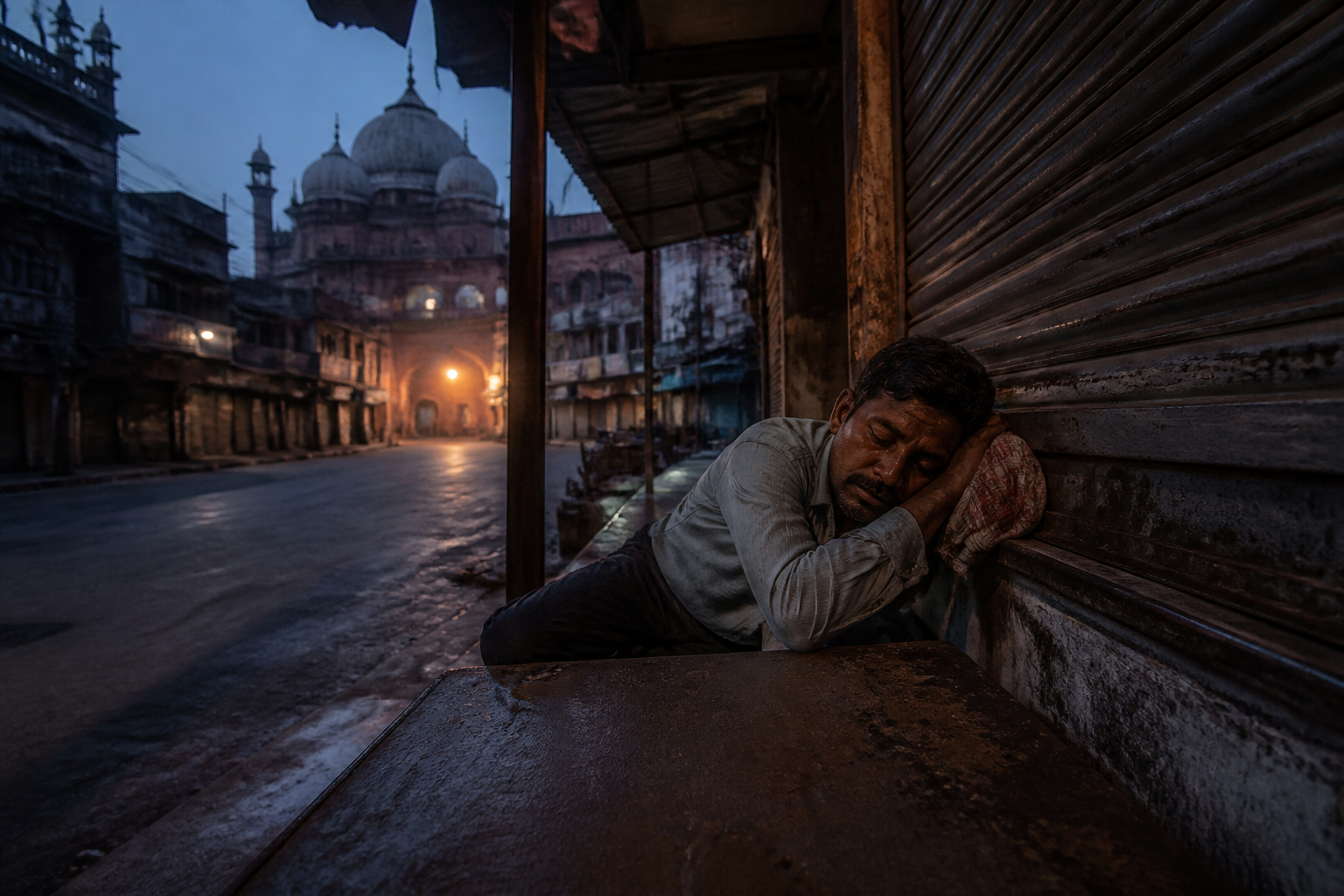
The Delhi High Court’s observation that labourers are among the least paid and least cared-for workers in India has brought a routine but largely invisible feature of urban life into focus: the city depends on physically demanding labour while often failing to provide workers with safety, rest and social respect. The remark came in a judgment modifying a man’s conviction and sentence for attacking a labourer who objected to a disturbance while trying to sleep in a shop verandah in Chandni Chowk.
The court’s decision was primarily about the legal classification of the assault. Justice Vimal Kumar Yadav held that the evidence did not establish the intention or knowledge required for a conviction for attempt to murder. The conviction was modified to voluntarily causing hurt by dangerous weapons, and the five-year sentence was reduced to three years. But the judgment also recorded a wider concern about the circumstances in which labourers live and work in Indian cities.
The case involved an incident from March 17, 2002. Rajinder Kumar, who was employed at a shop in Lajpat Rai Market, was about to sleep or was sleeping in the shop’s verandah when noise created by Veer Pal and others disturbed him. After Kumar asked them to stop, Pal pushed him and attacked him with a sharp instrument used by cobblers to cut leather. A patrolling policeman noticed the commotion, Kumar was taken to hospital and Pal was taken to the police station.
The physical setting is significant. Kumar was not described as sleeping in a formal residence, a workers’ hostel or another dedicated accommodation facility. He was resting in a shop verandah at a commercial market where he worked. The judgment does not establish why that arrangement existed or whether alternatives were available. It does, however, show how employment, shelter and rest can become compressed into the same urban space for workers at the bottom of the income ladder.
That compression is not incidental to the functioning of cities. Markets, construction sites, transport networks, warehouses, workshops and residential neighbourhoods rely on workers whose labour is physically demanding and whose working hours may be long or irregular. Yet the spaces designed for commerce and production are not necessarily designed for recovery, sleep or personal security. In Kumar’s case, the court connected the need for peaceful sleep directly to the ability to resume hard physical work the next day.
“A back-breaking hard day’s labour requires a sound, peaceful sleep in the night to rejuvenate the body to enable it to assume and discharge the next day’s assignments,” Justice Yadav said in the judgment passed on September 18. The court described the situation as a regular and unending plight, saying labourers were “least paid, least cared for and least bothered”.
The language is unusually direct for a judicial observation about labour and urban life. It does not amount to a new labour policy or a direction creating accommodation rights in the case. Its importance lies instead in identifying a relationship that is frequently separated in public administration: labour is treated as an economic input, while rest, shelter and personal safety are treated as private concerns. For workers without secure housing, that separation does not reflect lived reality.
The judgment also described the social failure to value physical labour, contrasting it with the court’s stated view that physical work is adequately compensated and valued in the western world. That comparison is part of the court’s reasoning and should not be read as a comprehensive assessment of labour markets across countries. The more immediate point established by the case is narrower: a worker’s need for quiet and safety while sleeping was linked to the dignity and continuity of the work he performed.
The legal outcome illustrates another institutional boundary. The criminal case could determine whether the assault amounted to attempt to murder or voluntarily causing hurt by a dangerous weapon. It could also determine the appropriate sentence after considering the age of the incident, the absence of recorded questionable antecedents and the lack of subsequent involvement in crime. It could not, within that appeal, resolve the larger conditions that left a worker sleeping in a market verandah.
The court noted that the incident dated back to 2002 and that there was no material showing questionable antecedents or later involvement after the case. Those factors supported the reduction of the sentence from five years to three. The judgment therefore contains two distinct institutional responses: criminal law addressed the assault, while the court’s observations drew attention to the social and urban conditions surrounding the victim.
This distinction matters because urban vulnerability often appears only when it produces a crisis. A worker’s lack of secure rest may remain invisible until it contributes to conflict, illness, injury or an encounter with the criminal justice system. The supplied case does not establish a broader pattern through data, nor does it identify the number of workers living in similar conditions. It does show how an ordinary urban activity—sleeping after a day’s labour—can become precarious when accommodation is located in a commercial setting with no clear separation between work, rest and public access.
The case also reveals the limits of treating labour only through employment status. Kumar was employed at a shop, but the judgment does not indicate that employment translated into dedicated residential space or protection at the place where he rested. The absence of such detail prevents a conclusion about the employer’s legal responsibilities in this particular matter. It nevertheless raises a governance question: which institution is responsible when a worker’s basic rest depends on informal use of a commercial premises?
That question sits at the intersection of labour administration, municipal regulation, market management and urban housing. The judgment itself does not assign responsibility among these systems. Nor does it announce a scheme, funding mechanism or administrative programme for labour accommodation. What it does is place the worker’s physical recovery within the frame of urban dignity rather than leaving it outside the public discussion.
For cities, the practical challenge is that workers who perform essential physical tasks are often mobile, temporary or tied to informal arrangements. The source material does not provide data on migration, wages, housing supply or the number of workers in Delhi who sleep at or near their workplaces. These gaps are important. Without such evidence, the court’s observations should not be converted into a quantified claim about the capital’s entire labour force.
Still, the judgment offers a clear evidence-based starting point. A labourer working in Chandni Chowk was resting in a shop verandah in 2002. A disturbance there led to an assault, a criminal prosecution and, more than two decades later, a High Court judgment that connected peaceful sleep with the ability to continue physically demanding work. The chronology shows how long legal proceedings can separate the final judicial record from the original urban condition.
The larger issue is not whether every worker requires employer-provided housing or whether every commercial premises can function as accommodation. Those questions require legal, administrative and financial evidence not contained in the judgment. The issue established here is that the city’s economic dependence on physical labour cannot be understood only through the output workers produce. The spaces and conditions that allow them to recover are part of the same urban system.
The Delhi High Court’s ruling therefore carries two messages. Legally, it modifies Veer Pal’s conviction to voluntarily causing hurt by dangerous weapons and reduces his imprisonment from five years to three. Socially, it records the court’s concern that labourers remain poorly paid, insufficiently cared for and undervalued despite the physical work on which urban commerce depends. What remains unresolved is how cities, employers and public institutions should translate that recognition into secure and dignified conditions for workers beyond the courtroom.
