


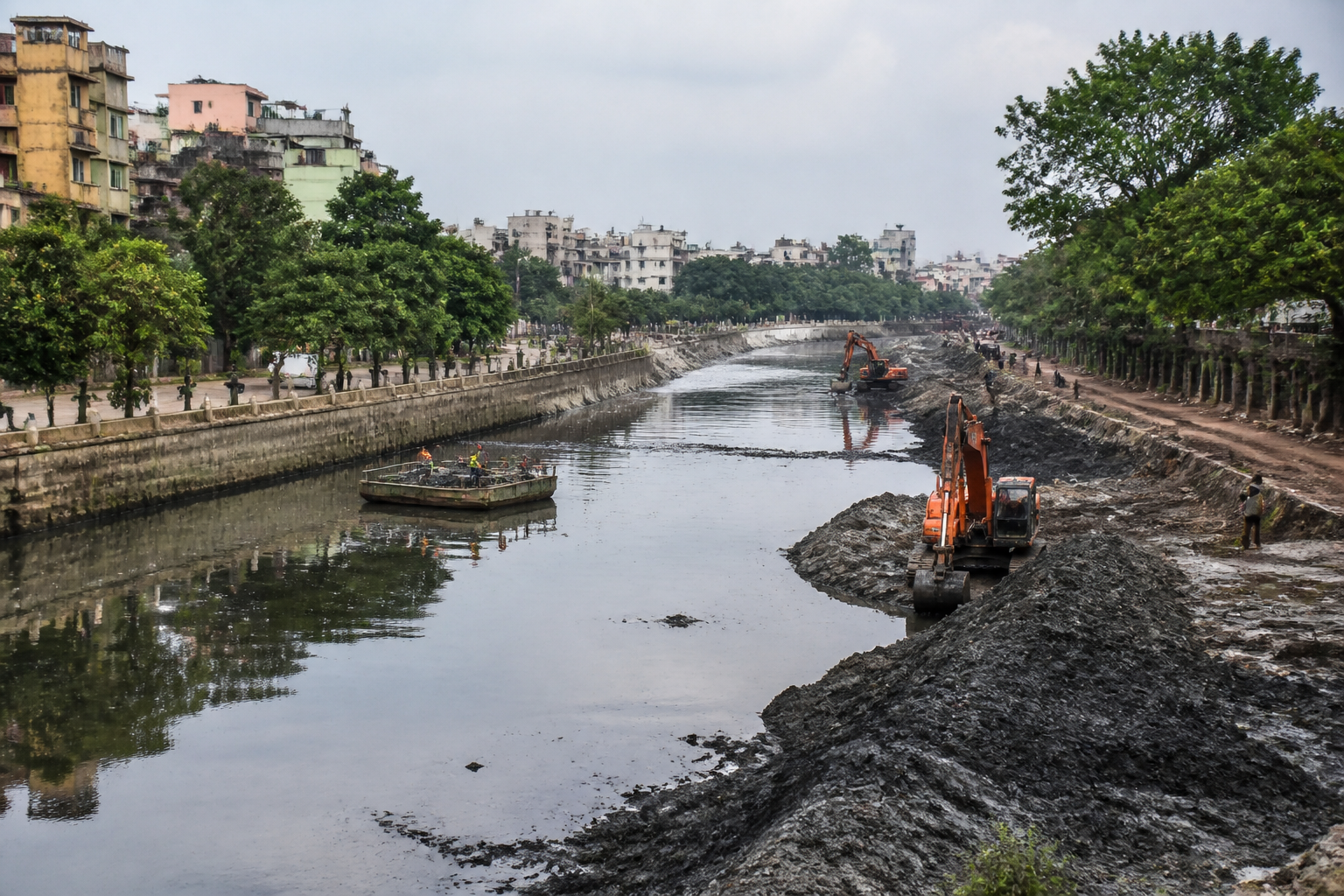
The latest plan for Cooum river restoration in Chennai is significant because it attempts to move the project beyond repeated clean-up drives towards a phased programme combining ecological repair, sewage interception, flood mitigation and public-space development. Chief Minister C Joseph Vijay has directed officials to bring in global technical expertise while preparing a detailed project report (DPR), but the effectiveness of the exercise will depend on how the government connects these separate objectives into one implementable river strategy.
According to a report by DT Next, Vijay reviewed preparations for the comprehensive restoration of the Cooum and instructed officials to pursue the project in phases. The review covered the DPR, proposed facilities and preparations for inviting global tenders. The State government had already identified river restoration as a priority in the 2026-27 Budget and announced that a DPR would be prepared for the Cooum.
The immediate administrative task is therefore not construction. It is the preparation of the technical and institutional framework that will determine what gets built, where it is built and in what sequence. The government is expected to finalise the DPR, concept plans and action plans before moving to global tendering and phased implementation. That makes the current stage important: the choices made during planning will shape both the river’s environmental recovery and the public amenities proposed along its edges.
The Cooum’s restoration has long been associated with large public expenditure and limited visible success. DT Next described the river as having remained a difficult urban problem despite successive administrations spending substantial amounts on efforts to clean it. The latest proposal acknowledges that a river cannot be restored through isolated desilting or beautification alone. It brings together sewage interception, water-quality improvement, flood-mitigation infrastructure, ecological measures and public access.
This is the central shift in the current proposal. Riverfront development is being presented not simply as the construction of walkways beside a polluted watercourse, but as part of a broader restoration programme. The interventions listed in the initial planning include pedestrian and cycling tracks, riverside walkways, viewing decks, green spaces, community facilities and nature-based environmental improvements. Whether these facilities support restoration or merely sit alongside an unresolved pollution problem will depend on the sequencing of the project.
The decision to study three-kilometre stretches in detail suggests that the government is beginning with defined sections rather than treating the entire river as an immediately uniform construction site. The supplied report does not specify which stretches have been selected, their current water-quality conditions, land ownership, encroachments, sewage loads or implementation costs. Those details will be important parts of the DPR because the physical and institutional conditions along the river are unlikely to be identical.
A phased approach can make a large restoration programme more manageable, but it also creates a risk of fragmented implementation if the phases are designed as independent beautification packages. A river functions as a connected system. Sewage entering upstream affects downstream water quality; blocked channels and inadequate drainage affect flood behaviour; and public spaces built without maintenance arrangements can deteriorate even when the initial construction is completed. The government’s stated intention to adopt an integrated and sustainable approach will therefore need to be reflected in the technical design and tender conditions.
The proposed role for global consultants and international technical expertise is another important feature of the plan. The State government had earlier announced that global consultants would be engaged for feasibility and project reports for both the Cooum and Adyar. In the current process, officials are preparing to invite global tenders for the Cooum restoration exercise. The report does not identify the consultants, estimated project cost, procurement model or performance standards. Those omissions mean that the proposal’s eventual quality cannot yet be assessed from the announcement alone.
Global expertise may assist with river engineering, water-quality management, nature-based solutions and the design of public spaces. It cannot, by itself, resolve local administrative responsibilities. Restoration will require coordination between departments responsible for water resources, sewerage, storm-water drainage, roads, land management, public spaces and urban maintenance. The review meeting was attended by Chief Secretary M Sai Kumar and senior officials, indicating high-level administrative attention, but the final institutional arrangement has not been detailed in the supplied report.
The policy landscape also shows why the DPR matters. The 2026-27 Budget has given priority to Chennai’s river restoration projects, while the proposed feasibility and project reports for the Cooum and Adyar are intended to cover sewage interception, water quality, recreational spaces and flood-mitigation infrastructure. These are related but distinct areas of public action. Sewage interception requires connections to the sewerage network and treatment capacity. Flood mitigation requires hydraulic planning and maintenance of drainage channels. Public spaces require land, access, safety and long-term upkeep. Ecological improvement requires measures that address the river’s environmental conditions rather than only its visible edges.
The available data in the report is limited but still establishes the scale and breadth of the proposed planning exercise. Three-kilometre stretches have been identified for detailed study. The proposed facilities include at least five categories of public or environmental intervention: walking and cycling infrastructure, riverside access, viewing decks, green spaces and community facilities. The report also identifies sewage interception, water quality and flood mitigation as part of the wider restoration agenda. It does not provide the total length of the river covered by the programme, the number of phases, a delivery timeline, the budget allocation or measurable water-quality targets.
That absence of baseline information is not a minor technical gap. Without an agreed starting point, it will be difficult to determine whether the project improves the river or simply changes its appearance. A credible DPR would need to establish the existing condition of each selected stretch and define how progress will be measured. The supplied material does not say whether such indicators have been finalised. It only records that officials are working on the DPR and related concept and action plans.
The timing of the latest review also connects the long-term restoration proposal to immediate river management. Ahead of the monsoon, the Water Resources Department has undertaken maintenance and desilting of the Cooum. These activities may address near-term operational requirements, while the DPR is intended to guide a larger restoration programme. The two should not be treated as substitutes. Maintenance can support channel function in the short term, but the broader plan is expected to address the systems that determine pollution, water quality, public safety and environmental condition.
The public-space component raises a further planning question. Pedestrian and cycling tracks, walkways, green areas, viewing decks and community facilities could make the river more accessible to Chennai residents. They could also help turn neglected river edges into usable civic spaces. But access is only meaningful if the surrounding environment is safe, clean and maintained. The report does not state how these spaces will be managed, who will be responsible for operations, or how public access will be reconciled with flood-mitigation and ecological requirements.
The larger urban question is whether Chennai can treat river restoration as a continuing public-service function rather than a sequence of one-time projects. The history described by DT Next—substantial expenditure followed by limited success—suggests that construction and spending alone have not solved the problem. The current proposal is more ambitious in scope because it combines the river’s environmental condition with infrastructure and public-space planning. Its success will depend on whether that integration survives the transition from DPR to tendering and then to phased implementation.
For now, the government has established the direction of travel but not yet the full delivery mechanism. The next decisive documents will be the detailed project report, the concept and action plans, the terms issued for global tendering and the eventual phase-wise implementation schedule. Those documents should clarify the selected stretches, technical objectives, institutional responsibilities, funding, timelines and performance measures. Until then, the latest announcement confirms a renewed planning effort for Cooum restoration, but not yet a completed solution to Chennai’s long-running river challenge.
