


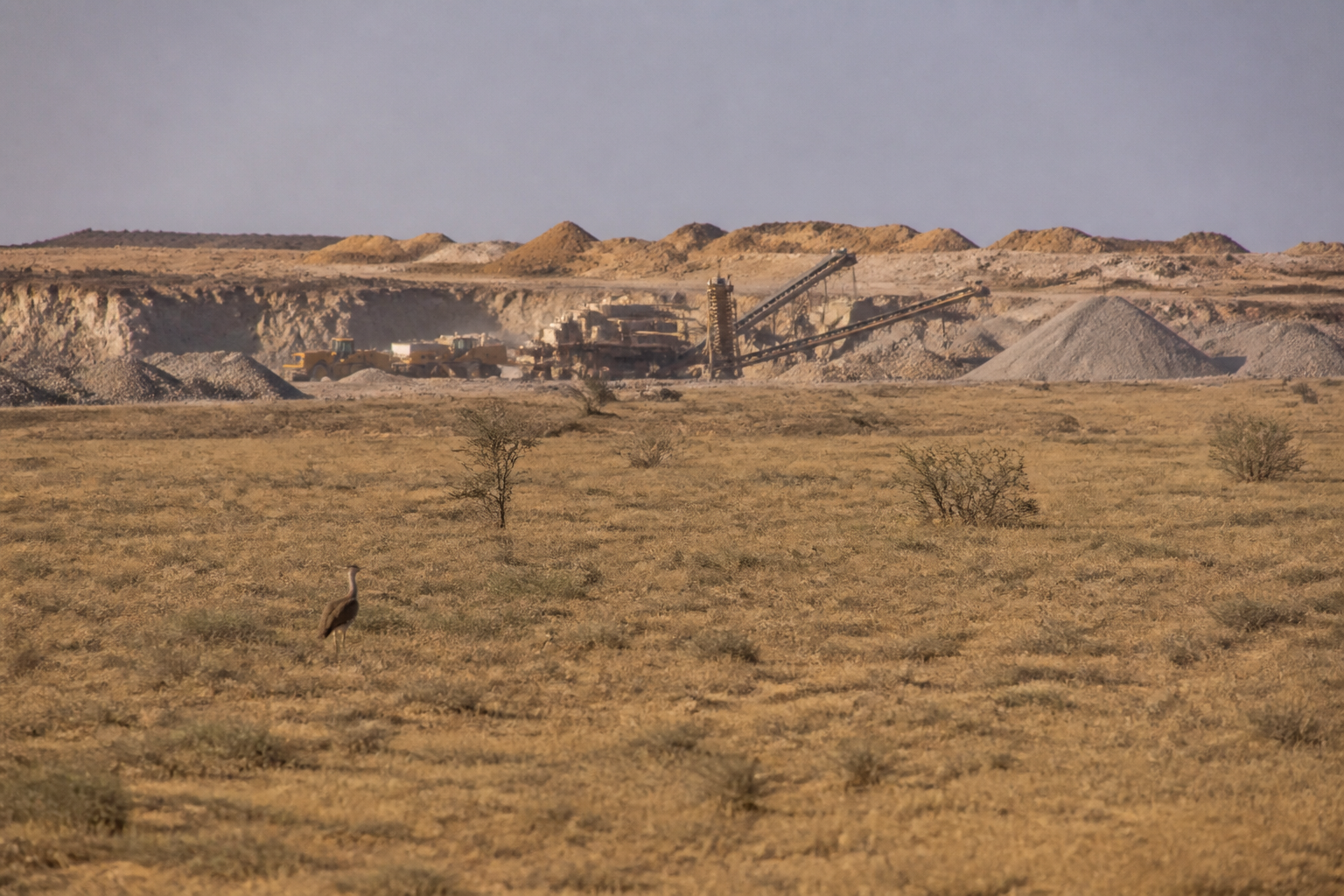
The proposed Jaisalmer limestone mine by UltraTech Cement has moved closer to environmental appraisal despite its location 5.8 km from a designated Great Indian Bustard priority area, bringing into focus whether regulatory safeguards can manage the cumulative pressures of mining, crushing, transport and human activity around one of India’s most fragile grassland habitats.
The Union environment ministry’s expert appraisal committee recommended the project for the grant of terms of reference during its meeting on September 10. This is an early procedural step, not a final environmental clearance. The terms of reference will define the scope, objectives, methodology and reporting requirements for the environmental impact assessment that the project must prepare.
The proposed project in Joga village, Jaisalmer, spans more than 400 hectares and includes a limestone mine and a stone-crushing unit. According to the minutes of the EAC meeting cited in the report, the mine is designed to produce one million tonnes of limestone a year, while the crusher would have a capacity of 1,500 tonnes per hour.
That scale matters because the project’s environmental footprint would not be limited to the extraction area. Mining would be accompanied by blasting, crushing, vehicle movement, dust generation, waste disposal and other forms of human activity. The EAC has therefore asked the project proponent to prepare a Great Indian Bustard conservation plan covering site-specific mitigation measures, grassland habitat management, breeding-habitat protection, monitoring systems, institutional arrangements and budgetary provisions.
The committee has also asked for a plan to regulate anthropogenic disturbance within and around the conservation zone. The requested plan is to address grazing, vehicular movement, human interference, waste disposal and other activities. These requirements recognise that habitat protection is not only a question of maintaining a fixed boundary around a priority area. It also depends on controlling the activities that can disrupt birds using adjoining grasslands and breeding locations.
The Great Indian Bustard priority areas are designated as crucial habitats, including retreats and breeding grounds, for the critically endangered bird. The proposed mine’s distance from such an area makes the quality of the environmental assessment particularly important. The available report does not establish that the project has received final approval, nor does it provide the findings of a completed impact assessment. At this stage, the regulatory process has moved to defining what the assessment must examine.
UltraTech has proposed several measures to reduce potential impacts. These include dust suppression through water sprinkling, bag filters at the stone-crushing site and efforts to minimise disturbance in adjoining areas. The measures are directed at pollution and operational disturbance, two pressures that can extend beyond a mine’s formal lease boundary through airborne dust, vehicle movement and industrial activity.
However, the company’s record at another Rajasthan mining site has become part of the context surrounding the Jaisalmer proposal. At a limestone mining site covering more than 500 hectares in Jodhpura-Mohanpura village in Kotputli-Behror district, UltraTech has faced allegations of failing to implement similar environmental and public-health safeguards. In November 2025, the Central Zone Bench of the National Green Tribunal held the company responsible for environmental damage and health hazards in the village.
The NGT directed the company to stop blasting operations at night, cover the stone-crushing area with tarpaulin, spray water on approach roads, and install or use bag filters, vacuum suction hoods and dry fogging systems for pollution mitigation. These directions are significant because they identify the practical controls required at an operating mine rather than only the commitments made during the approval process. A response from the company regarding the allegations and the compliance concerns is awaited, according to the report.
The comparison between the two sites does not by itself establish that the Jaisalmer project will cause the same impacts. It does, however, raise an institutional question: how should regulators assess proposed safeguards when a project proponent has been directed by an environmental tribunal to correct similar operational problems elsewhere? The answer will depend on the evidence submitted through the impact assessment, the specificity of the conservation plan and the effectiveness of monitoring after operations begin.
The project’s approval pathway also illustrates the layered nature of environmental governance in large industrial developments. The EAC’s recommendation for terms of reference sets the requirements for the next assessment stage. The project proponent must then provide information on environmental impacts and mitigation measures before subsequent regulatory decisions can be taken. The supplied report does not state when the assessment will be submitted or when a final clearance decision may be considered.
For the Great Indian Bustard, the key issue is likely to be whether mitigation is treated as a list of equipment and operating practices or as a wider habitat-management system. Water sprinkling, bag filters and dust-control systems can address specific pollution sources. They do not, by themselves, explain how breeding habitat will be protected, how disturbance will be monitored, how vehicle movement will be controlled or who will be responsible for enforcement across the conservation zone. The EAC’s requested conservation plan places those wider questions within the project’s formal appraisal framework.
For nearby communities, the relevant concerns are similarly operational. The NGT directions in the Kotputli-Behror case refer to blasting, crusher dust, approach-road pollution and health hazards. These are the points at which a large industrial project intersects with daily life: air quality around homes and roads, noise from blasting, movement of heavy vehicles and the reliability of safeguards after construction and commissioning. The Jaisalmer appraisal will need to establish how these impacts will be measured and managed in the local setting.
The available facts therefore show a project that has advanced procedurally but remains subject to further scrutiny. Its proposed annual limestone production is substantial, and its crusher capacity indicates an industrial operation rather than a small extraction activity. Its proximity to a Great Indian Bustard priority area gives the conservation plan a central role, while the NGT’s directions at another UltraTech site make implementation and compliance material parts of the project’s wider regulatory context.
The next important evidence will come from the environmental impact assessment and the project-specific Great Indian Bustard conservation plan. Those documents will need to clarify the project’s effects on grassland and breeding habitat, the regulation of human and vehicle activity, the monitoring arrangements, the institutional responsibilities and the budget allocated for mitigation. Until those details are available, the EAC recommendation should be understood as progress in the approval process—not as a finding that the mine is environmentally safe or as a final clearance to begin operations.
