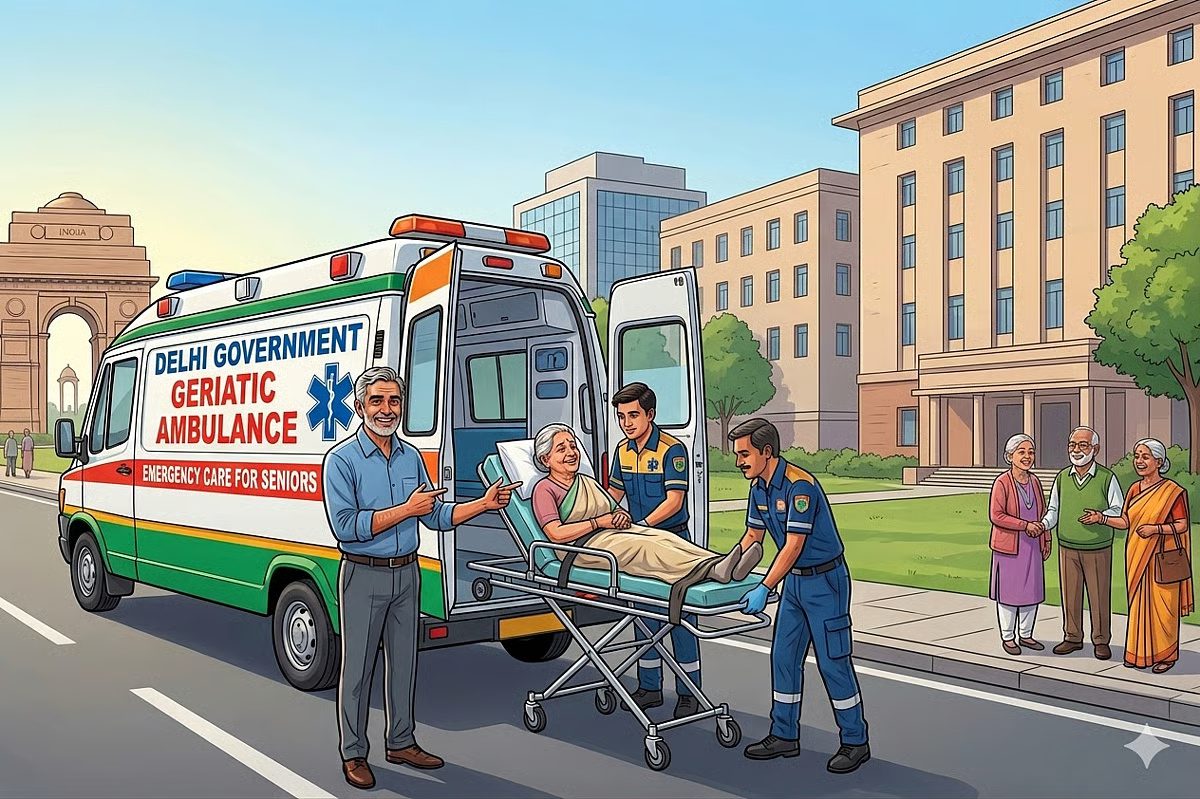
Delhi is set to strengthen its emergency medical services by introducing specialised ambulances designed for elderly patients, signalling a shift towards more inclusive and responsive urban healthcare systems. The move is expected to improve access to timely medical care for senior citizens while reinforcing the city’s broader emergency response capacity. The rollout of Delhi geriatric ambulances will add a new layer to the capital’s existing trauma response network, taking the total fleet size to over 350 vehicles. These additions are being positioned as part of a wider effort to address the healthcare needs of an ageing population, particularly in dense urban environments where rapid response can be critical.
Healthcare planners note that emergency services in large cities are increasingly required to cater to complex, age-related conditions. Unlike conventional ambulances, the new units are expected to be equipped with advanced life-support systems and features tailored to safely transport elderly patients. This includes improved handling mechanisms and monitoring equipment that can support patients with chronic or multiple health conditions during transit. The introduction of Delhi geriatric ambulances reflects a broader evolution in how public health infrastructure is being designed. As life expectancy rises and more older residents live independently in urban areas, emergency response systems must adapt to ensure equitable access. In many cases, delays in pre-hospital care can significantly affect outcomes, making first-response capabilities a critical link in the healthcare chain. Officials indicate that the initiative is aligned with ongoing investments in hospital capacity and critical care facilities across the city. Strengthening ambulance services is seen as essential to connecting patients with appropriate medical institutions quickly and efficiently. Improved coordination between dispatch systems, road traffic management, and hospital readiness is expected to play a key role in enhancing service delivery.
From an urban development perspective, the expansion highlights the growing importance of health infrastructure in shaping liveable cities. Experts suggest that integrating emergency healthcare services into urban planning frameworks can improve resilience, particularly during extreme weather events or public health crises. Ensuring that vulnerable populations, including the elderly, have reliable access to emergency care is increasingly viewed as a core component of inclusive city design. However, scaling such services presents operational challenges. Expanding the ambulance network will require sustained investment in trained personnel, maintenance systems, and digital technologies for real-time tracking and coordination. Without these supporting elements, capacity additions may not fully translate into improved outcomes. There are also economic considerations, as efficient emergency services can reduce long-term healthcare costs by enabling early intervention. For families, timely access to care can prevent complications and reduce the financial burden associated with delayed treatment.
As Delhi continues to expand its healthcare ecosystem, the deployment of Delhi geriatric ambulances signals a move towards more targeted and people-centric service delivery. The effectiveness of this initiative will depend on how well it integrates with existing systems and adapts to the evolving needs of the city’s population, setting a precedent for other urban centres navigating similar demographic shifts.