


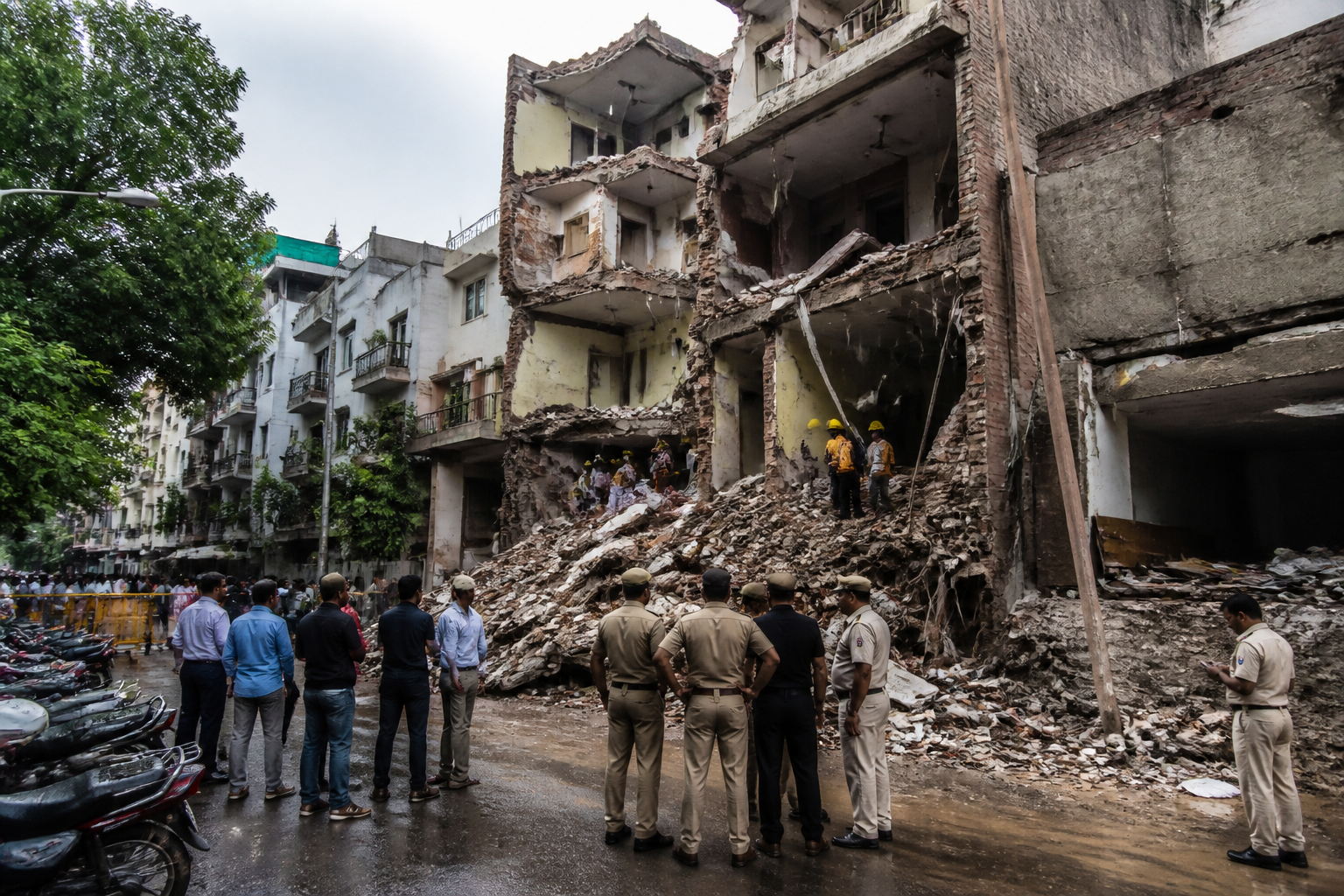
NEW DELHI | September 9, 2026
The Delhi building collapse in Satya Niketan killed seven people, but the central story is not limited to one ageing structure or the arrests that followed. The collapse has reopened questions about how unauthorised construction, changing land use, unsafe alterations and weak inspections are allowed to persist until a building becomes a fire or structural disaster. Read alongside the Malviya Nagar B&B fire three months earlier, the incident points to a regulatory system that repeatedly acts after deaths rather than before them.
In the Satya Niketan case, the property was being used as student accommodation. Around 15 rooms had reportedly been created in a 55-square-yard plot, with about 45 students living there and generating more than Rs 4 lakh a month in rent. Police have alleged that four floors were added to an ageing structure despite concerns that its foundation could not support the additional load. Construction and repair work was also under way when the building collapsed, killing five students and two labourers.
The immediate investigation is examining several possible contributors, including work in the basement, the accumulation of rainwater and waste, and the weakening of structural elements. Civic officials said the property dated from the 1970s, with some repairs carried out in 1990. The basement, constructed around 2007, reportedly had no reinforced cement concrete pillar and relied on load-bearing walls. Investigators are examining whether work on one such wall contributed to the collapse. The exact cause, however, had not been officially confirmed in the supplied report.
That uncertainty is important. The MCD has said it has zero tolerance for unauthorised construction, but officials have differed on whether construction activity at the property had been confirmed before the collapse. Mayor Pravesh Wahi said the building had not been classified as dangerous, although work was being carried out in the basement. MCD commissioner Sanjeev Khirwar told The Times of India that there was no confirmation of construction activity at that stage, while also saying officials had been suspended because of local allegations and the ongoing inquiry.
Five MCD South Zone officials were suspended after the collapse: Deputy Commissioner Rakesh Kumar, Superintending Engineer Ranvir Singh, Executive Engineer Lalit Kumar Goel, Assistant Engineer Sunil Chauhan and Junior Engineer Ashish Kumar. Three of them had been posted in the South Zone when the Hauz Rani B&B fire took place. That fire killed 23 people and injured 20, exposing a different but related chain of failures involving illegal expansion, licensing, inspections and fire safety.
The Hauz Rani case provides the clearest evidence of how responsibility can become dispersed across a city’s regulatory machinery. The B&B had been licensed for six rooms but had allegedly expanded into a 25-room hotel across four floors, a basement and an improvised rooftop facility. Investigators found a single entry and exit route, a locked terrace and inadequate fire-safety systems. A magisterial inquiry later identified alleged lapses involving the property owner and management, the MCD, Delhi Police, the tourism department and BSES Rajdhani Power Ltd.
The inquiry said the MCD had issued stop-work notices and requested police assistance. It had also asked the electricity distributor to disconnect power. Yet the unauthorised work allegedly continued. The police were criticised for not acting effectively on the notices, while the tourism department faced scrutiny over the licence and inspection process. The inquiry alleged that inspectors did not properly record the building’s configuration, overlooked the absence of a fire no-objection certificate and failed to flag inadequate ventilation.
The institutional pattern is significant. In both incidents, the property owner and operators became the first focus of accountability. In both, the investigation also raised questions about the public agencies responsible for approving, monitoring or stopping activities at the site. The distinction between private wrongdoing and public regulatory failure is not academic. A building can be altered by an owner, commercially operated by another party and occupied by residents, but the safety framework depends on several authorities identifying the risk before people are trapped inside.
Delhi’s inspection system reveals the limits of relying on visible deterioration alone. The MCD surveyed more than 30 lakh houses across the city by the end of June as part of a pre-monsoon exercise. Only 51 structures were declared dangerous. Yet Satya Niketan, Hauz Rani and Said-ul-Ajaib, areas associated with fatal fires or collapses, had not been declared dangerous during earlier surveys. The MCD says these inspections rely on visual checks and complaints. Once a building is classified as dangerous, the corporation can issue a vacation notice and initiate demolition action.
The available evidence does not establish that every unsafe building should have been identified through the pre-monsoon survey. It does, however, expose a structural limitation: visual surveys may not capture the risk created by unauthorised vertical expansion, intensified occupancy, commercial conversion or alterations to load-bearing components. A building may appear serviceable from the outside while its sanctioned use, internal layout and structural capacity have changed substantially.
The government’s response after the collapse has followed a familiar enforcement sequence. The MCD issued show-cause notices to five buildings and a demolition notice to one in the South Zone. Several nearby buildings received vacation notices, while one was declared dangerous under Section 348 of the Delhi Municipal Corporation Act. Junior engineers in all 12 zones were asked to identify buildings that had outlived their structural life or were in a dilapidated condition and begin action under the DMC Act.
The Delhi government also ordered inspections of paying guest accommodations and buildings with unauthorised construction. On September 8, the civic body surveyed 1,150 PG accommodations housing around 20,000 people for structural and fire-safety concerns. The chief secretary was directed to ensure structural audits of buildings in major PG hubs within a week. Lieutenant Governor T S Sandhu cautioned against indiscriminate sealing because it could leave students without accommodation. A committee was asked to contact students, record their grievances and prepare a database. Authorities were also examining alternative accommodation through universities, the MCD and the DDA, including vacant buildings owned by the agencies.
These steps reveal a policy tension between enforcement and housing supply. Sealing unsafe PGs may reduce immediate risk, but it can also displace residents if no alternative accommodation exists. The issue is particularly visible in areas where small residential plots have been converted into high-density student housing. The Satya Niketan property reportedly accommodated three students per room, illustrating how demand for affordable accommodation can be absorbed through informal intensification rather than planned, inspected facilities.
The regulatory framework already assigns responsibilities for basements, sanctioned plans and safety clearances. Civic officials said basements must form part of the sanctioned building plan and comply with the Master Plan and applicable building regulations. For plots up to 500 square metres, empanelled professionals have certification and inspection responsibilities, while the local body retains a statutory monitoring role. Fire and structural safety requirements apply depending on the nature of the construction or alteration.
The unresolved question is therefore not simply whether Delhi has rules. It is whether those rules generate timely information and enforceable action when a building’s use changes. The supplied report does not establish who approved the alleged additions at Satya Niketan or whether any agency had formally recorded the property as unsafe before the collapse. That gap is central to the inquiry because responsibility cannot be assigned only after the structure has failed.
The wider data points to a citywide problem. Delhi Fire Service records cited in the report show more than 330 building-related calls between January 1 and September 6 this year, resulting in 30 deaths and 120 injuries. During the corresponding period last year, there were 446 such calls, with 46 deaths or fatal incidents and 155 injuries. The calls include major collapses as well as complaints and precautionary responses involving cracks, falling bricks, roof collapses and other building-related concerns.
Delhi also recorded the Said-ul-Ajaib collapse on May 30, which killed six people, along with collapses in Malka Ganj’s Sabzi Mandi area and Karawal Nagar in June. At the national level, government data cited in the report indicates that nearly 33,000 people died across India between 2020 and 2024 in incidents involving building collapses, fires and falls into pits and manholes. The figures cover multiple categories, but together they indicate the human cost of weak maintenance and enforcement in rapidly changing urban environments.
The dispute over redevelopment adds another layer. Some MCD officials attributed unchecked vertical expansion in resettlement colonies to the absence of a clear redevelopment policy. They said such colonies had not received the same redevelopment benefits available under other provisions of MPD-2021 and that narrow plots and load-bearing structures made unauthorised additions particularly risky. The DDA disputed the suggestion that policy absence explained the problem, pointing to Clause 4.5.4(i)(c) of MPD-2047, which provides for redevelopment through regeneration schemes. It also said that every construction still requires a building plan to be sanctioned by the concerned local body.
This disagreement does not resolve the enforcement question. A redevelopment policy may address the mismatch between old housing forms and current demand, but it does not remove the requirement for sanctioned construction or safety compliance. Conversely, enforcement without a workable pathway for legal redevelopment may leave residents and property owners operating within buildings that no longer match the city’s housing needs.
The evidence from Satya Niketan and Hauz Rani confirms a recurring sequence: buildings acquire additional rooms or floors, their use becomes more intensive, inspections fail to capture the change, and enforcement accelerates only after a fatal incident. What remains uncertain in the Satya Niketan case is the precise structural mechanism of the collapse and the extent to which individual owners, operators, contractors and public officials contributed to it. The next test for Delhi’s institutions is whether the inspections, suspensions, audits and notices produce documented preventive action before another building becomes evidence of the same failure.
