


Pune | September 9, 2026
India’s urban crisis is no longer limited to congestion, poor roads or inadequate public transport. At a lecture in Pune, former civil servant and urban administration expert Dr Ramnath Jha argued that uncontrolled construction, shrinking green areas, changing rainfall patterns and sudden flooding are combining to make metropolitan regions more vulnerable. His warning was broader than a single city: if the quality of urban life continues to decline, the economic consequences could extend to the movement of young people and capital away from Indian cities.
Speaking at the Dr P. R. Dubhashi Lecture organised at the Gokhale Institute of Politics and Economics, Jha said climate-change resilience must become a central part of metropolitan planning. The lecture, titled ‘Crisis Before Metropolises: The Imperative of Reform’, placed urban infrastructure, municipal services, housing and mobility within the same policy problem. The argument is significant because the weaknesses identified in the lecture do not operate separately. Poor drainage becomes more damaging when green areas have declined; traffic congestion becomes harder to manage when public transport is inadequate; and housing shortages can push construction into locations where services and environmental protection are weak.
The lecture also highlighted a gap between the speed of urban growth and the ability of cities to expand their infrastructure and services. According to figures cited by Jha, more than 550 million people live in 80 major Indian cities. These urban centres have become key engines of national economic development, but their civic systems have not expanded at the same pace as their populations and built-up areas. The result is a widening pressure on roads, water and wastewater systems, public transport, air quality and public spaces.
That mismatch is central to understanding the urban crisis. Urbanisation creates demand for housing, workplaces, transport connections and public facilities. When planning and service provision lag behind, private construction may continue while public systems remain incomplete. The lecture’s reference to unauthorised and uncontrolled construction points to a governance problem as much as a construction problem: urban growth is taking place, but the institutions responsible for directing and servicing that growth may not have equivalent capacity.
## Climate risk is becoming an urban planning issue
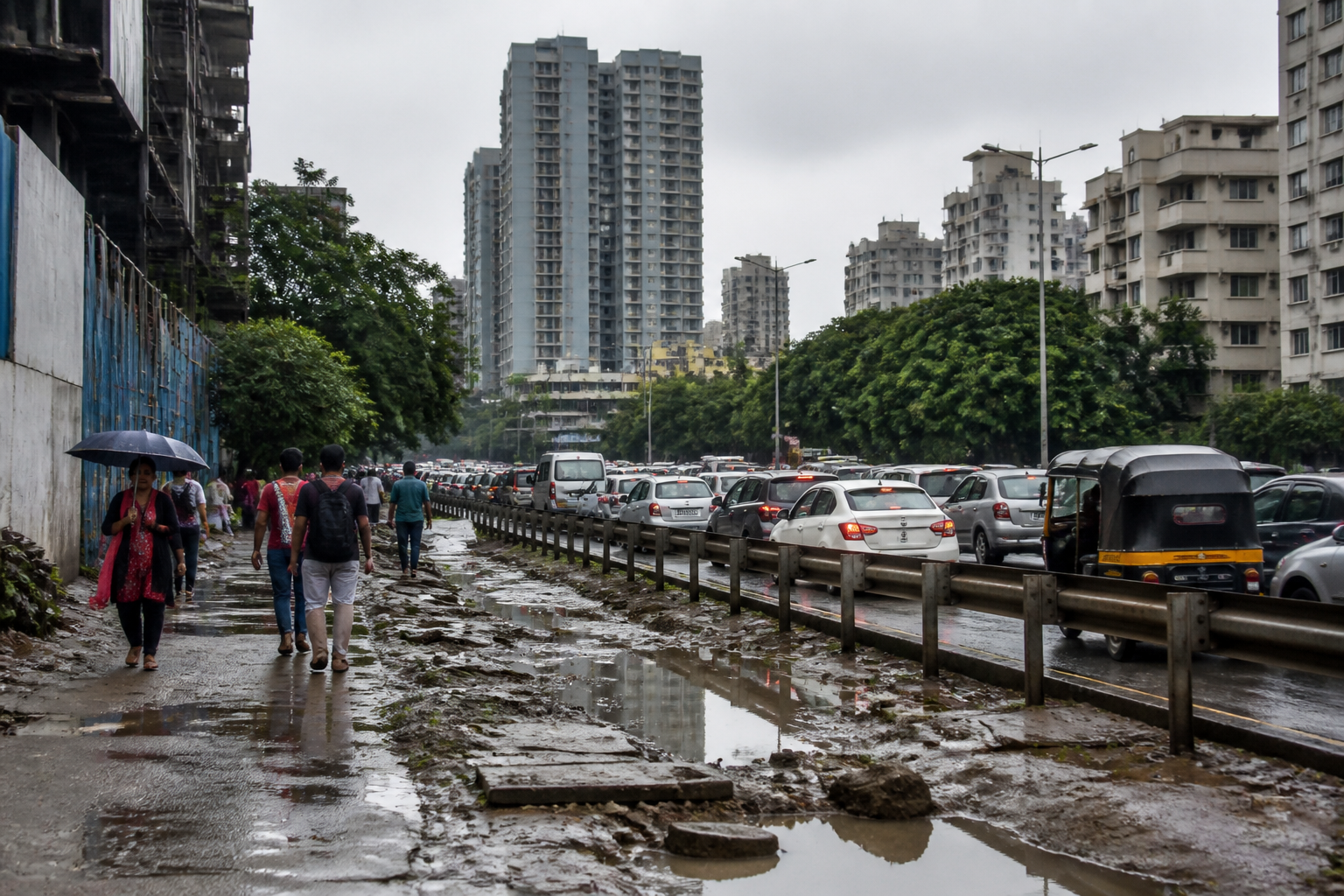
Jha identified rising heat, changing rainfall and sudden floods as consequences of declining green cover and climate change. The supplied report does not quantify the loss of green areas or provide city-specific flood or temperature data. It does, however, establish the planning relationship between environmental change and urban vulnerability. In a city with less open or green space, intense rainfall can create greater pressure on drainage and flood-management systems, while higher temperatures can make dense built-up areas less comfortable and less safe.
This relationship matters because climate resilience is often treated as a specialised environmental concern rather than a basic requirement of city planning. The lecture placed it within the design and management of metropolitan regions. That means decisions about construction, housing, roads, drainage, open spaces and public services cannot be assessed only by their immediate project objectives. They also affect how a city responds to heat and extreme rainfall.
The warning is especially relevant to cities where expansion has occurred through multiple authorities, developments and infrastructure projects. The report does not identify a single administrative model or agency responsible for the problems described. It does show, however, that the challenges cross institutional boundaries. Housing, transport, roads, sewage treatment and environmental protection are usually managed through different departments or agencies, while residents experience their combined effect at street level.
## The infrastructure gap is also a mobility gap
The lecture listed deteriorating air quality, inadequate sewage treatment, poor roads, weak pedestrian facilities, traffic congestion and insufficient public transport among the challenges facing Indian cities. These are not isolated service failures. Together, they determine how easily people can reach jobs, schools, healthcare and public institutions.
Jha said only 17 cities in India currently have metro rail services and argued that the country needs stronger urban transport systems. The figure, as reported, describes metro availability; it does not establish that metro rail alone can solve urban mobility problems. A functioning transport system also depends on the quality of roads, pedestrian access and the links between different modes. The lecture’s inclusion of pedestrian infrastructure and road conditions alongside metro coverage makes that broader point visible.
A city can add a major transport project and still leave many residents dependent on congested roads if access to stations is difficult or if other parts of the network remain weak. The supplied material does not provide ridership, route-length, cost or coverage data, so it cannot establish the performance of any particular metro system. It does support a simpler conclusion: the scale of urban growth requires transport planning that extends beyond isolated infrastructure projects.
The mobility issue also connects directly to the economic warning in the lecture. When commuting becomes unreliable, expensive or unsafe, the quality of a city’s labour market can be affected. Jha argued that young people and capital could increasingly move out of Indian cities in search of better infrastructure, public services and living conditions. The report presents this as a warning, not as a documented trend, and the available material does not provide migration or investment figures to measure it. Its importance lies in linking everyday service quality with the ability of cities to retain people and economic activity.
## Housing and construction remain central to the crisis
The reference to inadequate housing and unauthorised construction places land development at the centre of the discussion. Housing shortages can increase pressure on available land and make informal or poorly regulated development more likely. At the same time, construction without adequate public infrastructure can deepen the service deficit by adding residents without ensuring corresponding capacity in roads, drainage, sewage treatment, transport or public amenities.
The report does not provide figures on housing demand, unauthorised buildings, redevelopment, rents or affordability. It therefore cannot establish the scale of any specific housing deficit or identify which forms of construction are responsible for particular failures. What it does establish is that the lecture treated housing provision and construction regulation as part of the same metropolitan challenge as climate resilience and public services.
That connection is important for urban governance. A city’s planning system has to determine not only where buildings may be constructed, but also whether the surrounding infrastructure can support them and whether the development increases exposure to environmental risk. If these questions are handled separately, approvals, construction and service delivery can move at different speeds. Residents then inherit the consequences through longer commutes, waterlogging, inadequate sanitation or a lack of accessible public space.
## A governance problem disguised as a growth problem
The lecture’s core argument is that India’s cities are growing faster than the systems designed to manage them. The reported figure of more than 550 million residents across 80 major cities indicates the scale of urban concentration described by Jha. The report does not provide a time series showing how quickly this population has grown, nor does it compare infrastructure spending or service outcomes across cities. The available evidence therefore cannot measure the precise size of the gap between urban growth and civic capacity.
It does reveal the range of systems under pressure. Air quality affects public health; inadequate sewage treatment affects sanitation and water environments; poor roads and pedestrian facilities affect daily mobility; congestion reduces the reliability of travel; and limited public transport restricts alternatives to private vehicles. These problems sit across different administrative responsibilities, but they accumulate in the same urban areas.
The policy challenge, as presented in the lecture, is therefore one of coordination and resilience. Metropolitan planning must account for climate impacts while also addressing housing, transport, public services and the regulation of construction. The source does not specify a proposed reform package, funding structure or institutional reorganisation. It records the call for reforms and for greater capacity to withstand climate-related pressures.
The event also underlines the difference between the presence of infrastructure and the quality of urban life. Metro rail, roads, housing and sewage systems are often counted as separate assets. For residents, their value depends on whether they function together. A road that floods, a metro station without safe pedestrian access, or a housing development without adequate sewage treatment can all represent incomplete urbanisation even when construction has taken place.
## The larger urban question
The evidence in the report confirms that the risks facing Indian metropolitan regions are interconnected. Climate change is increasing the importance of drainage, green areas and heat resilience. Rapid urbanisation is increasing demand for housing and services. Inadequate transport is contributing to congestion and weakening access across the city. Poor air quality, sewage treatment and public infrastructure are affecting the conditions under which cities support economic activity.
What remains uncertain is the scale of each problem, the differences between cities and the institutional measures currently being taken to address them. The lecture provides no city-by-city comparison, budget data, implementation timeline or independently verified assessment of service performance. Those gaps matter because broad warnings must eventually be translated into measurable planning decisions and accountable public investment.
For Pune and other growing metropolitan regions, the immediate policy question is whether urban expansion will continue to outpace the systems that make city life safe, accessible and economically productive. Dr Jha’s lecture places that question in the context of climate resilience and national urban development. The next developments to monitor are the planning decisions, infrastructure investments and administrative reforms through which city authorities respond to these linked pressures.
